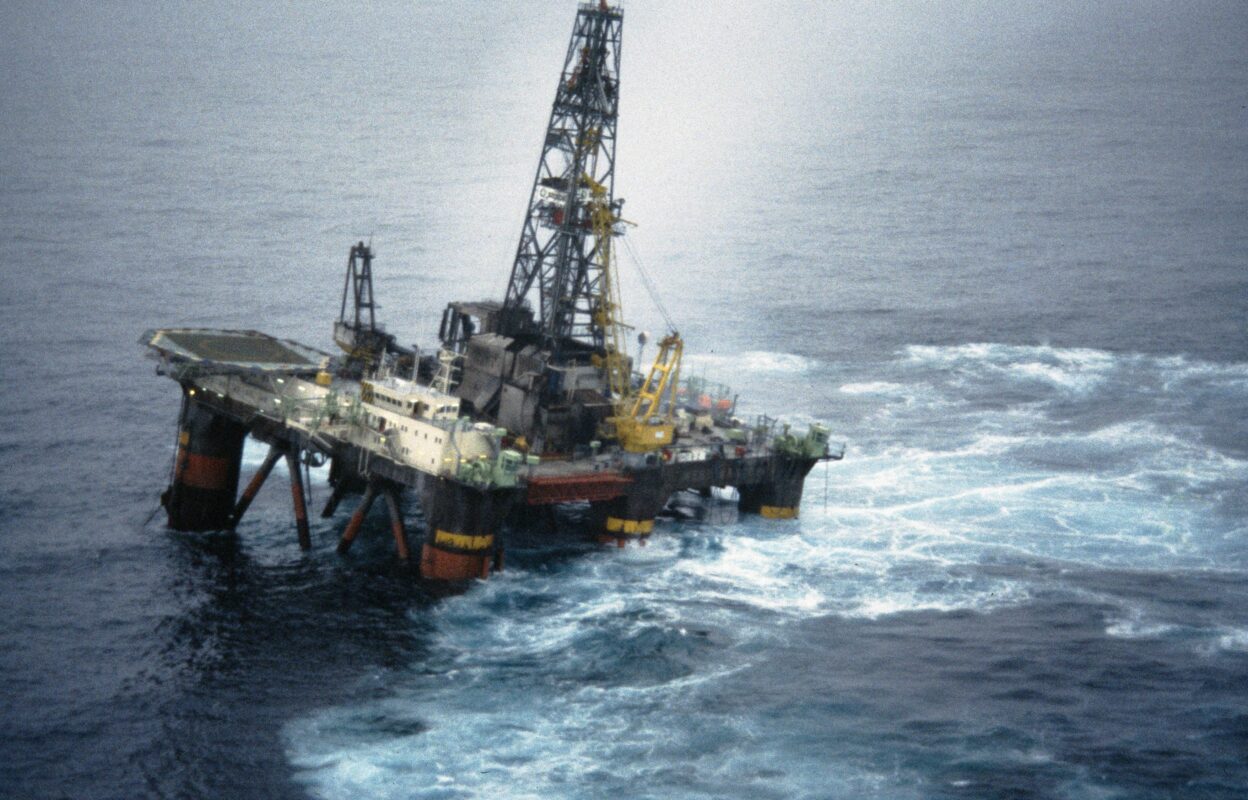
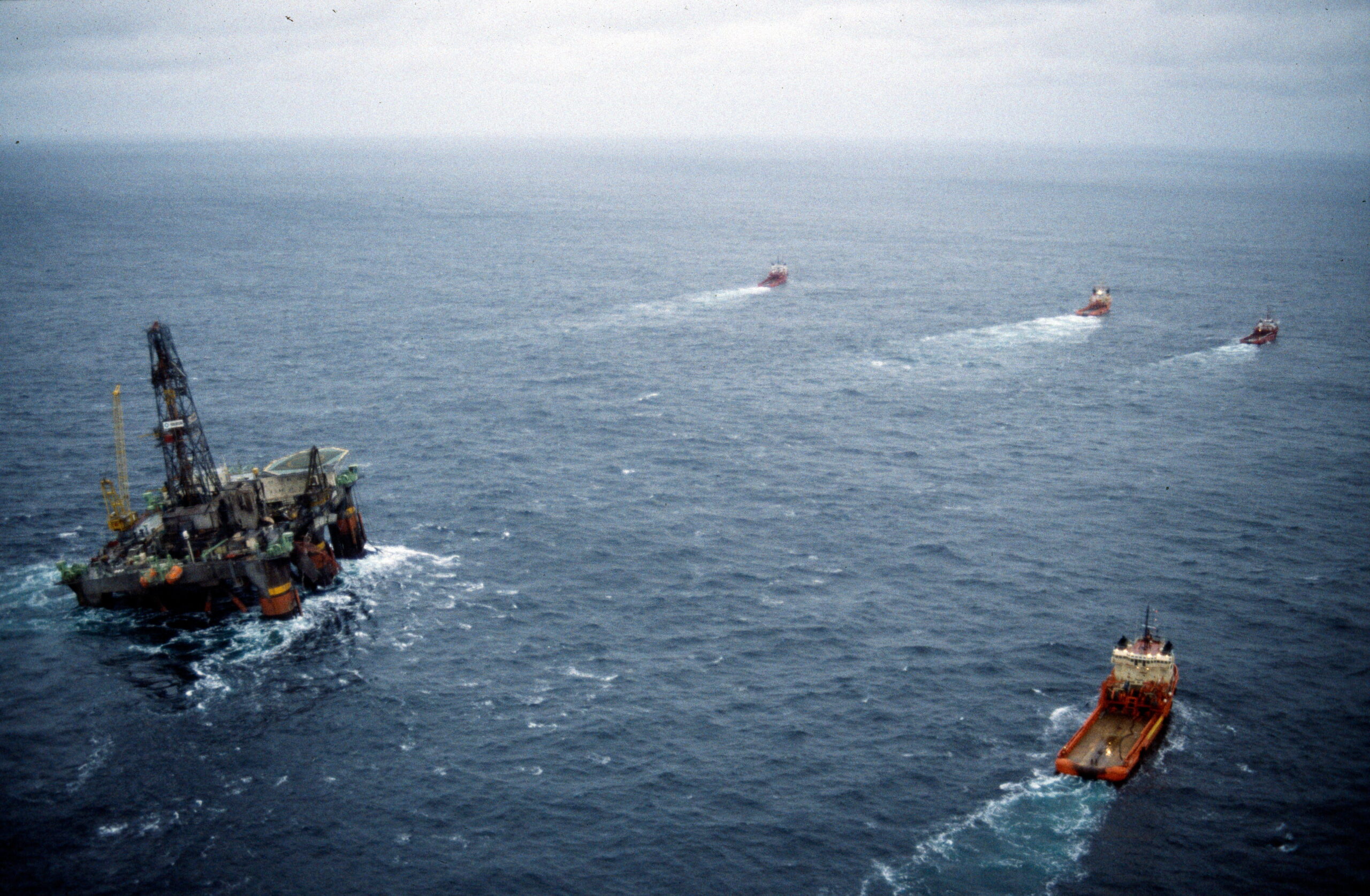
A message that West Vanguard had suffered a blowout and would be evacuated was picked up at 23.10 on 6 October 1985. More than 100 kilometres off Norway, gas flowing from the well ignited. Seventy-nine of the 80 crew were evacuated – and one was never found.
By Björn Lindberg, Norwegian Petroleum Museum
- West Vanguard listing sharply in the foaming sea. Photo: Øyvind Hagen/Equinor
The Smedvig-owned drilling rig had recently been in the Tromsø Patch area of Norway’s Barents Sea sector to drill a successful appraisal well on the Snøhvit discovery. It was now drilling the second wildcat (first well on a prospect) in production licence 092 on the Halten Bank in the Norwegian Sea for operator Statoil.
West Vanguard had reached this location on the evening of 3 October. Although its mooring spread had to be adjusted because of a crashed plane on the seabed, it was ready by lunchtime the next day and well 6407/6-2 could be spudded (started) at 13.30.
The well was intended to investigate Jurassic rocks more than 145 million years old at a depth of 4 000 metres beneath the sea. Gas and condensate were eventually discovered, with the find named Mikkel. However, that was preceded by a serious accident.
Shallow gas
One of the big hazards in drilling is encountering “shallow” gas, held in sandstone “lenses” or thin strata, before reaching the anticipated reservoir. Such deposits are relatively common on the Norwegian continental shelf (NCS), particularly on the Halten Bank and around Gullfaks in the North Sea.
A site survey conducted before starting to drill a well is meant to identify shallow gas, but will never be able to confirm or deny its presence with certainty.
The top section of a well is usually drilled without a blowout preventer (BOP). Any gas encountered should be guided away to leeward of the rig by a diverter system on the wellhead.
Gas alert
Drilling on West Vanguard progressed normally until 20.58, when the bit rather unexpectedly encountered a gas-bearing sandstone formation 506 metres beneath the rig. The site survey had admittedly indicated a possible gas-bearing sandstone layer about 60 metres deeper, and experience of the area also warned that such shallow deposits might be present.[REMOVE]Fotnote: Norwegian Official Reports (NOU) 1986: 16. Ukontrollert utblåsing på boreplattformen West Vanguard, 6 October 1985: 8.
Work was suspended temporarily and mud circulated from the hole for 35-40 minutes to remove the gas to the air. Although gas measurements rose, the position was considered stable by both Statoil’s senior drilling supervisor and Smedvig’s senior toolpusher.
Drilling resumed, and gas measurements quickly rose to a new peak at 22.18. Work halted again, and a warning of hazardous gas was issued. Among other measures, welding was banned. Mud circulation continued for 30 minutes and the gas measurements declined. The well was again judged to be stable by Statoil’s assistant drilling supervisor.
Blowout begins
Drilling continued from 22.41 to 22.52, when a new length of pipe was to be added to the drill string. During this operation, such a powerful return flow of mud and gas occurred that it became impossible to remain in the rig’s shale shaker room.
The gas diverter system was activated, and heavy mud began being pumped down the well in a bid to prevent the gas from forcing its way out. This appeared to work for a few seconds, and the noise was reduced even though the gas alarm undoubtedly added to it. But the blowout increased in intensity to a point where it was impossible for personnel to communicate.
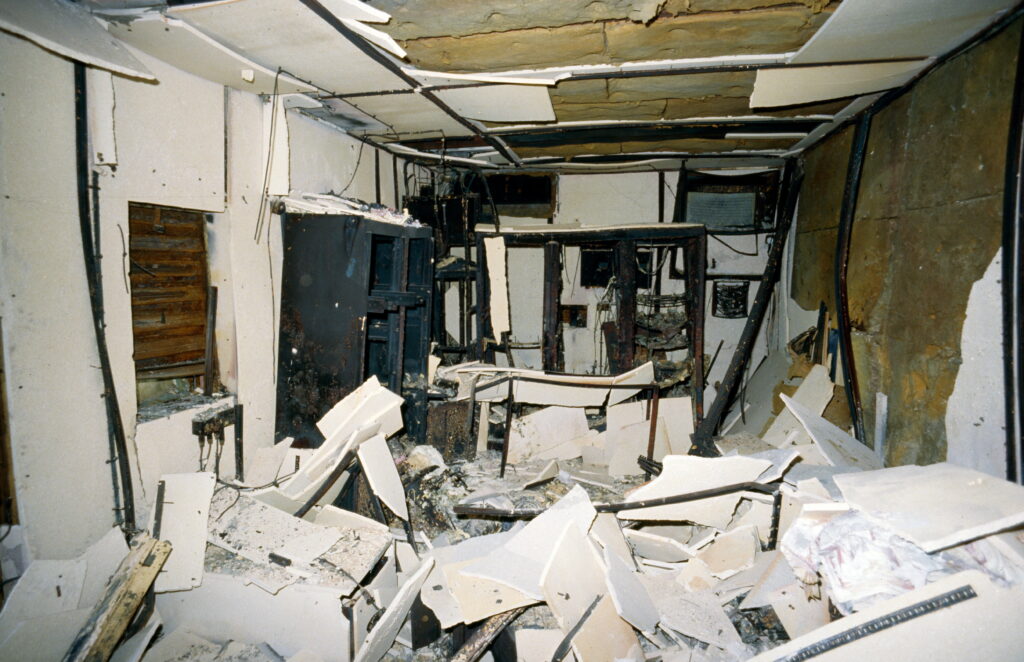
Equipment damage on West Vanguard. Photo: Leif Berge/Equinor
The diverter system, which had been tested only days earlier, proved unable to withstand the mix of gas and sand. This abrasive blend wore through the pipes and flowed onto the platform. With the drilling leadership now on the bridge, a full alarm was sounded around 23.15 which required everyone to take to the lifeboats.
The order to disconnect the wellhead connection to seal the well was communicated by one of the drilling crew running over to the cellar deck, where that job was to be done. Just before 23.20, the first explosion occurred. A mushroom of flame was observed around the derrick. Fires broke out immediately and subsequent explosions were registered.
Drill-floor roughneck Alf Oddvar Bjordal was never found. He probably left the subsea control room just before the explosion.
Immediately after the first blast, the offshore installation manager (OIM) activated the release mechanism for the stern anchors. This meant tension on the forward anchors could pull the rig off the well and away from the blowout.
Actually lowering the lifeboats and getting away from the rig was conducted without major problems, and personnel in both boats were taken aboard the Black Ice standby ship within 90 minutes. Evacuation was particularly dramatic for the OIM and stability manager, who climbed down the support columns and swam away in their survival suits before being eventually rescue by Black Ice.
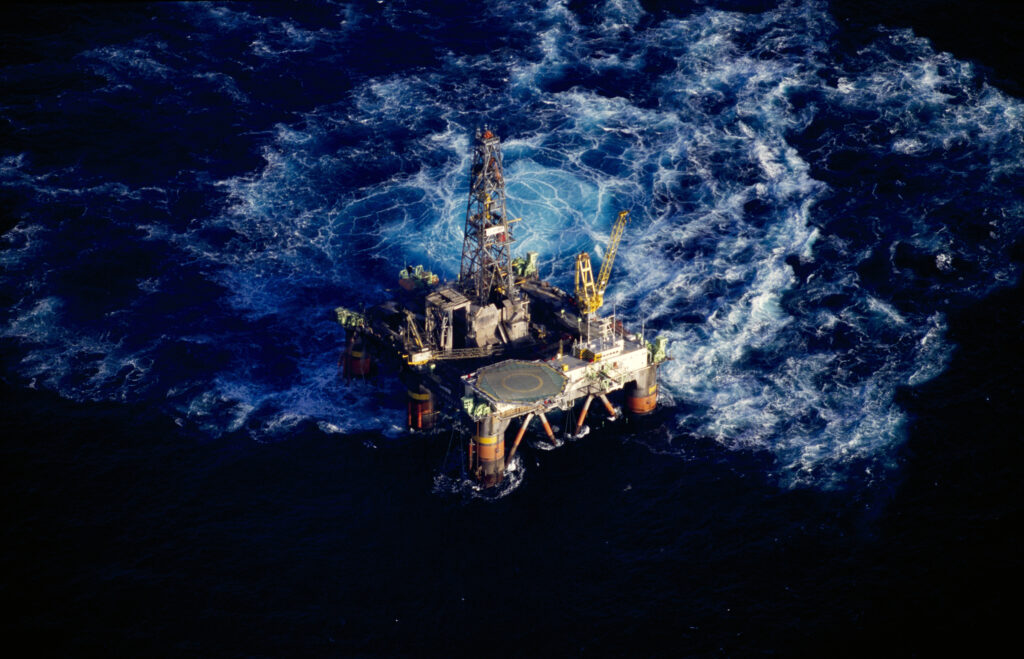
Blowout on West Vanguard. Photo: Øyvind Hagen/Equinor
The sea continued to boil with gas, which was still partly aflame, but the rig had moved away from the centre of the blowout. Although the amount of gas escaping declined considerably within a week, a substantial quantity was still flowing from the wellhead six months later and could be seen at the sea surface.[REMOVE]Fotnote: Letter from the Norwegian Petroleum Directorate (NPD) to operator companies on the NCS, 16 April 1986, Erfaringer fra West Vanguard-utblåsningen – pålegg om tiltak. Appendix to NPD report on the West Vanguard accident: uncontrolled gas blowout well 6407/6-2.
Material damage was massive and amounted to several hundred million kroner. But this could be repaired, and the rig was operational again by the following June, when it made an oil discovery in the same area.
What went wrong?
A commission of inquiry was appointed two days after the accident, and delivered its report on 14 March 1986. This listed a number of “unfortunate circumstances” underlying the incident. Inaccurate reporting, declining confidence in metering equipment, some deficiencies in the well programme and an exaggerated anxiety about increasing mud weight were cited as contributory factors.
In addition came inadequate understanding of how shallow gas blowouts develop, as well as certain deviations from the internal drilling procedures established by the companies.
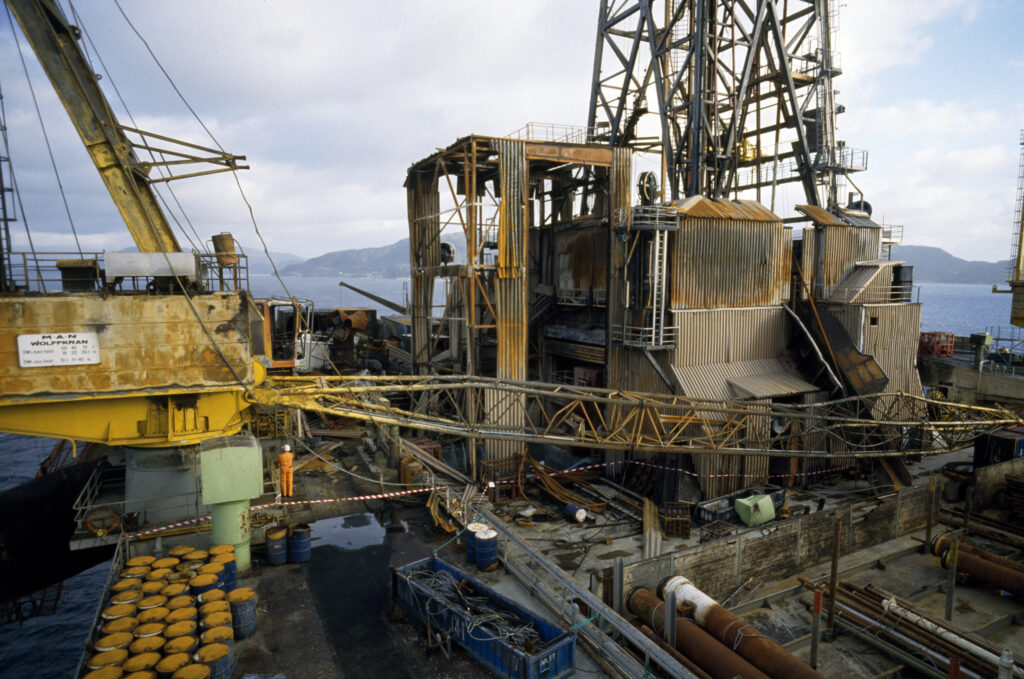
West Vanguard after the explosion, which destroyed the derrick and crane. Photo: Leif Berge/Equinor
As early as a month after the accident, the commission’s preliminary findings indicated that equipment had also failed. The rig’s gas diverter equipment, which was a regulatory requirement and functional, proved unable to cope with the stress. Gas under pressure mixed with sand caused “erosive wear” and quite simply wore holes in several of the pipes intended to convey the gas away from the mud room and the rig.
The pressure loss from reservoir to rig was minimal, and the gas poured from pipes at the speed of sound and with “an eerie deafening roar”.[REMOVE]Fotnote: Tim Dodson, interviewed by Arnt Even Bøe, Stavanger Aftenblad, 23 February 2001.
On the basis of its findings, the commission recommended that the following measures should be considered:
better training in and thereby understanding of the shallow gas problem among drilling personnel
better coordination of well planning
better metering equipment and further development of systems for handling shallow-gas outflows
changes to the regulations for using gas diverter equipment in top-hole drilling
changes to emergency response procedures so that evacuation is ordinarily initiated as soon as a gas diverter system of the traditional type has been activated
improving fire-prevention measures on a rig, such as placing the air intake to the engine room where the chances of drawing in gas are smaller
improving escape routes
assembling all disconnection panels in one safe place
continuing to develop solutions for moving a rig rapidly.
“The oil industry learnt a lot from the West Vanguard blowout,” Tim Dodson, then exploration vice president at Statoil, commented 25 years after the event.
“Among other results, drilling methods were changed so that shallow gas couldn’t reach the drill floor any longer. New free-fall lifeboats were also developed which hit the sea at a distance from the rig.”[REMOVE]Fotnote: Ibid.
West Vanguard is towed ashore after the accident. Photo: Øyvind Hagen/Equinor
The public prosecutor for Rogaland county (which encompasses Stavanger) fined Statoil NOK 1 million for breaching the Petroleum Act. This was because planning and preparation of the drilling programme and the start of the work allegedly failed to take prudent account of the threat posed by shallow gas.
The penalty was discussed by the Statoil board, which took the view that the operation had been conducted prudently but decided that it was not worth disputing the fine in court.
Both similarities and differences between Norway and Brazil as oil nations have emerged from the partnership which has developed between them. Neither country initially had petroleum production expertise, but both created state oil companies and their own specialist milieus. These joined forces early over subsea technology, helping to make the Latin American country one of Equinor’s core areas today.
By Kristin Øye Gjerde, Norwegian Petroleum Museum
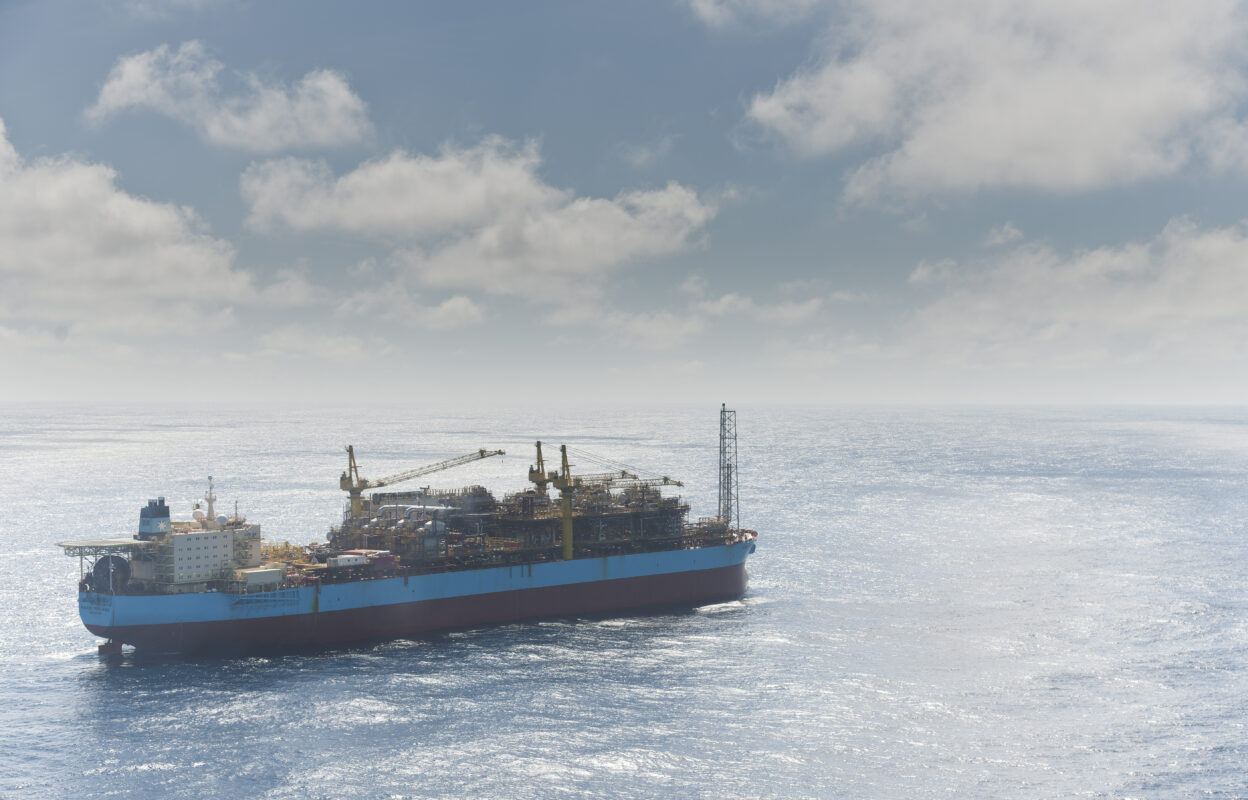
- The Peregrino field, Brazil. Photo: Equinor
Brazil and Norway have had wholly state-owned oil companies –Petrobras and Statoil respectively. The first of these dates back to 1953, when it produced on land. Unlike its Norwegian counterpart, which was founded in 1972, Petrobras had a monopoly of all domestic petroleum output. Although that ended in 1997, it retains a leading position in its home market. The company was part-privatised in 2000 – a year before Statoil.
Interesting offshore discoveries were made in both countries during the 1960s. While Norway is known for its Ekofisk find in 1969, the first oil field on the Brazilian continental shelf was proven the year before. The two nations made big offshore discoveries in deep water over the subsequent decade.
Initial subsea contacts
The Petrobras logo.
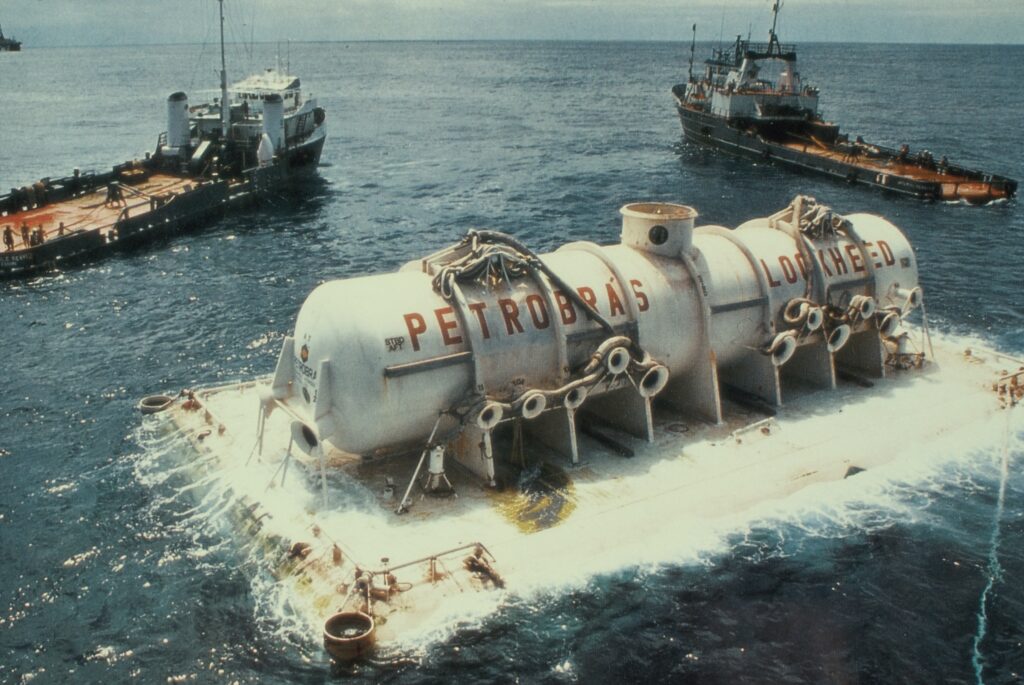
Brazil has been a pioneer with production ships and floating platforms tied back to subsea wells, with Petrobras testing a converted tanker for production as early as 1978. A floater solution was more flexible than fixed platforms. These ideas were picked up and further developed by Norway in the 1980s, when Norwegian oil companies also adopted them fully.[REMOVE]Fotnote: Gjerde, Kristin Øye and Nergaard, Arnfinn I, Getting down to it. 50 years of subsea success in Norway, 2019: 172
Along with their suppliers, Norway’s oil companies observed the boldness, inquisitiveness and willingness to pursue new technology displayed by Petrobras with great interest. A good relationship developed between Norwegian and Brazilian subsea specialists, and they learnt from each other.
When Statoil planned to utilise seabed wells on the Tommeliten field and its Gullfaks satellites in the North Sea during the mid-1980s, it hired two Brazilian subsea specialists from Braspetro – the international arm of Petrobras. Vincente de Silva and Mauro de Fauras contributed valuable operating experience to solutions for both fields. Statoil’s management was subsequently keen to continue the Petrobras collaboration, with Martin Bekkeheien – head of exploration and production activities at the time – taking the lead.[REMOVE]Fotnote: Hans Jørgen Lindland, e-mail to Kristin Øye Gjerde, 13 December 2021
Statoil drilling manager Idar Johnsen and Hans Jørgen Lindland, operations manager for Tommeliten, were dispatched to Brazil in 1987 to check the status of and interest for closer collaboration at Petrobras. They were very well received. The Norwegian company could offer collaboration on multiphase flow technology – in other words, transporting a mix of oil, gas and water in a controlled manner through a single pipeline with the use of chemical additives and pressure to prevent problems on the way to the processing plant. Much research underpinned this technology, which was highly profitable for the oil companies using it.[REMOVE]Fotnote: Gjerde and Nergaard, op.ci
Reidar Due. Photo: Storting
Arrangements were made for an official delegation to visit Brazil a week after Johnsen and Lindland had returned home. The plan was to formalise a collaboration between Norway and Brazil on offshore and subsea technology.[REMOVE]Fotnote: Hans Jørgen Lindland, e-mail to Kristin Øye Gjerde, 13 December 2021
This group was headed by Reidar Due from the Centre Party, who was chair of the standing committee on energy and industry in the Storting (parliament). He managed to offend the host of a dinner hosted by the Brazilian government so greatly that all forms of cooperation were put on ice.[REMOVE]Fotnote: This story has been confirmed by Hans Jørgen Lindland, 13 December 2021 After this incident, a number of years passed with very little contact between Statoil’s subsea technology department and Petrobras.
Diverless methods
Subsea specialists in both Brazil and Norway wanted to ensure that work underwater could be done in a safer way. That including finding alternatives to using divers for making seabed connections.
The Brazilians made efforts to place Xmas trees – valve assemblies installed on wells to control production – under atmospheric pressure in a sealed chamber or habitat on the seabed. Unlike simply installing a tree in the open sea, this ensured that it stood in a dry environment. Instead of an operator having to dive down under pressure in order to open or close the valves, they could be lowered in a bell to the habitat, connect on, enter a dry space and breath normal air while doing the work. Brazil tested such solutions offshore.[REMOVE]Fotnote: Gjerde and Nergaard, op.cit: 301.
In Norway, opportunities for utilising a habitat of this kind were discussed for the Statfjord satellites. But Statoil decided against that approach, and it was never adopted either on the satellites or elsewhere on the Norwegian continental shelf (NCS). Diverless solutions were developed instead to eliminate the use of people completely in conducting subsea operations. Since remotely operated vehicles (ROVs) could carry out much of the work involved, divers were largely phased out on the NCS during the 1990s.[REMOVE]Fotnote: Ibid: 123
Installing an atmospheric manifold centre on the Garoupa field off Brazil in 1979. Photo: Petrobras/Norwegian Petroleum Museum
Contact re-established and extended
The Society of Petroleum Engineers held its first subsea forum in 1993 at Seefeld in Austria. Both Petrobras and Statoil attended, and were each very advanced in terms of the new projects and underwater technology they could present.
Statoil could point to a world distance record for multiphase flow transport from the Statfjord North satellite. The way this had been accomplished attracted considerable interest from the other participants.[REMOVE]Fotnote: Hans Jørgen Lindland, e-mail to Kristin Øye Gjerde, 13 December 2021. For its part, Petrobras could report records for deepwater operations. The Brazilians had made discoveries in water depths close to 2 000 metres.[REMOVE]Fotnote: Gjerde and Nergaard, op.cit: 301. Petrobras set a record in 1997 for the deepest subsea well to date of 1 709 metres on the Marlim field, and followed up in 1999 with a well in 1 855 metres on the Roncador field.
At this meeting, Lindland and the other members of Statoil’s subsea technology department got to know Orland Ribeiro at Petrobras. Good professional contacts subsequently developed between the underwater specialists at the two companies. A technology collaboration, also involving BP, was agreed a little later. This yielded a number of important results:
Petrobras supplied Statoil with operational data on production regularity from subsea fields, along with the design basis for the Brazilian company’s latest floating deepwater platform.
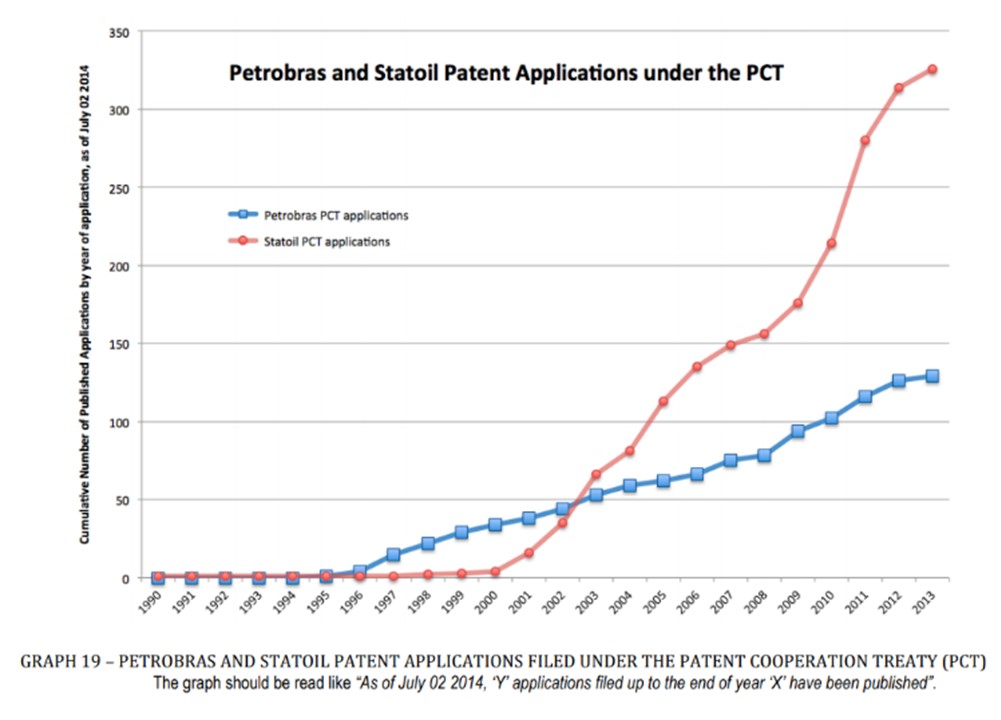
In return, Petrobras secured detailed information on drilling horizontal wells and results from Statoil’s research on multiphase flow.[REMOVE]Fotnote: Hans Jørgen Lindland, e-mail to Kristin Øye Gjerde, 13 December 2021 The Norwegian group was very innovative in terms of new patents, which made it an attractive partner for the Brazilians.[REMOVE]Fotnote: Bichara, Miguel, Technological innovation in Brazil and in Petrobras – the need of a systems approach to a complex problem
Patent applications by Petrobras and Statoil under the PCT.
As early as the mid-1990s, Statoil was recognised as a world leader in the design and operation of fields at depths down to 500 metres. The collaboration with Petrobras also gave the Norwegian group access to expertise on deep and eventually ultra-deep waters – in other words, 3 000 metres and beyond.[REMOVE]Fotnote: Hans Jørgen Lindland, e-mail to Kristin Øye Gjerde, 13 December 2021 This strategic partnership opened the way to securing a number of deepwater licences off Brazil and other countries.
Suppliers actively involved
Statoil’s establishment of such a close technology collaboration with Petrobras was also highly significant for Norway’s supplier industry in the petroleum sector and its market access in Brazil.
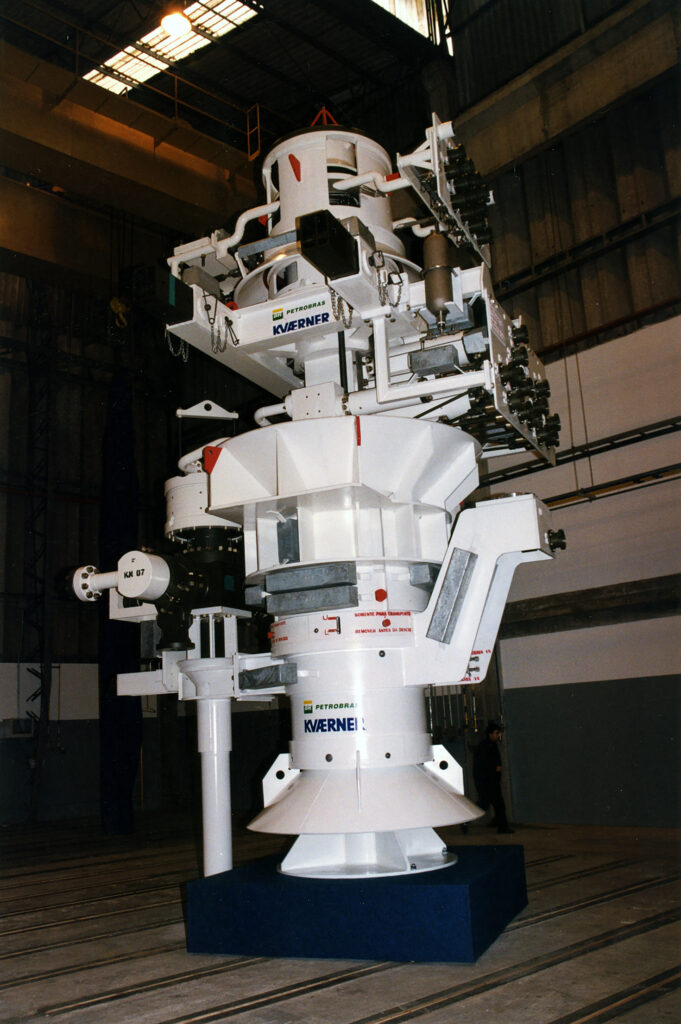
An example was the subsea connections with control systems developed by Kværner. Their installation could be assisted by ROVs, which helped to make it possible to utilise underwater technology in depths beyond the reach of diver assistance. That in turn made oil production feasible in deeper waters. Kværner established a presence in Brazil in 1996, followed by Kongsberg Offshore Subsea, Aker Solutions and others.
Kværner arrived early on the Brazilian scene, delivering Xmas trees and control systems to Petrobras as far back as the 1990s. Source: Kjell Øyvind Pedersen
These companies received good support from collaboration bodies established by the Norwegian authorities.[REMOVE]Fotnote: Gjerde and Nergaard, op.cit: 302. The Norwegian-Brazilian Chamber of Commerce, for example, was established in 1995 to promote trade, good relations and joint financial and professional interests between the two countries.
Rio de Janeiro was the centre for Norway’s commitment in Brazil, with Intsok[REMOVE]Fotnote: Intsok (short for International Continental Shelf) was created in 1997 as a Norwegian non-profit foundation by the Ministries of Petroleum and Energy, Industry and Trade, and Foreign Affairs as well as the Confederation of Norwegian Enterprise (NHO), the Norwegian Shipowners Association and the Norwegian Oil Industry Association (OLF), plus oil companies Statoil, Saga Petroleum and Norsk Hydro, the embassy and the consulate general holding seminars where Norwegian suppliers presented themselves. The government entered into trade agreements and the establishment of Norwegian subsidiaries was facilitated. The Innovation Norway trade promotion body not least established Innovation House in Rio in 2007.
The most recent addition to this set of organisations is Norwegian Energy Partners (Norwep), created in 2017 by merging Intsok with Norwegian Renewable Energy Partners (Intpow). The latter represented a relatively recent commitment in the renewables sector.[REMOVE]Fotnote: Gjerde and Nergaard, op.cit: 302-303
Collaboration of this kind between foreign and Norwegian oil companies and Norway’s supplier industry, with good backing from the government, helped to elevate a number of Norwegian companies into world leaders for subsea technology during the 2000s. The exchange of information and expertise with Brazil has been a crucial precondition for/driving force in this development.
Although the Tommeliten project reached its goals, it was not without problems along the way. Not all technical challenges were equally serious. Something good also came out of the problems, with solutions that benefited later projects.
By Kristin Øye Gjerde, Norwegian Petroleum Museum
- The Tommeliten template being installed on 20 September 1987. Photo: Leif Berge/Equinor
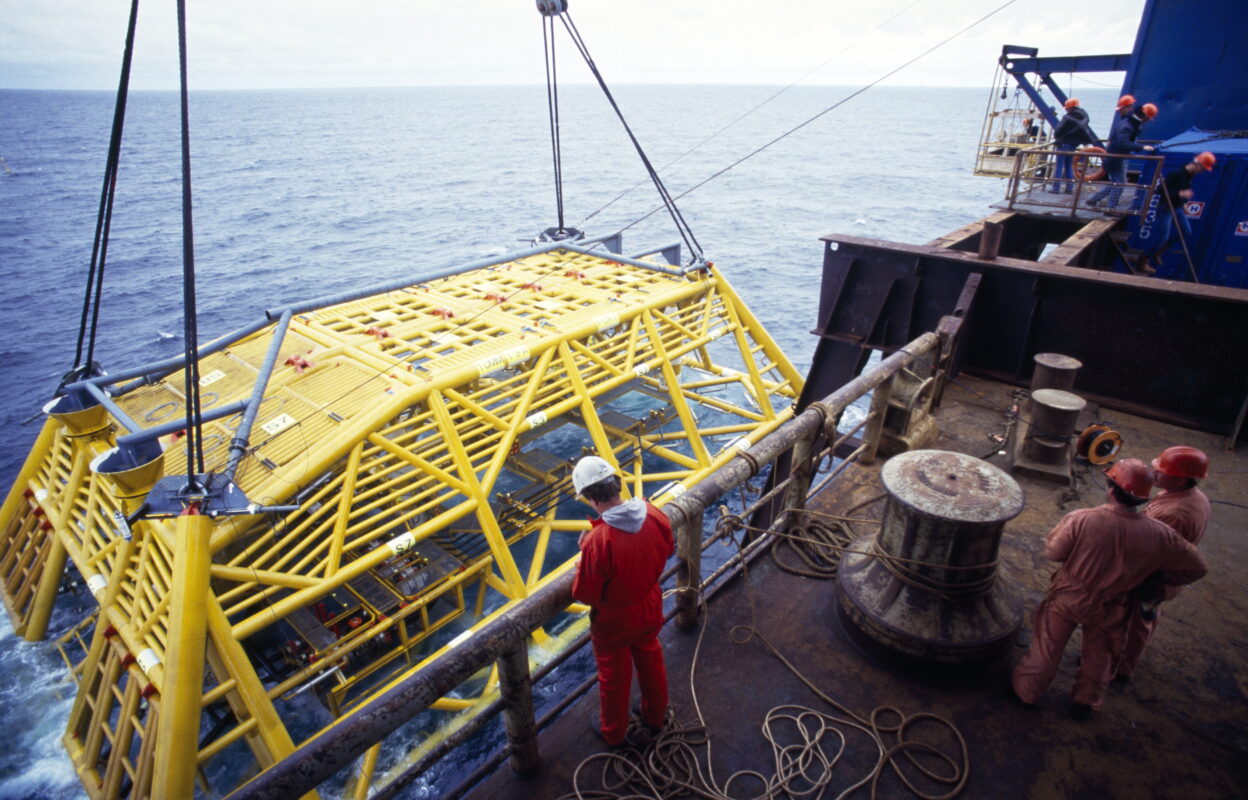
Since the water depth on Tommeliten is about 80 metres, divers did the subsea work. A template was placed on Gamma to speed up the development. The protective structure and manifold were manufactured at the Rosenberg yard in Stavanger while drilling was under way.
Shoelace creates problems
The decision was taken to send Per Moi down in a Mantis manned submersible. As soon as he reached the seabed, however, the control room heard him yelling “get me up, get me up”. Three subsea monitoring systems were available during the installation of Tommeliten, but both the remotely operated vehicles (ROVs) were out of operation during commissioning.
This sounded strange to the American supervisor, because the vehicle had only just reached bottom. But Moi had got his shoelace stuck in the Mantis hatch, which was enough to allow water intrusion.
Loose screws and bending pipes
A number of other accidents occurred. The screws used to attach the handles to the valves on the operation panel for each well eroded. Normal unbrako screws had been used, but their sockets had vanished. Divers were used to replace them all with the right metal and external slots.
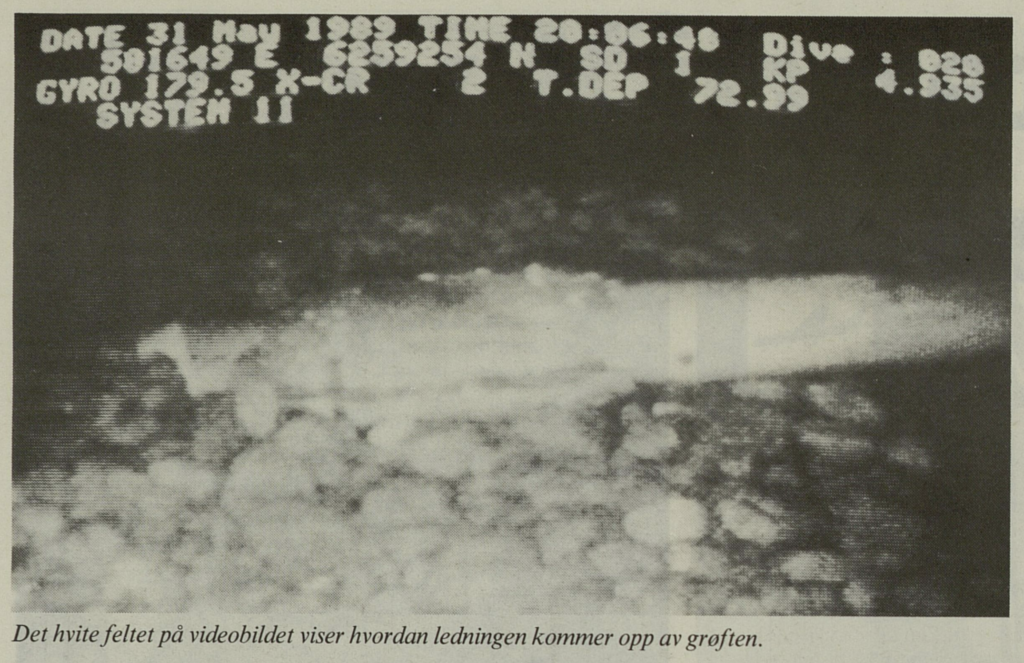
Image from a subsea video showing how the pipeline emerges from the trench. Source: Status, no 10, 1989
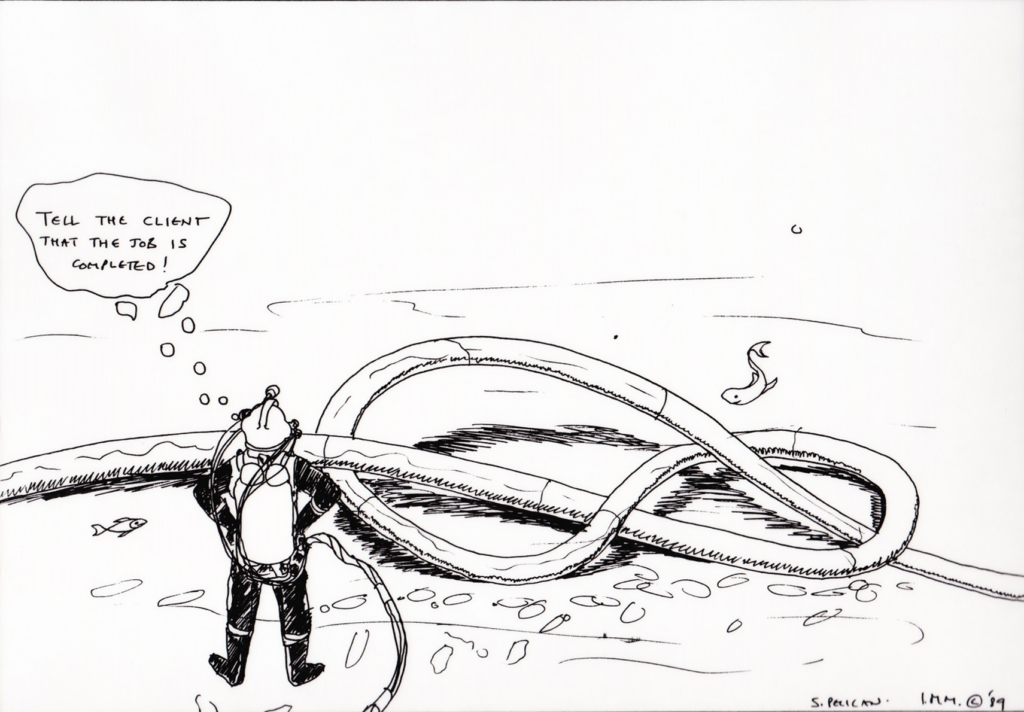
When the template was inspected before production began, a number of bolts turned out to be missing from the flange holes and were lying on the seabed. Two diving support ships, including Seaway Pelican, spent four weeks replacing all the bolts in the pipe flanges on the template, on the pipeline and beneath Edda. That delayed start-up.
Statoil laid three underwater pipelines to tie Tommeliten back to the Edda platform – two production lines and one for testing. Output from the field then entered the Ekofisk system for onward transport to Emden.
After allowing them to warm up, the pipelines were inspected. Specialists had conducted a long discussion over whether the trenched pipes should be covered with gravel or left for nature to do that job. The heated pipelines were meant to curve between the trench sides rather than escape from it. Those who favoured covering were dubious about this, since friction would differ from place to place.
Inspection showed that the pipelines had escaped from the trench in several places. The worst case of this “upheaval buckling” was about 30 metres long and 5.5 metres high. It looked as if the pipelines had come to life. Measures were needed to stabilise them.
The decision was taken to attach cement supports cast in situ. Specially manufactured plastic “tents” with attached straps were made fast to the pipelines by divers and reached down to the seabed. Each chute had several pockets which were filled with cement through a hose from a ship, starting at the bottom and moving gradually up as each pocket made contact with the pipe.Gravel was subsequently dumped at six upheaval points in an optimum manner which dispersed it both under and over the pipelines. Dumping alone was used for the smallest cases. It took a boatload totalling 8000 cubic metres of gravel to ensure that the transport lines were securely pinned down and could be overtrawled.[REMOVE]Fotnote: This article is mostly based on an interview by Hans Birger Hansen, Olav Bruset and Jarle Aksnes conducted by Kristin Øye Gjerde, 01.12.2015.
The Storting (parliament) had resolved to establish a state oil company. This now had to be built up. So who was to be responsible for managing the state’s commercial interests in the oil industry? And who were these people who would shape the company?
By Trude Meland, Norwegian Petroleum Museum
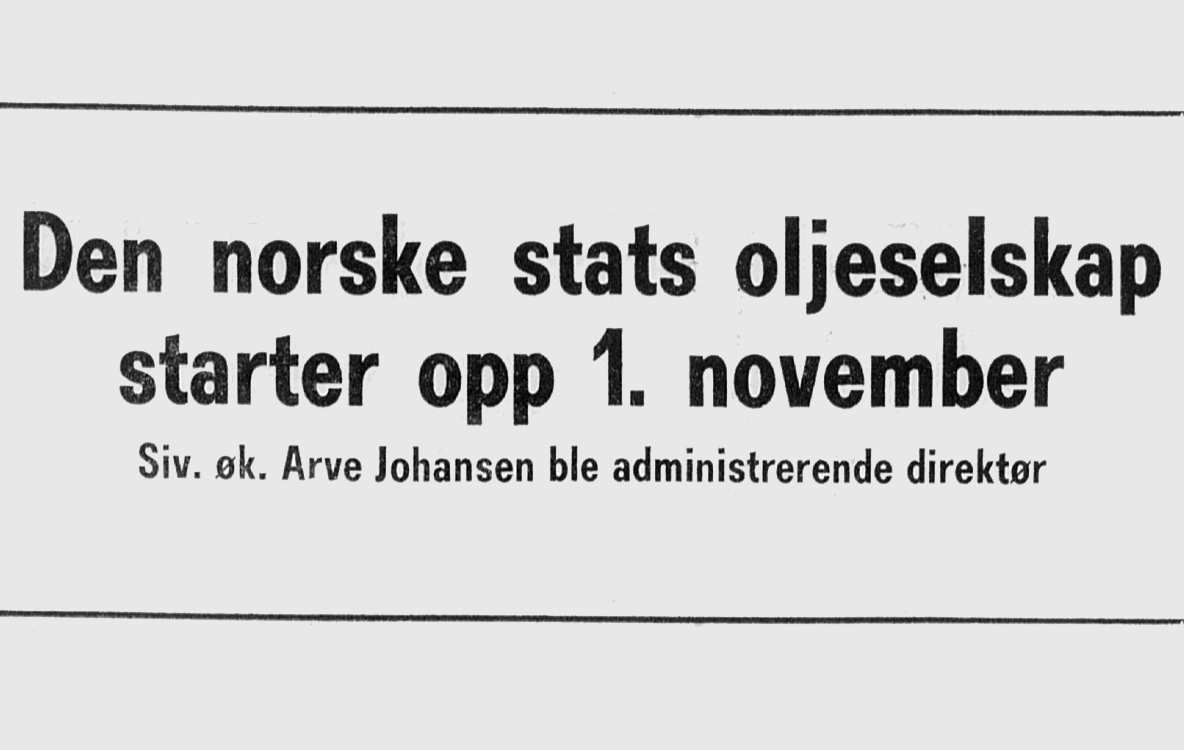
- “Det norske stats oljeselskap will commence at 1 November. Arve Johansen (sic) became CEO”. Facsimile from Moss Avis 26 October 1972
The first step was to put a board of directors in place. It had been decided that the company’s general meeting, comprising the responsible government minister, would appoint its members. In June 1972, that person was Finn Lied from the Labour Party.
He was accordingly present as promoter at the statutory general meeting of the company on 18 September 1972, along with his state secretary Arve Johnsen (later to become CEO). Also attending from the Ministry of Industry were secretary general O C Müller, director general Knut Dæhli, division heads Harald A Sommernes and Karl-E Manshaus from the ministry’s oil office, and consultant Nils Heilemann. Furthermore, representatives from the Auditor General’s office were present along with supreme court attorney Jens Christian Hauge as chair-designate of the board.[REMOVE]Fotnote: Minutes of the statutory general meeting of Den norske stats oljeselskap a.s. SAST/A-101656/0001/A/Aa/Aaa/L0001. Accessed at https://www.digitalarkivet.no/oe10511205100002.
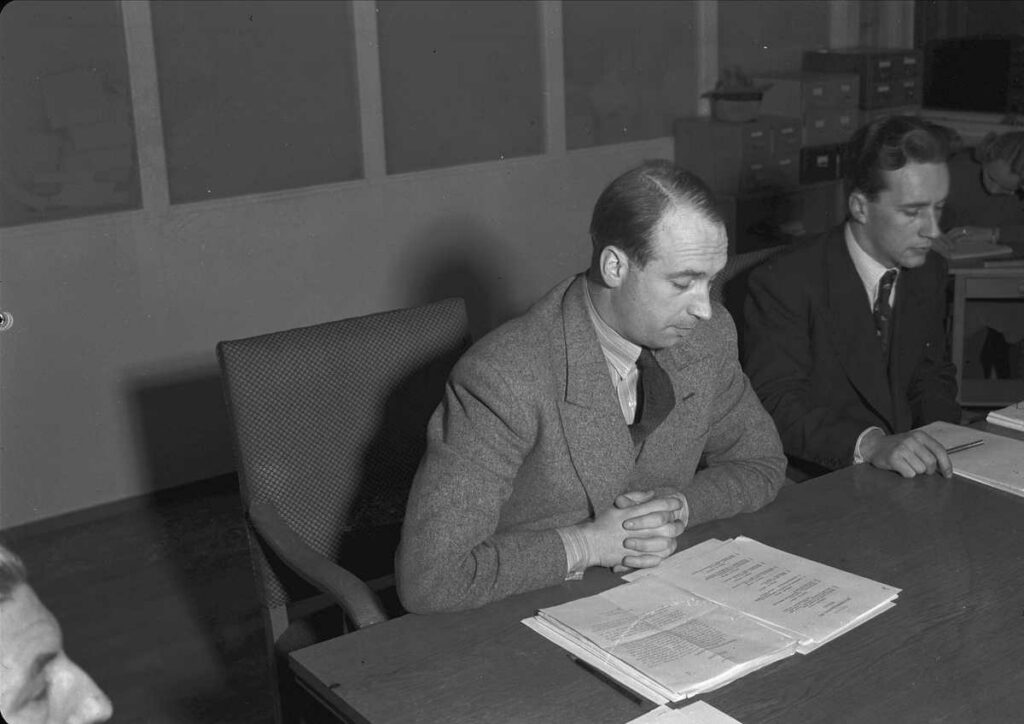
Resistance leader and lawyer Jens Christian Hauge had a significant political career after the Second World War. He served as secretary to prime minister Gerhardsen in 1945, minister of defence in 1945–52 and minister of justice from January to November 1955. He then ran a law practice in Oslo. Hauge was a director of several state-owned companies and chair of Statoil in 1972-74. Photo: Leif Ørnelund/Oslo Museum
Together with Johnsen, Lied had clarified at an early stage who he wanted as chair of the company. The government approved his proposal to give the job to Hauge, his close friend and ally.[REMOVE]Fotnote: Njølstad, O, Jens Chr. Hauge: Fullt og helt, Aschehoug, 2008, Oslo: 630. Both had been active in the resistance to the German occupiers during the Second World War and were members of Labour’s inner circle. During the 1960s, they had helped to frame the party’s programme.[REMOVE]Fotnote: Wicken, Olav, “Finn Lied”, Norsk biografisk leksikon, snl.no, 12 October 2014. Accessed 26 June 2020 from https://nbl.snl.no/Finn_Lied.
Hauge was a lawyer and politician. Following his wartime role as a leader of Milorg, the main Norwegian resistance organisation, he became defence minister in 1945 at the age of 30. After stepping down as defence minister in 1952, a new post at the Labour Party offices gave him an active role in shaping Norwegian industry policy.
He was responsible for establishing the Norwegian Defence Research Establishment in 1946, where Lied became head of research in 1957. The latter was moreover to be his successor as Statoil chair in 1974.
Petroleum minister Vidkunn Hveding (left) was one of the prominent guests flown out to Valhall for the official inauguration of the field on 26 May 1983. Photo: unknown/Norwegian Petroleum Museum
Vidkunn Hveding, an engineer and Conservative politician, was appointed deputy chair of the new company. His experience from various parts of the energy supply sector and the management expertise acquired in the same industry made him a professional expert. He also brought with him broad international experience through advisory and consultancy roles in such countries as Ethiopia, Brazil and Kuwait as well as a number of offices in industry and shipping.
The general meeting furthermore elected Aksel Fossen, a Storting representative from Labour who had served in the Norwegian merchant navy through six wartime years and was one of Norway’s most respected industry politicians. He was known as the “power socialist” from Odda near Stavanger.[REMOVE]Fotnote: Commemorative speech on former representative Aksel Fossen, Storting session of Thursday 22 October 2009 at 10.00.
In addition came the Conservative Party’s Per Mauritz Hanssen from Kaarbøs Mekaniske Verksted in Harstad. Finally, senior lecturer Aage Solbakken in the department for industrial chemistry at the Norwegian Institute of Technology (NTH) was appointed an alternate director.
The composition of the board gave the impression of a political compromise between the two biggest parties of the day – two from Labour and two from the Conservatives. The common denominator of these directors was that their expertise from different fields, industries and political persuasions was relevant to Statoil’s business.
Although it was due to sit until the annual general meeting in 1975, the whole board actually stepped down abruptly a year early.
Personnel required
“National management and control” was the overall goal of Norwegian oil policy from the early 1970s. Where Statoil was concerned, this translated into technological control.
Arve Johnsen. Photo: Equinor
One way of achieving that was the rapid build-up of an organisation which mastered all the technical challenges faced when operating in the North Sea. That called in turn for recruiting the best team in terms of technological expertise.[REMOVE]Fotnote: Ryggvik, Helge, Til siste dråpe, 2009, Aschehoug, Oslo: 96.
As early as the day after the statutory general meeting of Den norske stats oljeselskap a.s, Hauge called the company’s first board meeting. That was held on 5 October 1972 at Drammensveien 40 in Oslo, and its most urgent priority was to put a management team in place.
The first step was to appoint a vigorous and visionary chief executive. This job was advertised, but Hauge quickly saw that the applicants were “pretty much of a disappointment”. In consultation with Lied and Müller, it was agreed to look around for other candidates.
Several were assessed, but the choice fell on Johnsen, who was leaving his post as state secretary at the industry ministry owing to a change of government.[REMOVE]Fotnote: Njølstad, O, op.cit: 631. With degrees in business economics and law, he had experience from the oil industry as well as the innermost circles of petroleum policy-making. According to the board minutes, he was “a person all the directors knew as an unusually able man and an outstanding leadership type”.[REMOVE]Fotnote: Minutes, board meeting, Den norske stats oljeselskap a.s, 5 October 1972. SAST, Pa 1339 – Statoil ASA, A/Ab/Aba/L0001: Styremøteprotokoller, 05.10.1972-14.12.1978, 1972-1978: 9 Hauge argued that no further candidates needed to be called in.
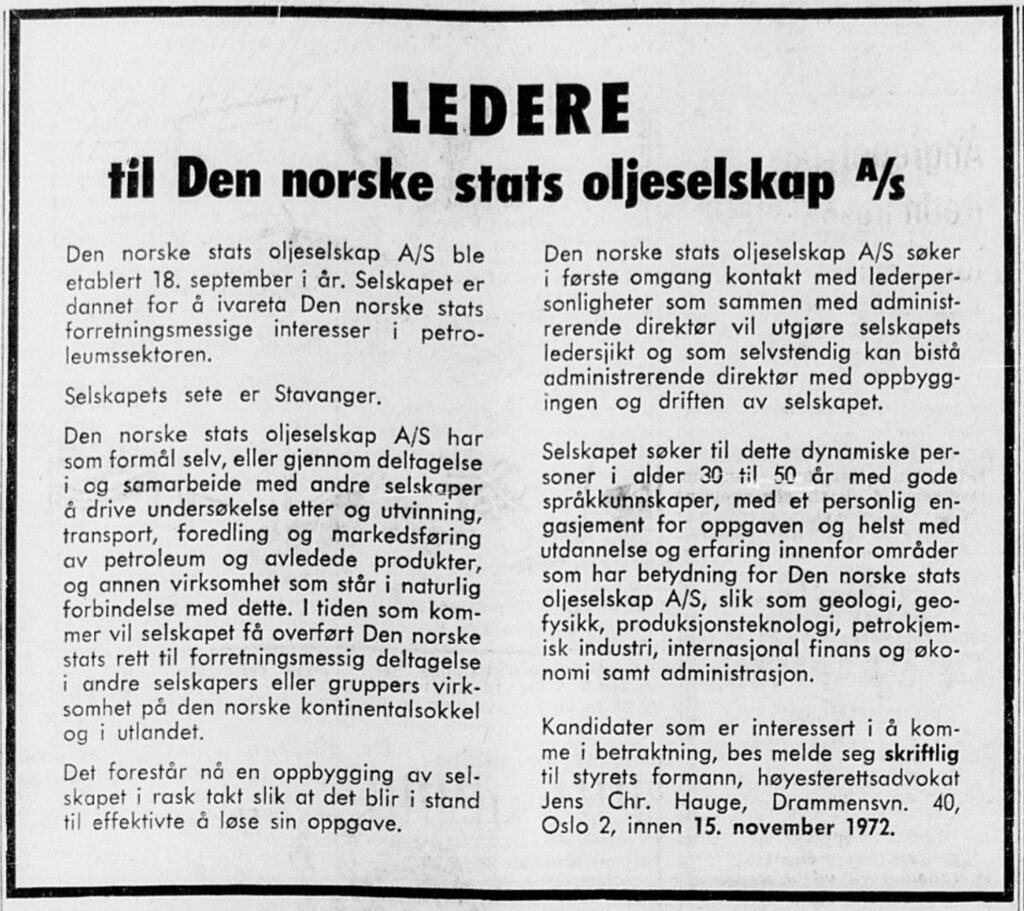
At the same meeting, the chair was given the board’s blessing to place job advertisements in a number of Norwegian newspapers and selected foreign oil journals.[REMOVE]Fotnote: Minutes, board meeting, Den norske stats oljeselskap a.s, 5 October 1972. Accessed at http://urn.digitalarkivet.no/URN:NBN:no-a1450-db60034661000003.jpg. These sought applications from “dynamic people” aged 30-50 with qualifications and practical experience in such areas as geology, geophysics, petroleum technology, petrochemical industry, international finance and economics, and administration. Putting a management team in place was the first priority.
Job advertisement. Facsimile from Dagbladet, Wednesday 18 October 1972
Johnsen was appointed CEO in December 1972, and the first interviews could then be held with relevant applicants for other posts. No job descriptions were drawn up. Johnsen wanted decisive colleague with independent views and operational experience. Those looking for formal positions or titles were rejected.[REMOVE]Fotnote: Johnsen, A. (1988). Utfordringen: Statoil-år. Oslo: Gyldendal.s.26 “I was determined not to appoint people with such ideas,” Johnsen wrote in his first memoir.[REMOVE]Fotnote: Ibid: 26.
The company had few problems recruiting competent Norwegians for financial and administrative roles or general engineering posts. But petroleum expertise was less easy to find.
Nigeria was Africa’s largest oil producer and one of the world’s biggest exporters of this commodity, with Angola close on its heels. These two big west-coast petroleum nations were designated as the second big priority area for the Statoil-BP alliance. But war, corruption, intricate licensing systems and domestic opposition did what they could to undermine the commitment.
By Trude Meland, Norwegian Petroleum Museum
- One of Nigeria’s many gas metering stations. Photo: Bjørn Rasen
When their partnership began in 1991, the two companies became involved in the Democratic republic of the Congo as well as Angola and Nigeria, but withdrew from the first of these areas in the same year. A venture in Equatorial Guinea, operated from Nigeria, was also short-lived.[REMOVE]Fotnote: Ryggvik, Helge. (2009). Til siste dråpe. Oslo: Aschehoug: 238.
Through various engagements, BP was already established in all three west African states when the alliance with Statoil began. However, the military regime in Nigeria had taken over the British oil major’s operations in the country during 1979 as part of a massive nationalisation wave. During the 1990s, the Nigerian mood shifted from nationalisation to internationalisation, and a more open attitude was adopted towards foreign companies. That change in climate created an opening for BP to return to the giant of Africa, this time accompanied by Statoil.
Repressive regimes, executions and environmental disasters
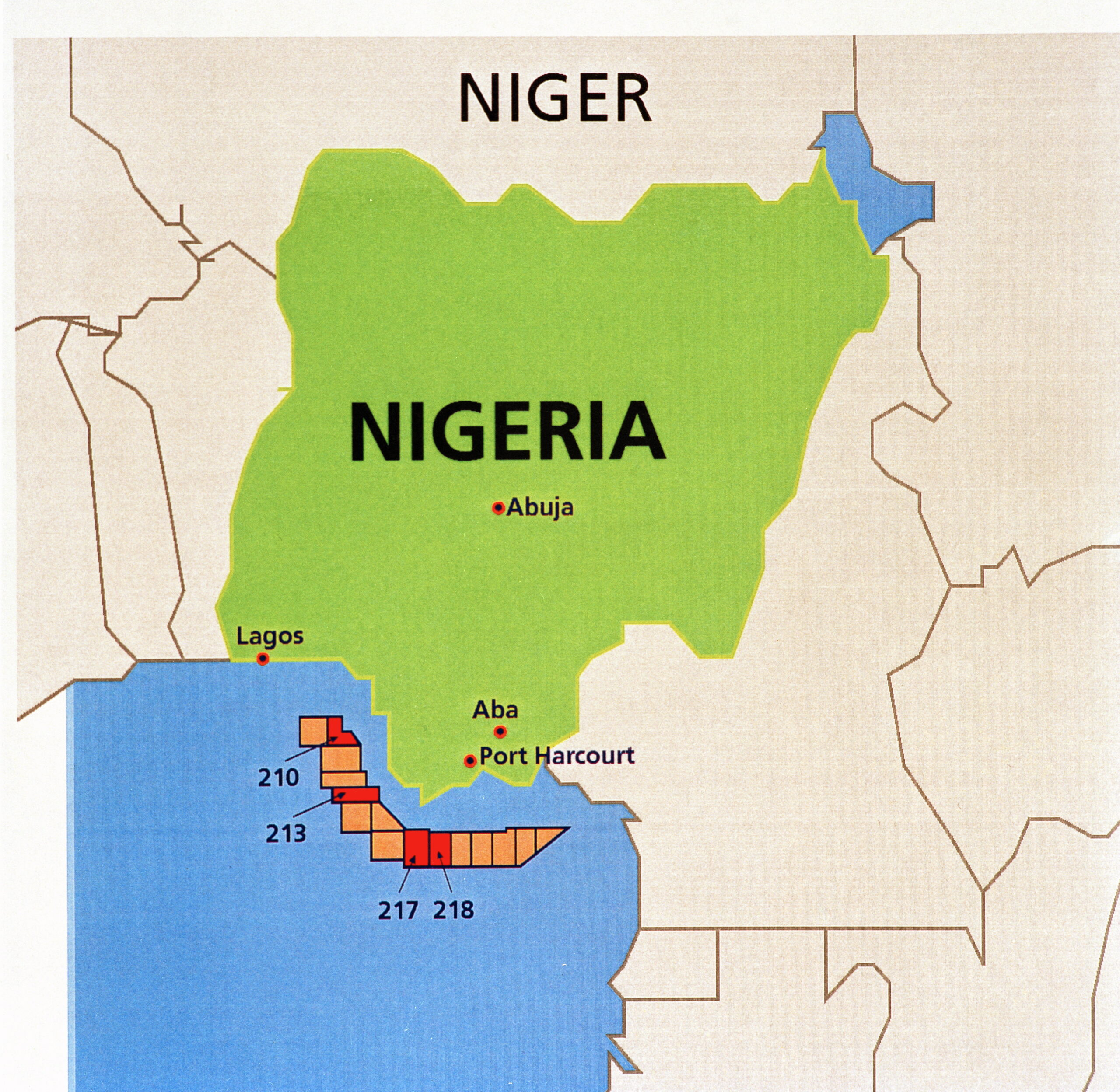
Map of Nigeria. Source: Equinor
Statoil was to be responsible for the alliance’s joint operations in Nigeria, making this country its baptism of fire as an international oil company. A significant proportion of the staff intended to support these activities were located in Stavanger. But a number of BP personnel were included in this Norway-based Nigeria management from the start.[REMOVE]Fotnote: Ryggvik, Helge. (2009). Til siste dråpe. Oslo: Aschehoug: 231
Operational responsibility for the west African commitment was allocated to BP and its London head office. Only a minimal share of alliance personnel were permanently stationed in Africa. While 23 people, all BP employees, worked with Angola from London, only one was based full-time in Luanda. Thirty staff handled Nigeria in Stavanger, with a single person in the African country itself.
Nigeria remained an important priority area until the mid-1990s, and activity there expanded. The alliance succeeded with its strategy and established itself as a leading player in the deepwater areas off the Nigerian coast. That position was completely overturned in 1995, when political conditions in Nigeria deteriorated dramatically.
Ever greater dissatisfaction had spread among many of the people living around the Niger delta. They received little or no share of the big revenues generated by the oil resources in their region. In addition, a massive environmental disaster began to manifest itself in the delta area.
A coup in 1993 had introduced one of the most brutal and corrupt regimes in Nigeria’s history. The repressive government banned all political activity and opponents were jailed. That in turn unleashed extensive protests across much of the country. These increased from 1995 after the military regime executed nine activists from the oil-rich delta – including author and environmental activist Ken Saro-Wiwa.
These executions helped to create pressure from international public opinion. Foreign companies faced demands to pull out of Nigeria. The worst-affected was Shell, which had been producing oil for many years from a controversial part of the Nigeria delta. But organised campaigns were also conducted against Statoil in Norway. The company responded that it did not want to become involved in political processes and chose to accept the political burden of remaining in Nigeria. It argued that the human rights position would not improve if it and BP withdrew.
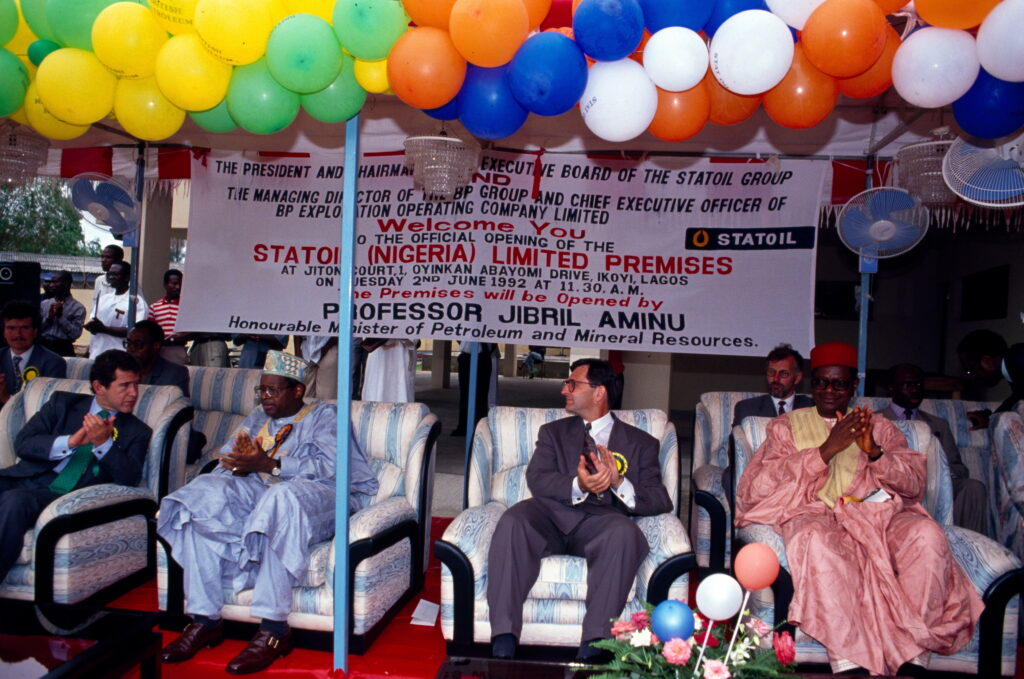
John Browne from BP, Nigerian politician Jibril Aminu and Statoil’s Harald Norvik in Nigeria. Photo: Leif Berge
These developments were not particularly concerning for the alliance to begin with. It concentrated on offshore exploration, and was not involved with oil spills and dead fish in the delta. And, in the middle of the unrest on land, the alliance could raise a mighty cheer when oil was proven with its first wildcat – which also represented the first deepwater discovery off Nigeria. But the jubilation was short-lived, since the resources proved non-commercial. At the same time, the political conditions caught up with the partners.
Statoil had the most to lose by pulling out. Nigeria was where the company intended to demonstrate that it could serve as an operator, even under difficult conditions, outside the North Sea.
It now transpired that repressive regimes, executions and environmental disasters were not the only problems facing BP and Statoil. The financial difficulties were a more difficult challenge. Nor had the alliance succeeded in securing its own operatorships. And its interests in other fields had also failed to yield sufficient oil to justify the exploration costs. The accounts were looking critical.[REMOVE]Fotnote: Ryggvik, Helge. (2009). Til siste dråpe. Oslo: Aschehoug: 233.
The Agbami oilfield project is one of Nigeria’s largest deepwater developments. Photo: unknown/Offshore Technologies
No big breakthrough occurred on the exploration side. On 20 April 1998, Statoil and BP signed a contract with Nigerian company Allied Energy on the sale of the alliance’s 40 per cent interest in block 210 – the Oyo oil field. It afterwards transpired that neither Statoil nor BP received the sale price. In addition came a price reduction of about 30 per cent, which many have characterised as incomprehensible.[REMOVE]Fotnote: Keilen, Erlend. (2003. 3. november). E24. Statoil fikk aldri betalt for oljefelt i Nigeria
An investigation was conducted, and its report concluded in 2004 that: the fact that the statements obtained are ambiguous, combined with the fact that no written documentation exists about the decisions which must have been taken, provides some scope for speculation. On that basis, the investigation committee would recommend to Statoil that it conducts an internal inquiry to clarify the circumstances. The following day, Statoil declared itself not guilty of corruption at a press conference in Oslo.[REMOVE]Fotnote: E24. (2010. 1. mars). NTB. Hemmelig Statoil-gransking av priskutt i Nigeria.
Although the alliance itself withdrew from Nigeria, Statoil remained on an independent basis and had interests in 2020 in Agbami – the country’s largest deepwater field.
Chevron is the operator of the field with a 67.30 percent ownership interest and Prime 127 has the remaining 12.49 percent. Equinor also operates two exploration licenses – OML 128 and 129 – with a share of 53.85 per cent in both. Six wells have been drilled in both, with two discoveries made. None of the fields are planned developed.
On Equinor’s own website, the company describes that its success in Nigeria “is underpinned by our sustainability work, ensuring we are a responsible operator and are proactive in improving opportunities for the communities where we work.”[REMOVE]Fotnote: https://www.equinor.com/where-we-are/nigeria
Carbon capture and storage (CCS) is often presented as a means of combating climate change – and has already been under way on Norway’s Sleipner gas field since 1996.
By Björn Lindberg, Norwegian Petroleum Museum
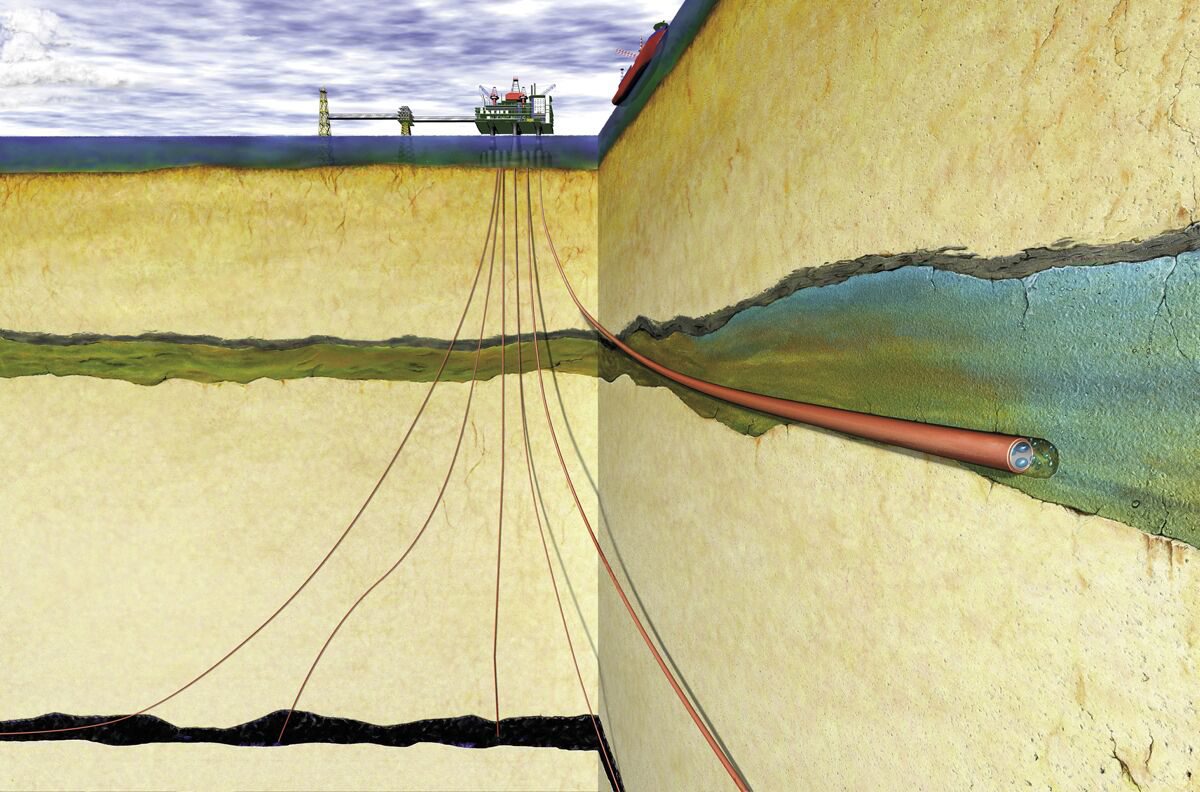
- Illustration of carbon capture and storage (CCS) at Sleipner. Illustration: Equinor.
Sleipner West was discovered as early as 1974 with Esso as the operator and declared commercial in 1984. After a plan for development and operation (PDO) was submitted to the government in 1992, it came on stream in 1996. But something had to be done about the high CO2 content in the field’s output in order to meet the specifications in the gas sales contract.
While natural gas primarily comprises methane (CH4), it also contains varying amounts of undesirable substances such as hydrogen sulphide (H2S), nitrogen and carbon dioxide (CO2). Many fire extinguishers contain pure CO2 because it displaces the oxygen needed to sustain combustion. This is also why a high CO2 content is undesirable in natural gas for use with ovens and the like – it will not burn so well. As a result, gas sales contracts will often specify a maximum quantity of undesirable substances permitted on delivery in order to ensure combustion quality.
Scrubbed clean and stored
CO2 pipeline on Sleipner A. Photo: Øyvind Hagen/Equinor
The gas in Sleipner West comes from 3 450 metres beneath the seabed and contains about nine per cent CO2. That exceeds the ceiling specified in the Troll gas sales agreements, which is 2.5 per cent for this component. As a result, the excess CO2 must be removed before exporting the gas. This is done in two ways – by blending the Sleipner West gas with gas from Sleipner East and other fields with low CO2 content. To further reduce the CO2 content in the exported Sleipner West gas, CO2 is removed from it. This is done by adding amines – organic bases containing a nitrogen atom which bind to the CO2 – on the separate Sleipner T gas treatment platform tied back to the concrete Sleipner A installation.
After being removed from the gas flow, the CO2-rich amines are heated to separate the mix into its component parts again – a process called scrubbing. That allows the amine to be reused and leaves the CO2 to be disposed of. This technology was not off-the-shelf, and had some problems and was costly. Countless modifications had to be made. One favorable factor for Statoil as operator was that the technology used was from the French company Total. Total was also a partner in the license, and hence did not cause much commotion when there was trouble with the technology. [REMOVE]Fotnote: Kyrre Nese in e-mail 8. august 2022.
CO2 is re-injected
Since the latter has no commercial value, the simplest – and cheapest – way of dealing with this gas would be to release it to the air. That might have been done on Sleipner West, too, but the introduction of a Norwegian carbon tax for petroleum operations on the NCS meant it would be very expensive. So operator Statoil opted for a different approach, which involved pumping the CO2 back underground. Since returning the gas to the reservoir of origin would simply increase its content in future production, the geologists had to find somewhere else to put it.
A number of conditions must be in place for CO2 to be stored in the sub-surface. The relevant formation must have sufficiently porous and permeable rocks, be saturated with saline water, be deep enough (more than 800 metres below sea level) to ensure that the CO2 has the desired properties, have an impermeable cap rock to prevent the gas leaking out, and cover a sufficiently large area with a big enough volume.[REMOVE]Fotnote:https://bellona.org/assets/sites/3/Case_Study_on_the_Sleipner_Gas_Field_in_Norway.pdf
The Utsira formation, which overlaps the Sleipner reservoirs at a different depth, meets these criteria and represents an ideal location for disposing of CO2. It lies about 800 metres beneath the seabed, while the main Sleipner East reservoir is roughly 1 700 metres further down.
Using a single well drilled from the concrete Sleipner A platform, an annual injection rate of about a million tonnes means some 20 million tonnes of CO2 have been deposited in the Utsira formation since 1996.
Regular investigations of the sub-surface have been conducted using seismic surveying to ensure that no CO2 is leaking from the structure to the seabed. These studies show that the injected gas is occupying an ever-expanding area of the formation and that no threat of leaks exists.
CO2 injection from Sleipner West was a pioneering project on the NCS and has been a success. Since 2019, CO2 from Utgard – which comprises no less than 16 per cent of this field’s output – has also been separated out on Sleipner T and injected into the Utsira formation.[REMOVE]Fotnote: Annual report Utgard 2019, AU-UTG-00002, Equinor.
The Snøhvit gas produced in Norway’s Barents Sea sector contains five-eight per cent CO2. This is separated out in the same way as on Sleipner, but at the Melkøya processing plant on land rather than on an offshore platform. Separated CO2 is piped back to the field in a compressed liquid phase and injected into the subsurface. Although injection problems have arisen, studies indicate that no gas is leaking out. A similar CCS process was pursued on the Salah gas field in Algeria, but terminated in 2011 because of capacity limitations in the geological structures.[REMOVE]Fotnote:https://uit.no/om/enhet/aktuelt/nyhet?p_document_id=552337&p_dimension_id=88137 and https://www.equinor.com/energy/carbon-capture-utilisation-and-storage
CCS on Sleipner has been under way longer than any comparable project, and the data and experience this has yielded will be important for future schemes of this kind. In 2019, Equinor and its partners in the field released information on CO2 injection and monitoring as a contribution to innovation for and development of storing greenhouse gases.[REMOVE]Fotnote:https://www.equinor.com/news/archive/2019-06-12-sleipner-co2-storage-data
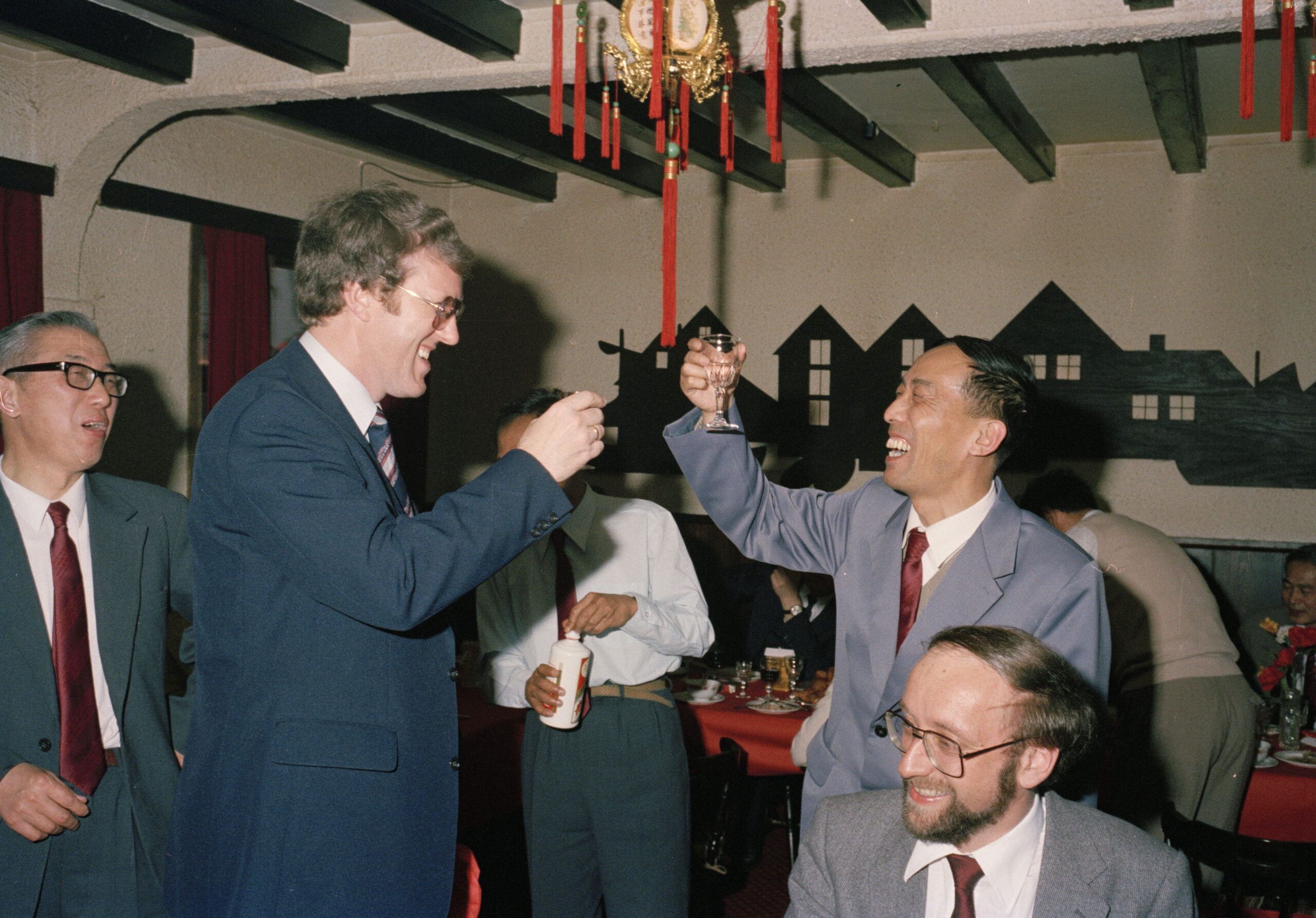
Many groups, both Norwegian and foreign, visited Statoil in the 1970s. The company welcomed 700 guests in the first half of 1977 alone. But some meetings yielded unintended culture clashes.
By Kristin Øye Gjerde, Norwegian Petroleum Museum
- Chinese visit at Statoil. Photo: Leif Berge/Equinor
Frugal style
The head of the American Petroleum Institute (API) – which represents the whole US oil and gas sector – visited Statoil in 1975. CEO Arve Johnsen was host to this highly influential executive, and provided a briefing on Statoil’s business. That included explaining how it was becoming an interesting oil seller. One point raised by the API president was whether Norway had ambitions to join the Organisation of the Petroleum Exporting Countries – Opec. Johnsen could affirm that it did not.
Following their meeting, the pair strolled over the road to the KNA Hotel in Stavanger for lunch. Johnsen asked his guest whether he would like something to drink with his food. The American smiled broadly, and perhaps expected a glass of wine. His surprise can be imagined when the frugal Norwegian went on: “How about a glass of milk?” Without any change of expression, the API man expressed his thanks and drank milk in good Norwegian style together with Johnsen.[REMOVE]Fotnote: Related by Håkon Lavik, former information office at Statoil, 2 July 2020.
Formal versus informal
International banks were queuing up in 1976-77 to lend Statoil money for its share of the Statfjord development. A Japanese bank delegation announced it was arriving in Stavanger on a Sunday evening and requested a meeting with Statoil’s finance team. This encounter was scheduled for Monday morning at 08.30. Information officer Håkon Lavik was assigned to fetch the visitors from the city’s best hotel – the Atlantic – at 08.00.
He met four vice presidents, very correctly dressed in pin-stripe suits and ties. They insisted on leaving at once to avoid being late. A taxi was ordered and the group arrived at about 08.15 at Statoil’s international department, which was then based at Flintgaten 2 in the Hillevåg district.
The only Norwegian present then who was due to attend the meeting was Jørn Larsen, a burly type from the Jæren farming district south of Stavanger wearing jeans and a pullover.
Tor Espedal, the chief financial officer, arrived soon afterwards. He always started his working day with a swim and still had wet hair, as well as being sweaty and open-collared (his tie was in his pocket) after cycling to the office.
Then came a very correctly dressed Eivind Brekkelund, an economist, followed by Jan Erik Langangen – a later Statoil chair – in jogging gear. His suit was in the changing room.
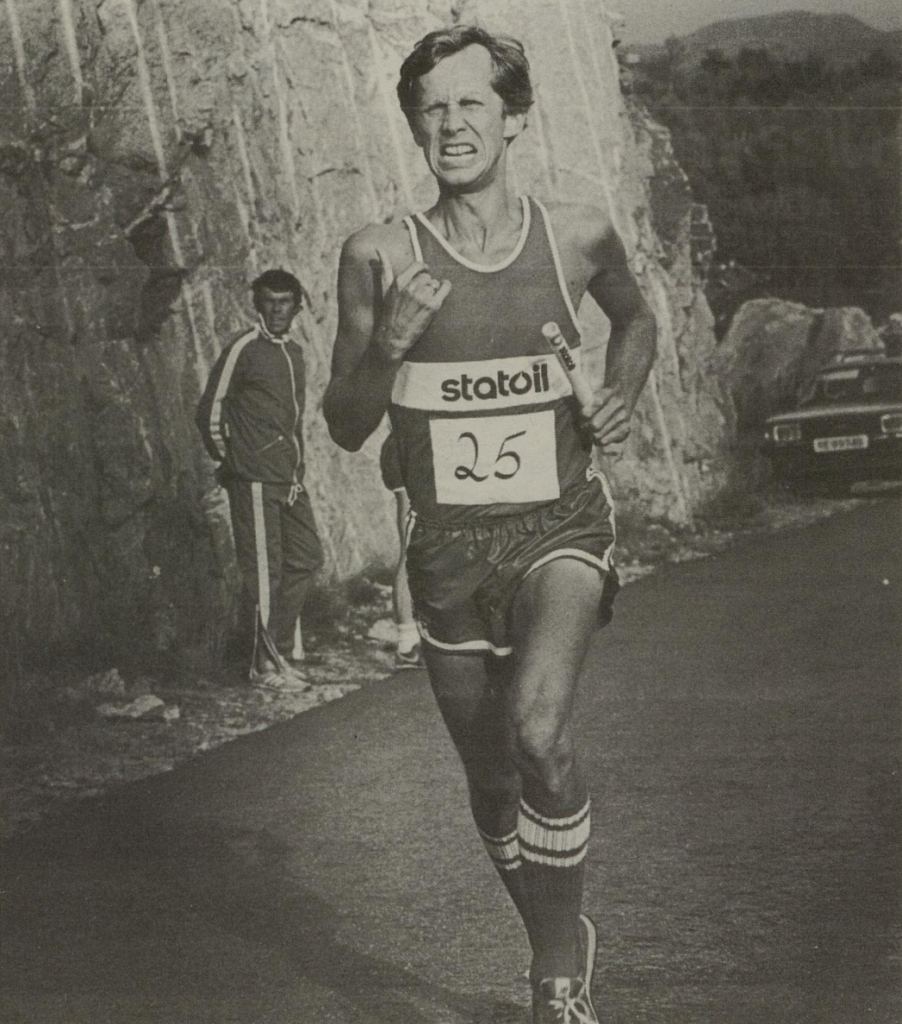
Jan Erik Langangen running the Holmenkoll relay. Photo: Equinor
Svein Andersen, head of the company’s internal audit function, turned up next. He was also on a bike, wearing trainers and an anorak.
Finally came Thor Inge Willumsen, later Statoil’s CFO, in a pullover and without a tie, and munching on a carrot which marked the end of his breakfast.
Only a few minutes passed before everyone was ready for the meeting, and Statoil was loaned billions of kroner. But the Japanese visitors were undoubtedly taken a little aback at Norwegian culture of informality.
Despite their relaxed style, the Statoil team was no gang of small fry. All those mentioned later become senior vice presidents in Statoil, while Brekkelund went to Mobil and then to Shell.[REMOVE]Fotnote: Ibid.
Anti-aircraft guns on Statfjord
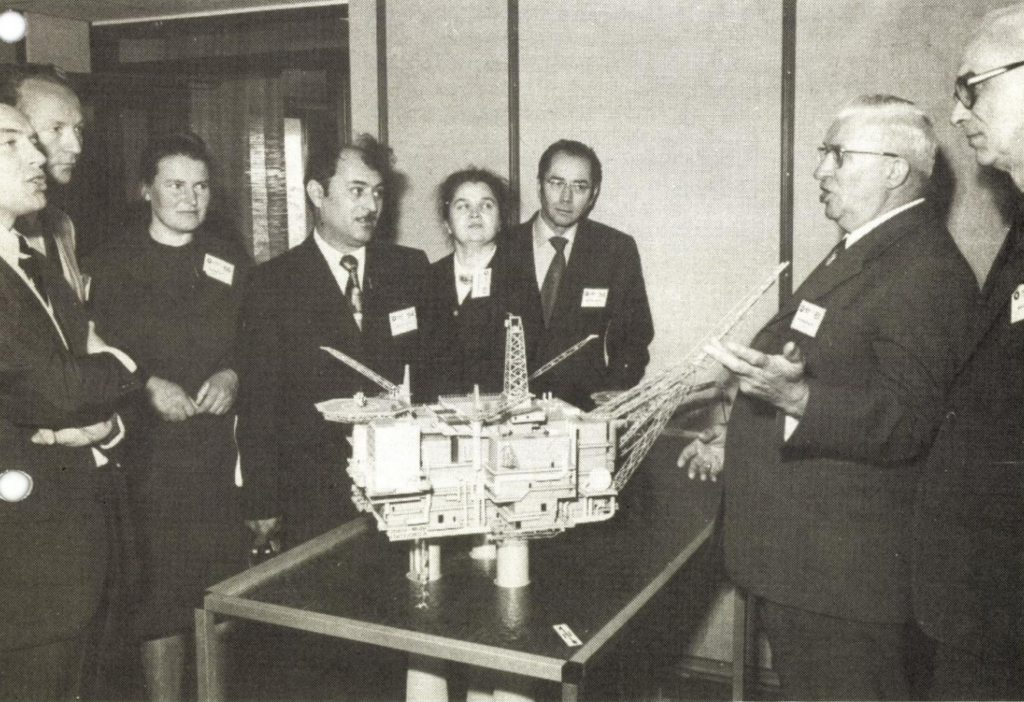
The Statoil management received an important visit from the Supreme Soviet one September day in 1976. After the conventional introductions by chair Finn Lied and CEO Johnsen, the latter gave a briefing on the company’s operations. That included a review of the current construction of the Statfjord A platform, with particular emphasis on building concrete gravity base structures. This was long before the computer age, and engineers commissioned detailed models of such installations to help their design work.
The model of Statfjord A stood in the corridor outside the meeting room in Lagårdsveien 78, which functioned as Statoil’s head office at the time. During the presentation, with associated slides, a discussion began with and between the visitors about whether the Soviet Union had any such structures. The delegation claimed it had, and even some that were larger.
Representatives from the Soviet Union, on a visit to Statoil, gathered around a model of Statfjord Phase I. Photo: Equinor
After the meeting, the group assembled around the model. This was very detailed, and visitors noticed that water monitors were installed around and about the topsides in case of fire. But the Soviet delegates through they were anti-aircraft guns – because that was something they really knew about. From their perspective, this felt to be was essential. Fire-fighting was an unnecessary precaution. The visitors were otherwise very grateful for Statoil’s openness, which they much appreciated. It only emerged later how distinguished this visit had been.
When the next session of the Supreme Soviet opened a few weeks later, and the event was shown on the TV news, three of the delegates were seen seated in the first row on the podium. They were immediately behind Communist Party head Leonid Brezhnev, who gave the opening speech. The visitors had been really top politicians with great influence in the Soviet Union.[REMOVE]Fotnote: Ibid.
Different rules and much turbulence were key features of worker-employer relations during the early years of Norway’s oil industry. That marked a big contrast with the way the onshore labour market functioned.
By Kristin Øye Gjerde, Norwegian Petroleum Museum
- Coffee break on the Statfjord A pipe deck. Photo: Mobil Exploration Norway Inc./Norwegian Petroleum Museum
Instead of organisations affiliated with the Norwegian Confederation of Trade Unions (LO), company or “yellow” associations were established which then developed into proper unions outside the LO system. These newcomers were not afraid to take on the employers by striking. That made its mark on collective pay settlements for the Norwegian continental shelf (NCS) during the first few decades.
American oil companies, in particular, were anti-union. That was much of the explanation for why the LO failed to win support among offshore personnel from the start.
Many Norwegian oil workers had a background as seafarers. When they got a job on an oil rig or platform, their earnings rose markedly and disposed them to accept the US mindset. The workers saw little reason to join the LO-affiliated Norwegian Seamen’s Union, since it represented seafarers with low pay and poor shift and tour arrangements. Instead, they chose to take new routes.
Inside and outside the LO
A company union on the American model was established in 1973 on the Ekofisk field, which was the first discovery off Norway to come on stream. This was converted relatively quickly into the independent Ekofisk Committee, a union in the traditional sense – except that it was led by a Conservative and remained outside the LO. In order not to stand alone, it forged links with oil workers on the Statfjord and Frigg fields.
The logo of the Ekofisk Committee.
The Statfjord Workers Union (SaF) was established in 1976 on the original Ekofisk model – in other words, a company association exclusively for employees of operator Mobil. In the same way, the Elf Aquitaine Norge Offshore Union (Eanof) was founded in May 1977. These three groups joined forces in 1977 through the Collaboration Committee for Operator Unions (OFS), which also remained unaffiliated with the LO. But each of the unions continued to negotiate independently with their respective employers, so that pay and working conditions varied greatly from company to company.[REMOVE]Fotnote:The Ekofisk Committee – an unusual union – Ekofisk (industriminne.no)
The OFS quickly became powerful. It was not afraid to promote demands for higher pay and improved working conditions, and to back them up with strikes. That became a challenge for the operator companies.
The NOPEF logo.
These competitor unions were also a problem for the LO. To fight over members and the rules offshore, it set up the Norwegian Oil and Petrochemical Workers Union (Nopef) in 1977. This imposed stronger discipline than the OFS on its members – in line with what industrial workers on land were used to.[REMOVE]Fotnote:NOPEF-nytt no 1, vol 1, May 1978, “Ny lov vil hindre amerikanske tilstander i Nordsjøen?” — Regional State Archives in Stavanger, SAST/A-101609/X/0001.
That these two union organisations both saw the light of day in 1977 was no coincidence. They were partly a response to the adoption of Norway’s Working Environment Act in that year. Under to this legislation, all operator companies were required to work in accordance with Norwegian norms. These included a “tripartite” collaboration between employers and unions (the parties in the labour market) as well as the government.
The Act was extended to the fixed facilities in the North Sea, and had an “educational” effect on both the operator companies and the unions.[REMOVE]Fotnote: Mobile units such as ships and rigs were not covered by the Working Environment Act, but remained subject to maritime legislation. They were therefore less strictly regulated. Ryggvik, Helge and Smith-Solbakken, Marie, 1997, Blod, svette og olje, vol 3, Norsk oljehistorie: 144, 55-58.
Government role in pay talks
Collective pay bargaining in the oil industry as well as the rest of Norway at this time was affected by the particular economic circumstances prevailing in the country. An international slump had followed the first oil crisis in 1973, with Norwegian shipping companies and shipyards forced to restructure extensively after the oil tanker trade crashed.
While Norway was in recession in 1976-78, light could fortunately been seen at the end of the tunnel. North Sea developments meant Labour finance minister Per Kleppe expected the supplier sector to win a lot of work. With the oil industry also likely to yield substantial revenues in the future, Kleppe persuaded the government to adopt a countercyclical policy to surmount the crisis. That required moderate pay demands and strict control of settlements.
The government became heavily involved in negotiations between employers and unions. Instead of pay rises, it offered welfare benefits, tax reliefs and subsidies – known as the Kleppe packages. A pay and price freeze was even imposed in 1978.
At this interface between crisis, caution and future wealth, offshore remuneration created dilemmas. By no means all oil workers were willing to accept strict government pay control. Development projects on the NCS were progressing at high speed, and labour was in big demand. Why should oil workers doing challenging jobs accept a pay freeze? They were surely entitled to their share of the future oil wealth they were helping to create? The workers stuck to their guns and were willing to down tools to achieve their goals. As a result, the most sought-after occupational groups were able to drive up their pay.
Anxious about mainland industries which competed for the same labour, the government viewed this trend with concern. Another question was whether it was “morally” appropriate for offshore personnel to be paid so much more than an industry worker on land. Labour premier Odvar Nordli told Nopef in 1977 that pay developments on the NCS for employees outside the national union organisations – in other words, the OFS – was “one of the biggest problems we face today in the economic system”.[REMOVE]Fotnote:NOPEF-nytt, no 1, 1978.
Although Statoil was not an operator with offshore employees at this time, CEO Arve Johnsen was also worried that pay deals for such workers were out of step with onshore developments. “The main reason was that the same level of tradition and organisational experience which prevailed between the LO and the Norwegian Employers Confederation (NAF) for land-based industry did not yet exist on the NCS,” he wrote in his memoirs.[REMOVE]Fotnote: Johnsen, Arve, 1988, Gjennombrudd og vekst: Statoil-år 1978-1987: 171-174.
OFS flexes its muscles
The OFS secured the status of a national union organisation in 1980, and displayed its readiness for a fight at the first opportunity.
Illegal stoppages on Statfjord in 1981 were the first in a long series. Operator Mobil wanted industrial peace on the field, and fairly quickly made a pay offer which was accepted. The US company’s practice of yielding to demands for more money was a matter of great concern to the Statoil management, since the company was soon to take Mobil’s place as operator. Like Nordli, neither Johnsen nor his other senior executives wanted the oil sector to become the pacesetter for pay settlements.[REMOVE]Fotnote: Ibid; Board document 73/79, Statoil: Statoils uttalelse vedrørende NOU 1979: 30; Samordning av Statens Arbeidsgiverinteresser – Regional state archives in Stavanger, SAST/A-101656/0001/A/Ab/Abb/L0008, XA01A890806-900158.
Once the Statfjord workers had secured a 30-35 raise, their counterparts on Ekofisk and Frigg demanded the same. After several strikes on these fields that autumn, the employers yielded there as well.
LO chair Tor Halvorsen was shocked at what Mobil’s indulgence of the OFS had led to. He described it as “a concrete example of how the parties outside the income policy fellowship could destroy the solidarity [in this area] which has been a cornerstone of the post-war period”.[REMOVE]Fotnote: Meland, Trude, Illegal labour conflicts, Industrial heritage Statfjord. https://statfjord.industriminne.no/en/2019/12/03/illegal-labour-conflicts/
Not all offshore workers agreed with him. A number of members in the seamen’s union were dissatisfied with the results achieved. It had staged a legal strike in early November 1981, but was met with compulsory arbitration. That prompted drillers, roustabouts and rank-and-file seafarers to down tools illegally. This stoppage lasted 11 days without any financial benefits being achieved. During the strike, the union faced a mass walkout by members. A new organisation rooted in the strike committees was founded as the Union of Shipping Company Employees (ROF), which secured more than 1000 members within a few weeks.
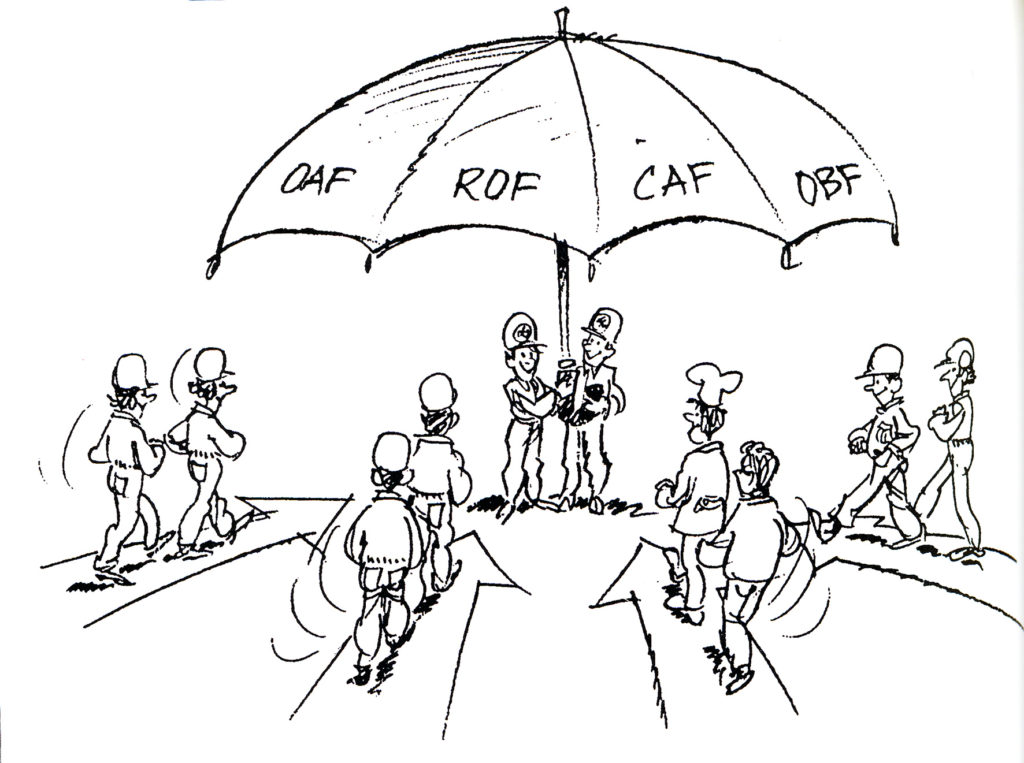
OFS gradually gathered more unions under its umbrella.
The ROF applied to affiliate with the OFS. So did an independent organisation for drilling personnel which had just been established. Called the Oil Drillers Union (OBF), it organised former Nopef members.
This flood of offshore workers to the OFS prompted a restructuring of the organisation in the spring of 1982 to become the Union of Operator Employees (OAF). That in turn joined with the ROF and the OBF in the Federation of Oil Workers’ Trade Unions (which retained the OFS abbreviation).
The success of the OFS through its willingness to down tools illegally attracted new groups of workers. In March 1983, the Catering Workers Union (CAF) became the fourth affiliated union.
Instead of submitting to the income policy collaboration between the LO, the NAF and the government, the OFS stood forth as an independent body which was a match for the companies and able to pressure them to pay more. The federation was willing to breach the financial parameters set through the income policy collaboration by shutting down all oil production on the NCS. It had thereby become a power player and a risk factor to be reckoned with.[REMOVE]Fotnote: Ryggvik and Smith-Solbakken, op.cit.
Fight-back
OFS changed its name from the Collaboration Committee for Operator Unions to the Federation of Oil Workers’ Trade Unions in 1980.
As the 1980s progressed, the OFS was involved in a number of stoppages which all ended in compulsory arbitration. In 1986, the catering workers demanded a 30 per cent raise during the pay negotiations. They were angry and disappointed at being paid so much less than other offshore workers. The employers then took the unusual step of imposing a lockout. This was at a time when oil prices were very low, and the government did not intervene since it probably felt that shutting down production would serve its interests by helping to drive prices back up.[REMOVE]Fotnote: Meland, Trude, Strike and lockout, Industrial hertiage Statfjord. https://statfjord.industriminne.no/en/2019/12/03/strike-and-lockout/ So the CAF achieved nothing.
Pay rates were strictly regulated by law in 1988-89, and inflation was moderate. A strike called as a political demonstration in April 1989 was cancelled after Norway’s Industrial Disputes Court found that it to be illegal.
The oil workers were now frustrated and wanted to make up lost ground once free pay bargaining was restored. While the LO still wanted to maintain a policy of moderation, the OFS took a different view and had great expectations of the 1990 settlement. That laid the basis for last illegal strike on the NCS.
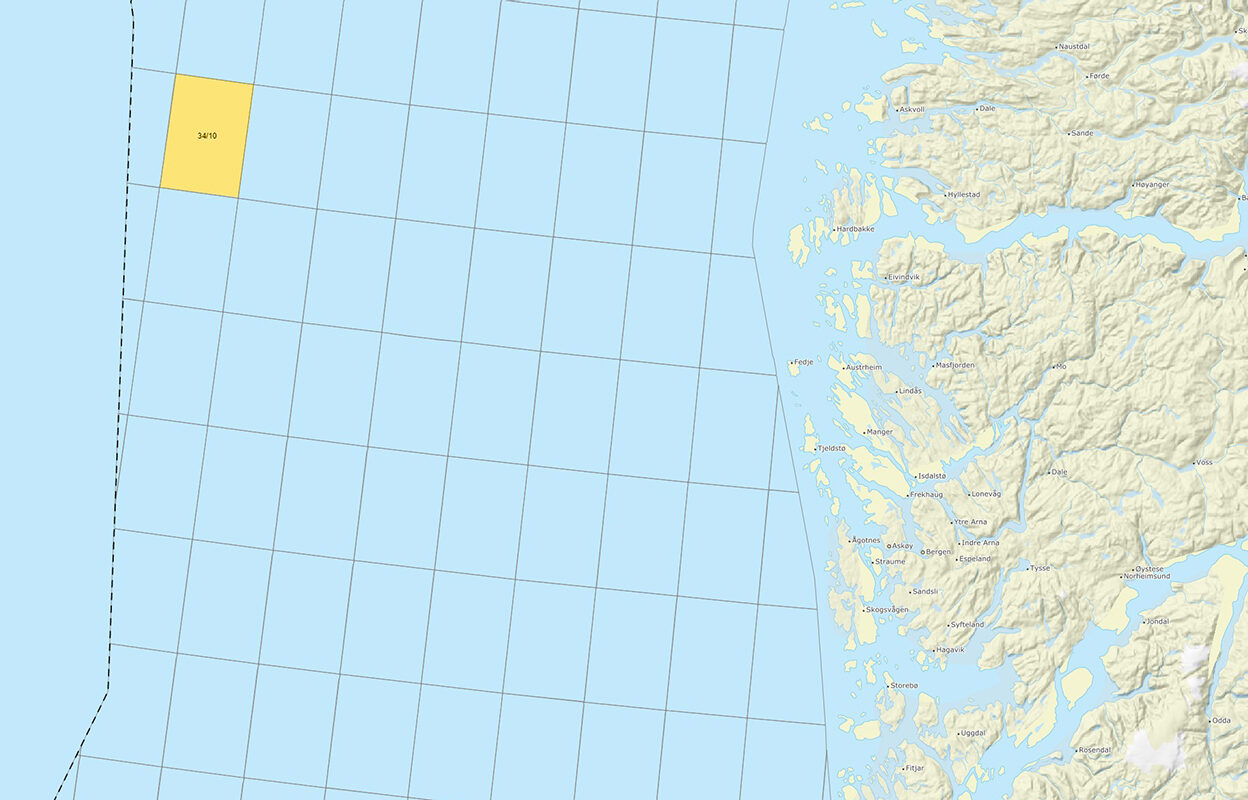
Norway’s block 34/10 was so attractive that it had been nicknamed the “golden block”, and became Statoil’s baptism of fire as an operator. Although the company had to share it with two partners, it secured the operatorship of the first licence on the Norwegian continental shelf (NCS) with only domestic licensees.
By Trude Meland, Norwegian Petroleum Museum
- Location of block 34/10. Map: https://www.norskpetroleum.no/en/interactive-map-quick-downloads/interactive-map/
Statoil ranked in 1977 as a privileged company. It had been awarded half the Norwegian share of Statfjord outside the regular licensing rounds and was now in full swing – together with operator Mobil – on planning and developing this field. So the company held 50 per cent of the largest oil field discovered on the NCS and was being trained in a large and complex development project by a major oil multinational with much experience. It was thereby ready for new tasks, preferably a major operatorship, and block 34/10 was at the top of its wish list. But, as always where its position, power and strength were concerned, political conflicts arose.
Wish list
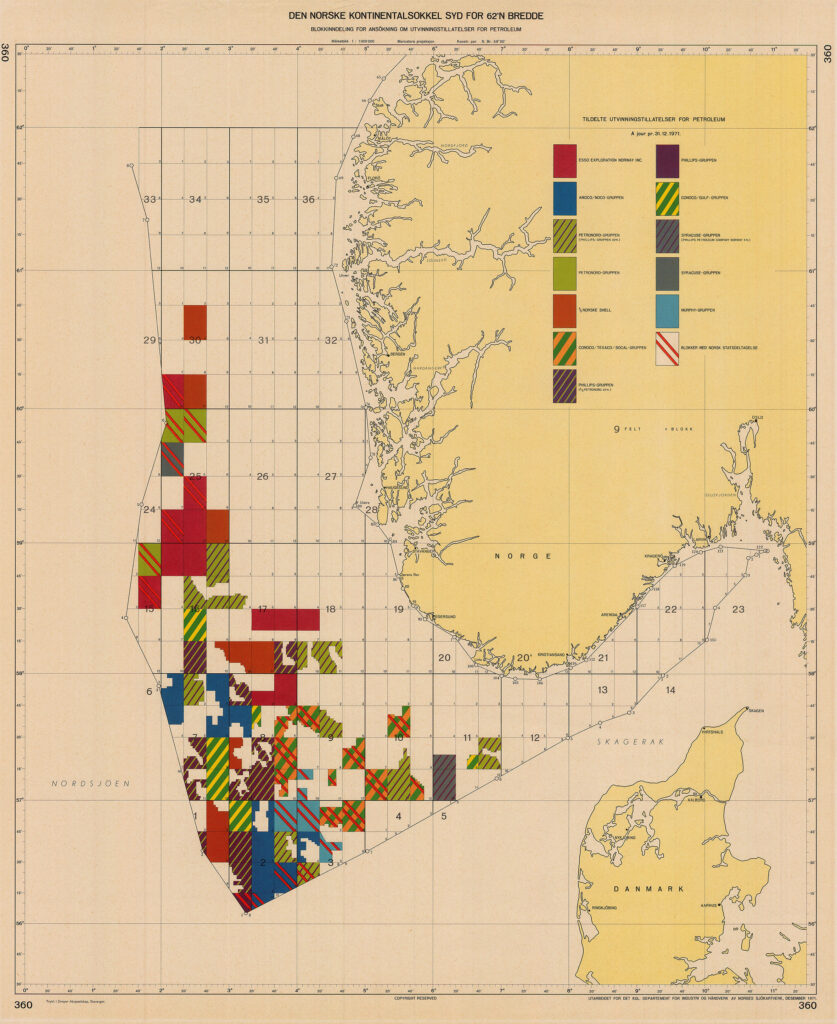
“Division into blocks for the purpose of applying for petroleum production licences”. Map of the Norwegian continental shelf, 1971. Map: Norwegian Petroleum Directorate
In connection with the third licensing round during the mid-1970s,[REMOVE]Fotnote: A licensing round is the term for a collective award of production licences which allow the recipient oil companies (licensees) to explore for and produce petroleum from designated areas of the NCS. the Ministry of Industry had asked Statoil to list the blocks it believed should be controlled by the state through the company. The ministry had decided as early as 1970 that a number of “key” blocks should be set aside. These particularly interesting areas of the NCS would be reserved for greater state and national participation than had been achieved until then through the licensing system.[REMOVE]Fotnote: Report no 95 (1969-70) to the Storting, Undersøkelse etter og utvinning av undersjøiske naturforekomster på den norske kontinentalsokkel m.m, Ministry of Industry and Craft, Oslo. Accessed at https://www.stortinget.no/no/Saker-og-publikasjoner/Stortingsforhandlinger/Lesevisning/?p=1969-70&paid=3&wid=d&psid=DIVL896.
In practice, the foreign companies had more or less dominated the first two licensing rounds in the mid to late 1960s. They obtained operatorships and holdings, and largely determined the licence terms – even though the government later negotiated a degree of state participation.
The blocks reserved either had a big potential, were adjacent to the boundary line with other national sectors of the North Sea, or lay close to known discoveries.
Key blocks
When the third-round blocks were put on offer in June 1973, the issue of the key blocks had become more specific and the ministry decided to reduce their number.
The announcement stated that nine blocks along the boundary with the UK and close to the border area had been held back. They were 1/2, 1/9, 24/3, 24/6, 24/11, 24/12, 25/7, 34/7 and 34/10.
That same autumn, Statoil was asked to present an overall plan for the best way to utilise the reserved acreage. This was extremely important for the company, but also represented an extensive and time-consuming job. Its main analysis was completed in January 1974, when a 60-page report was submitted to the ministry.[REMOVE]Fotnote: Johnsen, A, 2008, Norges evige rikdom oljen, gassen og petrokronene: 135.
The company had been given full freedom of action in conducting the analysis, and held meetings during the autumn of 1973 with all the companies and groups which had expressed an interest in collaborating on utilising the key blocks. These discussions yielded substantial quantities of geological and geophysical data, and confirmed Statoil’s view that 34/7 and 34/10 were particularly interesting.
Block 34/7 was later awarded to Saga Petroleum and includes the Snorre field among other assets.
Statoil had designated 34/10 as its principal choice since the autumn of 1973. It would eventually become the company’s first development assignment, and the first field on the NCS developed by a domestic company. This acreage came to set its stamp on Statoil’s development – and technological progress – on the NCS.
In a memorandum to the board dated 8 February 1974, CEO Arve Johnsen described how he envisaged that the key blocks should be managed.[REMOVE]Fotnote: Memorandum to the board, doc no 69/74, 10 October 1974, SAST, Pa 1339 – Statoil ASA, A/Ab/Abb/L0002: Styremøter Statoil, 1974. Accessed at https://www.digitalarkivet.no/db60034662000735 This called in his view for a staged exploitation of the acreage, both to accord with the Storting’s call for a moderate pace of oil production and to give Statoil time to deal with the awards and adapt.[REMOVE]Fotnote: Report no 30 (1973-74) to the Storting, Virksomheten på den norske kontinentalsokkelen m.v, Ministry of Industry. Accessed at https://www.stortinget.no/no/Saker-og-publikasjoner/Stortingsforhandlinger/Lesevisning/?p=1969-70&paid=3&wid=d&psid=DIVL896.
The company also had to take account of the ministry’s presumption that Norsk Hydro and Saga, Norway’s two other oil companies, would be involved in one of the licences.
Other issues of principle underlying Statoil’s prioritisation were that the Norwegian state – via the company – should obtain the best possible return from the key blocks, and that the organisation of development and production should secure the largest possible share of the petroleum value.
An express political goal was for Norway to become an independent, self-sufficient oil nation. Building up national technological expertise was crucial for achieving that ambition. Where Statoil was concerned, the target was to become a technologically competent operative company. Through the Statfjord development, Statoil had gradually expanded a shadow organisation and recruited a number of specialist personnel. Agreements to be entered into with foreign companies had to include requirements that Statoil would learn from their expertise. The company was to be able to take over as operator on the key blocks within a reasonably short space of time – without “reasonably” being more closely defined. Another aspect of this managed Norwegianisation was the strengthening of industry in mainland Norway by ensuring petroleum deliveries through Statoil’s operations.[REMOVE]Fotnote: Letter from Statoil to the Ministry of Industry and Craft, 8 February 1974, signed by Jens Christian Hauge, chair. SAST, Pa 1339 – Statoil ASA, A/Ab/Abb/L0002: Styremøter Statoil, 1974, Accessed at https://www.digitalarkivet.no/db60034662000739.
Criteria applied by the company in choosing prioritised key blocks were that a possible field must contain oil, be large, and lie in a water depth accessible to the technology of the day. Several had been assessed and considered promising: 30/6 (which turned out to contain Oseberg), 34/7 (Snorre), 34/8 and 34/10. The last of these satisfied all three of the requirements set, while 34/7 lay in deep water and depended on technical advances to be producible, and it was thought likely that 30/6 held more gas than oil.
Block 34/10 was characterised by a complex geology, with fracturing and many faults. But this was precisely what offered a unique opportunity for moving Statoil towards its goal of becoming a technologically competent and technology-driven company.[REMOVE]Fotnote: Lerøen, B and Statoil, 2006, 34/10: Oil the Norwegian way – a story of boldness, Statoil, Stavanger: 58.
Its final prioritisation placed 34/10 at the top of the list, with 34/7 in second place.
Statoil proposed that block 1/9, which was lower down the ranking, should be exploited in collaboration with a foreign partner. A discovery there could provide substantial revenues for the company at a relatively early stage because it was close to the Ekofisk complex, and existing infrastructure was therefore available. This acreage was awarded on 27 August 1976 with Statoil as operator, and proved to contain the company’s first discovery. It was named Tommeliten Alpha.
Where the rest of the blocks were concerned, Statoil did not envisage anything being done with them for the moment.
Fourth round
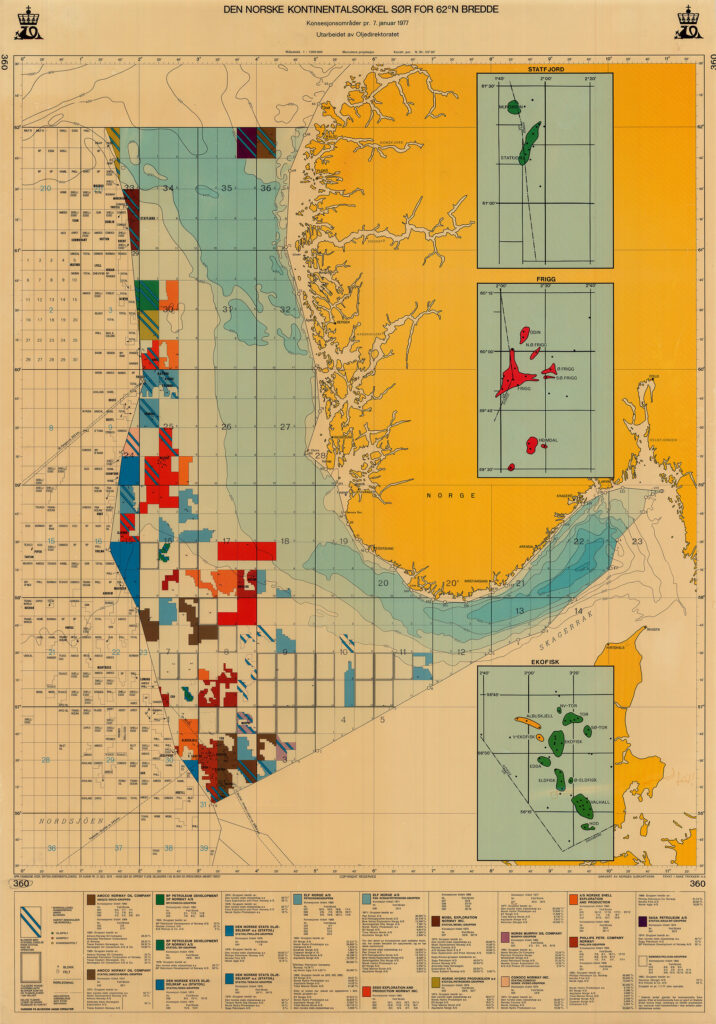
Areas licensed on the NCS at 7 January 1977. Map: Norwegian Petroleum Directorate
By 1977, the time had come for a new licensing round. The Norwegian economy was stagnating, with activity in the North Sea waning. Since drilling on blocks awarded in 1974 and 1975 had yielded largely negative results, making new acreage available could help to maintain exploration.[REMOVE]Fotnote: Proposition no 142 (1976-77) to the Storting, Om utlysning og tildeling av blokker på kontinentalsokkelen, og om boring etter petroleum i statlig regi, Ministry of Industry, Oslo: 3. Accessed at https://www.stortinget.no/no/Saker-og-publikasjoner/Stortingsforhandlinger/Lesevisning/?p=1976-77&paid=2&wid=b&psid=DIVL400. Activity could not be allowed to decline if Norway wanted to maintain a positive impact from the offshore industry, particularly for its hard-pressed shipbuilding sector.
As a first step, the plan was to award a limited number of blocks – probably five-six. Based on the results of drilling these, the ministry would decide whether to license more.[REMOVE]Fotnote: Proposition no 142 (1976-77) to the Storting, Om utlysning og tildeling av blokker på kontinentalsokkelen, og om boring etter petroleum i statlig regi, Ministry of Industry, Oslo: 3. Accessed at https://www.stortinget.no/no/Saker-og-publikasjoner/Stortingsforhandlinger/Lesevisning/?p=1976-77&paid=2&wid=b&psid=DIVL400. The principle established with the licensing round in 1974 that Statoil would hold a 50 per cent interest in all blocks awarded was maintained. This percentage could also be increased were a commercial discovery made.
By now dubbed the golden block, 34/10 had attracted particular attention. Statoil was not the only company keen on it – no less than 19 of the world’s leading oil companies expressed an interest. This block was considered to have such great potential that it called for special treatment, and the government decided to award it ahead of the regular round. The Labour Party was in government and worked hard, in concert with the unions, to secure Statoil as sole licensee.
In proposition no 142 (1976-77) to the Storting, the ministry recommended that 34/10 be awarded outside the regular round – as had also been done with Statfjord – and to Statoil alone.
A North Sea blowout disrupted these plans. On 22 April 1977, a month after the proposition had been approved by the Council of State, oil flowed uncontrollably from a well on the Ekofisk field’s Bravo platform and caused questions to be asked about offshore safety. Was this good enough and did the Norwegian authorities have it under proper control? And what about contingency planning for oil spills? The Bravo blowout clearly demonstrated that the government had been caught unawares and that preparedness was far from adequate.[REMOVE]Fotnote: Meyer, J, 1977, Ukontrollert utblåsing på Bravo 22. april 1977 Norwegian Official Reports (NOU) 1977:47, Universitetsforlaget, Oslo. The commission of inquiry submitted its report to the Ministry of Justice on 10 October 1977. In line with the precautionary principle, the decision was taken to halt all awards and licensing until an investigation of the accident had been completed. This meant that proposition 142 was not considered by the Storting and the awards were adjourned.
The ministry nevertheless continued its work, and a new proposition was submitted in December 1977. This largely conformed with the original proposals presented in March. But one significant change was that, instead of being the sole licensee, Statoil would now have Hydro and Saga as partners.
Proposition no 72 (1977-78) to the Storting stated that “… participation in a relatively prospective block would appropriate in that Hydro and Saga can help to ensure the many tasks we face in the oil sector are performed in the manner the Storting expects”.[REMOVE]Fotnote: Proposition no 72 (1977-78) to the Storting, Om utlysning og tildeling av blokker på kontinentalsokkelen, og om boringer etter petroleum i statlig regi. Accessed at https://www.stortinget.no/no/Saker-og-publikasjoner/Stortingsforhandlinger/Lesevisning/?p=1977-78&paid=2&wid=a&psid=DIVL895. The ministry emphasised that the block was regarded as sufficiently promising to potentially “[…] promote the organisational and financial basis for the development of and collaboration within the Norwegian oil industry and thereby to maintain and protect a Norwegian petroleum milieu.”
Continued favouritism towards domestic players at the expense of foreign oil companies was displayed by these proposals. The Norwegianisation policy aimed primarily to create a broad national oil community which would make the country less dependent on foreign expertise and capital. While the main part was assigned to Statoil, Hydro and Saga had important supporting roles.
Over its first five years, the state company had built up an ever-stronger position. Now the two private players were to be given a leg up. The ministry proposed that they should each receive five per cent of 34/10, while Statoil got the rest. And the latter continued to be favoured, since Hydro and Saga were both also required to pay 10 per cent of the exploration costs.
This solution was intended to give all the Norwegian companies a stronger position on the NCS. No role was envisaged for foreign participants. That meant their capital and expertise was no longer seen as so important for developing the NCS. The earlier concern that the international companies might pull out did not appear to worry the politicians. In contrast to earlier political signals, the ministry now believed that the foreigners were welcome to shift their activities elsewhere if their role was reduced. That opportunity was not available to Hydro and Saga, and new assignments on the NCS would represent an important basis for their continued existence. Were they given less to do, it would be harder for them to retain the expertise they had acquired.[REMOVE]Fotnote: Proposition no 72 (1977-78) to the Storting, Om utlysning og tildeling av blokker på kontinentalsokkelen, og om boringer etter petroleum i statlig regi. Accessed at https://www.stortinget.no/no/Saker-og-publikasjoner/Stortingsforhandlinger/Lesevisning/?p=1977-78&paid=2&wid=a&psid=DIVL895.
Foreign companies reacted to the recommendation with fears that this was the start to a complete nationalisation of the NCS, while Hydro was shocked that it received such a small slice.
The government came under pressure from every side – Hydro, the Norwegian Confederation of Trade Unions (LO) and the non-socialist parties. Hydro naturally wanted part of the best block on the NCS. The LO – and particularly members at Hydro plants – also called for the company to get rights to the golden block. For their part, the non-socialists – and the Conservatives in particular – pressed for greater participation by the two private companies.[REMOVE]Fotnote: Kvam, Ragnar Jr, 26 January 1978, “Får Hydro 10 prosent andel i gullblokken?” They wanted to shift the centre of gravity in order to improve the balance between the three Norwegian players. Statoil’s privileged position had been politically contentious before, as it was now and would be again.
The issue was sent to the Storting’s standing committee on industry. In its consideration of the proposed award, the division between Labour and the Conservatives over their views of Statoil and its relationship with the private Norwegian companies became plainly visible. Where the Conservatives were concerned, it was a “remarkable misapprehension that [Hydro and Saga] are less national than Statoil”.[REMOVE]Fotnote: Odd Vattekar, Conservative, Storting proceedings, 16 March 1979: 2269. Accessed at https://www.stortinget.no/no/Saker-og-publikasjoner/Stortingsforhandlinger/Lesevisning/?p=1977-78&paid=7&wid=a&psid=DIVL382&pgid=b_0931. The party was dissatisfied with the size of the private-sector share and, together with the oil development sceptics from the Centre, Liberal and Social Democrats, threw a spanner in the government’s works.
The Conservatives primarily sought larger holdings for Hydro and Saga. It also wanted Norse Petroleum – one of the “people’s joint stock companies” which had raised capital by selling shares direct to ordinary Norwegians – to have a one-per-cent stake, and not a big reduction in the carrying of Statoil’s costs by the private licensees.
During the hearing by the industry committee, Hydro demanded a 15 per cent interest and Saga called for 10 per cent. They had admittedly accepted five per cent apiece in advance, but maintained that they had been forced to yield to pressure from Labour. It was time for one of the many oil-policy compromises between Labour and the three largest non-socialist parties.
The government was not only subject to external pressures, but also faced an internal conflict over the golden block. A number of Labour representatives expressed strong opposition to the final outcome.
This solution was characterised by the pragmatic approach which has typified Norwegian oil policy formation. Hydro was to get nine per cent and Saga six, leaving Statoil with 85 per cent. The junior partners also had to pay 1.5 times their share of the exploration costs. Since the probability that the golden block contained large quantities of petroleum was considered very high, an 85 per cent holding was not considered an excessive risk. While no foreign oil company was included in the allocation, Statoil was to receive considerable assistance from commissioning Esso to serve as its technical guide and assistant.
Within two years, the company had twice struck it rich – first with a 50 per cent holding in Statfjord and now by landing 85 per cent of the golden block and the operatorship.
Signing contracts for the 4th licencing round (2-4 May 1979). Photo: Equinor
Statoil also emerged well in every respect from the fourth licensing round itself. It secured three other operatorships – which proved to contain Huldra, Veslefrikk and Oseberg. Troll was the only fourth-round discovery with a foreign operator in the shape of Norske Shell. But that company was only allowed to handle the field development, and had to transfer the operatorship for the production phase to Statoil – which also had a stake of no less than 75 per cent.
Awards in the third and fourth rounds
Third licensing round
038 – awarded 1 April 1975, operator Statoil 50% (Varg and Rev), first well 15/12-1 – Ross Rig – oil discovery (later awarded to production licence 1034).
039 – awarded 1 April 1975, operator Conoco, Statoil 50% – dry.
040 – awarded 1 April 1975, operator Hydro, Statoil 50%. Martin Linge, proven 1978, plan for development and operation 2012.
041 – awarded 1 June 1975, operator Saga, Statoil 50%.
042 – awarded 1 June 1975, operator Amoco, Statoil 55% – dry.
043 – awarded 6 August 1976, operator BP, Statoil 50% – Martin Linge.
044 – awarded 27 August 1976, operator Statoil 50% – Tommeliten (1/9), proven 1977-78.
045 – awarded 3 December 1976, operator Statoil 50%.
046 – awarded 3 December 1976, operator Statoil 50% – Sleipner.
047 – awarded 7 January 1977, operator Hydro, Statoil 50%.
048 – awarded 8 February 1977, operator Hydro, Statoil 50% – Gina Krogh.
049 – awarded 23 December 1977, operator Agip, Statoil 50%.
An international commitment had long been a dream at Statoil, and the office doors finally opened in the spring of 1983 at the company’s first foreign subsidiary – Statoil Netherlands BV in the Hague. Two Norwegians and a Dutch secretary moved in.
By Trude Meland, Norwegian Petroleum Museum
- The four employees of Statoil Nederland B.V. photographed on the opening day of their new office. From left: CEO Kjell Helle, technical manager Øivind Reinertsen, secretary Carla Kraagenbrink and finance manager Johan M Andersen. Photo: Leif Berge/Equinor
Statoil was not unfamiliar with the Dutch continental shelf. It had interests in two licences inherited from the Norwegian government after the Storting (parliament) gave its blessing for the company to exercise the state’s option for them in 1982 – with the rights and obligations that this involved.[REMOVE]Fotnote: Ministry of Petroleum and Energy, Proposition no 102 (1981-1982) to the Storting, Om utøvelse av Statoils opsjon til å delta i lisensen K/18-L/16 på nederlandsk kontinentalsokkel m.m.
The assumption was that all revenues generated within the licences were to be transferred to Norway. In addition, the Ministry of Petroleum and Energy felt it was appropriate for Statoil to establish a dedicated subsidiary if the options were exercised.
As a result, the Dutch sector of the North Sea became the first of many foreign continental shelves where Statoil made a commitment. But the international dream there proved relatively short-lived. After eight years, the company sold off everything and left the country.
Acquiring the licences
Statoil’s first licence in the Netherlands. Source: Equinor
The Norwegian government secured access as early as 1970 to four licences on the Dutch continental shelf as the result of a swop deal involving Norwegian Gulf Oil Company. When the latter was allowed to transfer its rights in two blocks off Norway to Norske Conoco, one of the conditions was that Conoco’s then US parent, Continental Oil Company, would give the Norwegian state a right to at least 10 per cent in a Conoco licence in a country other than Norway.[REMOVE]Fotnote: The two blocks in the Norwegian North Sea represented two-thirds of production licences 019 (Ula and Gyda) and 020.
The result was that the state acquired 10 per cent of the Continental Netherlands Oil Company (ConNed) holdings in blocks F/7, F/9, K/18 and L/16 in the Dutch sector, which amounted to 7.5 per cent of this acreage.
These blocks were transferred in 1973 to Statoil along with other agreements on state participation which the government had secured at that point.[REMOVE]Fotnote: Proposition no 78 (1972-1973) to the Storting, Utøvelse av statens opsjon på deltakelse i utvinningstillatelse for petroleum (Frigg-feltet), og overføring til Den norske stats oljeselskap A/S av avtaler om statsdeltakelse i utvinningstillatelser m.v.
The decision to transfer all such agreements left the company with options for four Dutch blocks.
Several of the prospects were later assessed by operator Conoco as uninteresting, with F/7 and F/9 as well as half the acreage in K/18 and L/16 being relinquished to the Dutch government.[REMOVE]Fotnote: Proposition no 102, op.cit.
Oil discovered in the remaining area of K/18 in 1980 was declared commercial the following year. Under the agreement originally entered into with the Norwegian state, Statoil then had seven months to decide whether to exercise its option.
While the company was free to decide that it wanted to pull out, any decision on participating in development and operation would be taken by the Storting. When the matter came up for debate there in June 1982, there was no discussion – Statoil was to participate for the first time in oil production on another country’s continental shelf.
With a green light from the Storting, the company opted to participate in developing K/18 in accordance with the plans drawn up by Conoco.[REMOVE]Fotnote:Annual report and accounts1982, Den norske stats oljeselskap a.s, Stavanger.
Subsidiary
Opening the Statoil Netherlands BV office in The Hague. From left: Petter Graver, Norwegian ambassador to the Netherlands, Jakob Eri, chair of the company and Statoil’s vice president operations, Kjell Helle, the CEO, and Harry van Ulzen from the Dutch Ministry of Economic Affairs.
In line with the Storting’s wishes, Statoil established a subsidiary and permanent office in the Netherlands. It also regarded the model of a wholly owned daughter company as the most appropriate way to organise foreign operations.
The advantage of this approach was that subsidiaries abroad could draw on parent company expertise in a flexible and straightforward manner. They were charged for such services at the hourly rates normally applied between oil companies.
Since these foreign arms were Statoil’s own limited companies, they had to comply with the laws of the country they operated in. That in turn meant they had to keep full accounts for their own activities, which had to be confirmed and approved by auditors in the subsidiary’s own country and in Statoil.
K/18, or the Kotter field, came on stream on 22 September 1984, and Statoil began earning revenues from a foreign engagement for the first time. Production from the Logger field in L/16 began a year later.[REMOVE]Fotnote:Status, Statoil house journal, no 8, 1985, “Logger-feltet i produksjon”.
Looking for more
Statoil was keen to participate when new blocks were put on offer in the Dutch sector during 1984. Its board raised the issue of such involvement with the general meeting (the minister of petroleum and energy). Statoil’s preference was to be an operator.
The Dutch authorities had an express desire to develop collaboration with Norway in the oil sector in order to reduce the influence of the big multinational companies.[REMOVE]Fotnote:Status, Statoil house journal, no 16, 1984, “Operatøroppgave i Nederland?”.
Statoil applied for the operatorship of three blocks in this fifth licensing round, and reinforced staffing at the Dutch subsidiary by eight people.
The company secured 60 per cent of block F/14a. According to the Dutch government, it had the best geological interpretation and a good work programme. An award to Statoil would also fit well in a broader energy-policy context. To judge from the number of applications, the blocks sought by the company were the best in the round.
Drilled by American jack-up Zapata Scotian, the initial wildcat on F/14a was Statoil’s first well as operator outside Norwegian waters and was spudded on 8 August 1986.
Drilling personnel in the Netherlands make direct contact with the “black gold”. From left: Øivind Gulli, Ivar Holm, Oddbjørg Greiner, Øivind Reinertsen, John Self, Rolf Dirdal and Kjell Helle.
Oil was encountered in the licence,[REMOVE]Fotnote:Status, Statoil house journal, no 10, 1986, “Oljefunn på nederlandsk sokkel”. but not much. Small oil deposits were also discovered in the neighbouring block, along with gas assumed to be commercial. F/14a proved a disappointment, since the oil found was much less than the company had hoped for.
Statoil nevertheless did not give up, and applied for further licences – securing three operatorships in 1987 and two more in 1989. That meant the company had six operatorships plus participation in the producing Kotter and Logger fields.[REMOVE]Fotnote:Status, Statoil house journal, no 19, 1989.
An end and a new beginning
While Statoil was celebrating its 20th anniversary in 1992, its Dutch involvement terminated. The company sold its remaining exploration licences and the subsidiary there.
It wanted to concentrate its international involvement by making a full commitment to the collaboration project with BP in the former Soviet Union, south-east Asia and west Africa.[REMOVE]Fotnote:Stavanger Aftenblad, 8 April 1993 “Statoil selger i Nederland”.