Statoil secured the Ross Rig drilling unit on a long-term charter in 1974, initiating a new operational phase with associated requirements for organisation and expertise. Key areas were geology and geophysics (G&G) and drilling and well technology (B&B).
By Björn Lindberg, Norwegian Petroleum Museum
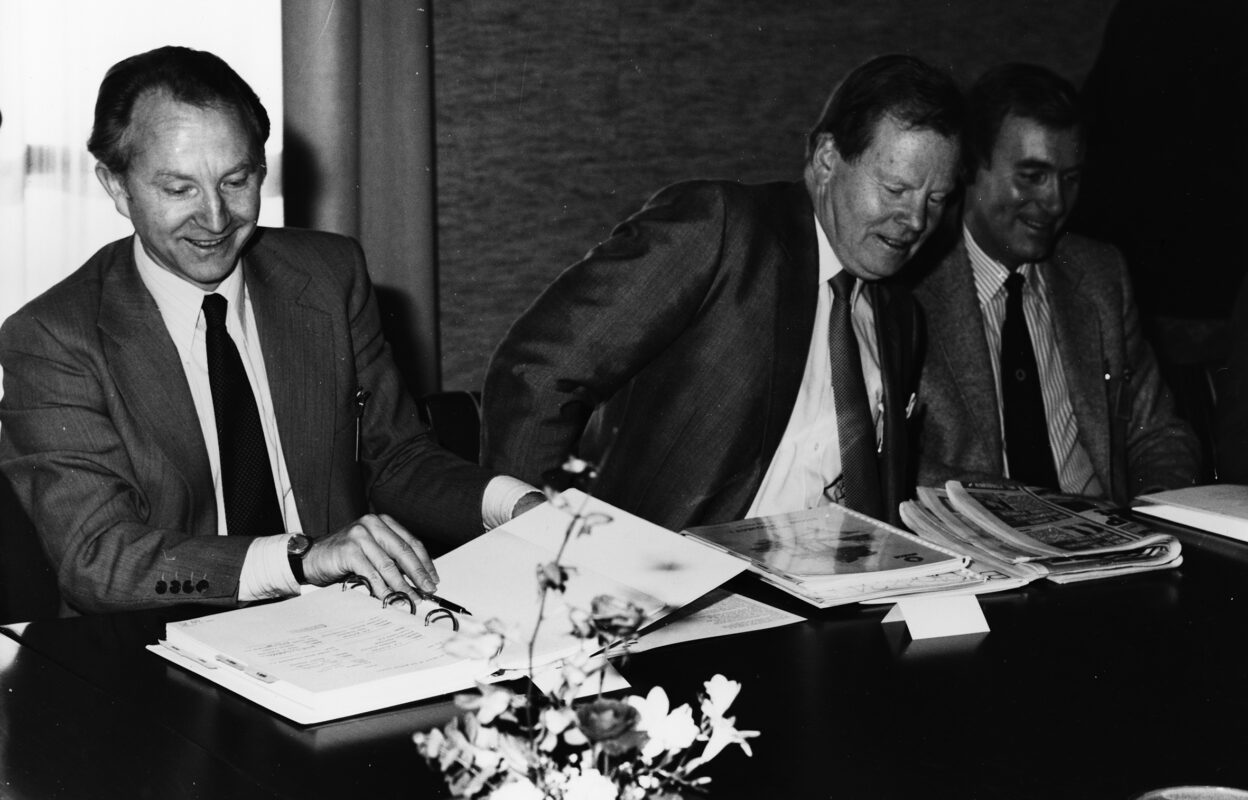
- Signing the charter for the Ross Rig drilling unit between A/S Vestfolk and A/S Rosshavet on 25 June 1974. Photo: unknown/Equinor
Building up these departments progressed rapidly, driven by a desire to recruit qualified people and to train internal resources through both courses and practical experience. The first job for an oil and gas company which wants to identify resources is to assess where to look. That a job for geologists and geophysicists. Their work continues with an assessment of which prospects (potential opportunities to make discoveries) are most suitable for drilling. They then consider two main parameters – the possibility of finding something, and how much oil/gas might be found. Next comes the expensive bit – actually drilling a wildcat (initial exploration well on a prospect) to see whether the G&G assumptions are correct. That usually involves chartering and crewing a mobile drilling unit (rig). The work of carrying out such operations is known collectively as B&B.
Sub-surface organisation
The first generation of sub-surface managers in Statoil – covering both G&G and B&B – were largely recruited from abroad. Norwegians hired were often new graduates without experience from the oil industry. Agreements with such big foreign companies as Shell, Elf, Exxon and Mobil allowed newly recruited petroleum engineers at Statoil to participate in courses and to be seconded offshore in order to learn on the job.
A number of Statoil employees, for example, completed a training programme offered by Exxon in New Orleans, where they started at the bottom of the ladder as roustabouts – unskilled labourers – before advancing rapidly to the post of superintendent (the highest administrative rank on a field). Postings for such trainees were generally to Lafayette, Houston, Ventura and Midland, all key locations in North American oil production.[REMOVE]Fotnote:Status, vol 6, no 11, 12 & 18.
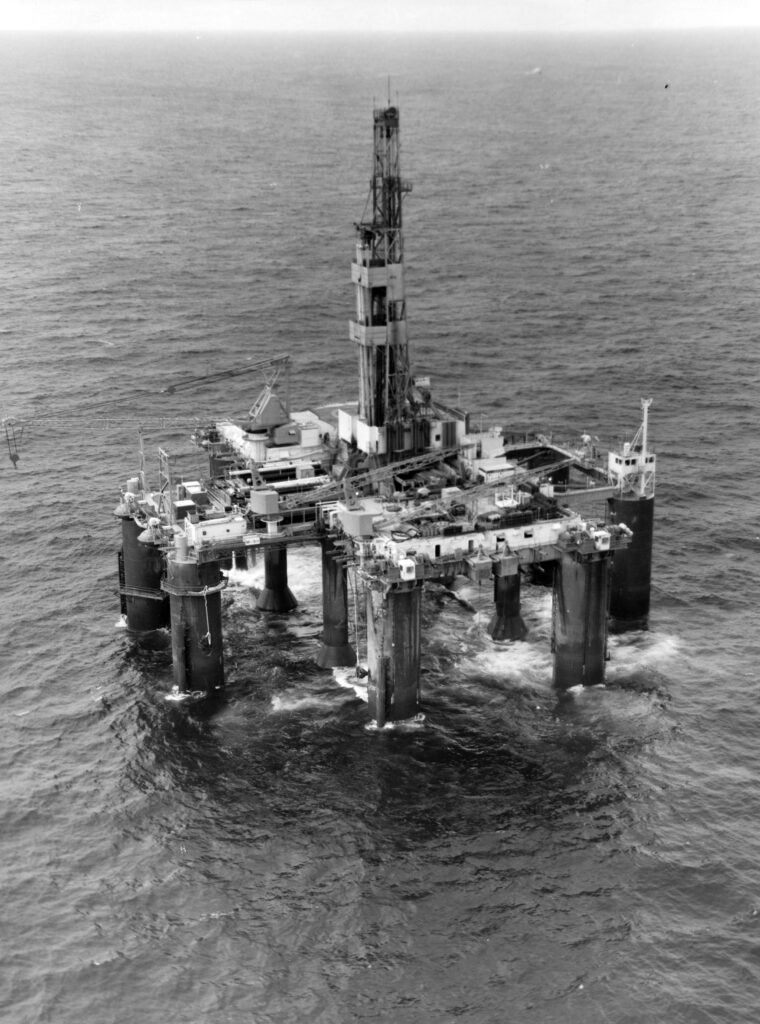
Norskald on the Statfjord field in 1975. Photo: Equinor
An exploration department was established fairly quickly in Statoil. This drew up guidance on where and how oil and gas would be sought as the company acquired a number of licence interests both as operator and partner. With operatorships in exploration licences, a number of prospect identified and a long-term charter for Ross Rig, the need also arose for an operational and competent organisation to conduct exploration drilling. This is potentially a highly risky business unless done properly and with the right equipment.
Statoil was operator for no less than 25 exploration wells between 1975 and 1979, drilled by six different rigs which operated simultaneously for periods of varying length. Ross Rig drilled 14, Norskald and Deepsea Saga three apiece, Dyvi Beta two, and Dyvi Gamma, Borgny Dolphin and Treasure Seeker one each. This called for a highly competent and adequately dimensioned organisation, which had to be built up in a short time and more or less from scratch. That was achieved in part by recruiting people from other parts of the world as well as through technical assistance from other companies with more experience.
Veterans with personality
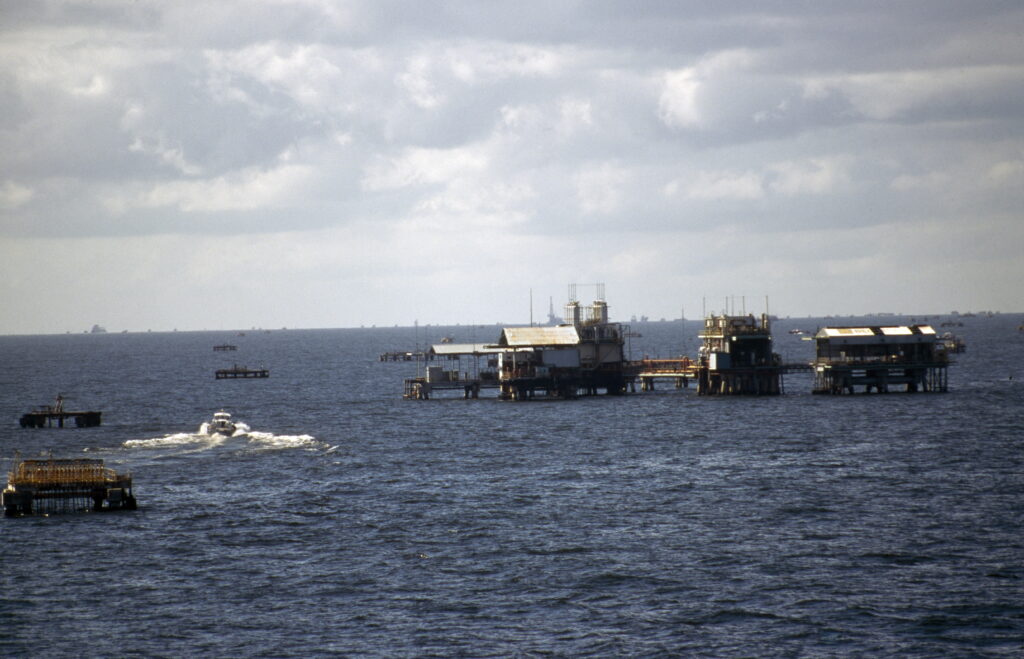
Hundreds of platforms lie in Lake Maracaibo, an old, but still important oil region in western Venezuela. Photo: Leif Berge/Equinor
The company’s first head of drilling and production was American Eugene Muhlenberger, who quit in 1975 to work in the Middle East. He was replaced by Mexican-American Jose Antonio Carlos Kauffmann de la Madrid (known as Joe), who could be said to have been a true oil baby. When he was an infant in 1930, an unsuspecting nanny had placed him on a red-hot oil pipeline which burnt his thigh. Later, Kauffmann experienced several oil incidents and was literally fire-branded by a blowout in Venezuela’s Lake Maracaibo, which left him hospitalised for a long time. Experience from such locations as Venezuela, Bolivia, Ecuador, Ethiopia, Cameroon, Texas and Iran meant the 45-year-old was well qualified to build up and head the operational part of Statoil’s drilling organisation.
The first phase involved doing the work with Esso as the technical operator and service provider, and then assistant, until Statoil was able to stand on its own feet.[REMOVE]Fotnote:A-Magasinet, 13 March 1976.
Over time, the first generation of foreign sub-surface managers was complemented with recruits from Statoil’s own ranks. Kauffmann undoubtedly contributed in many ways to this process, not least because – by his own account – he preferred technical work and was keen to delegate administrative assignments: “I’ve worked actively for three years to delegate authority, precisely in order to avoid unnecessary administrative centralisation,” he told Statoil’s house journal.[REMOVE]Fotnote:Status, vol 6, no 11/12.
By 1980, Kauffmann – then head of exploration and production – was the only foreigner left in the executive management team.[REMOVE]Fotnote:Annual report, 1979, Statoil.
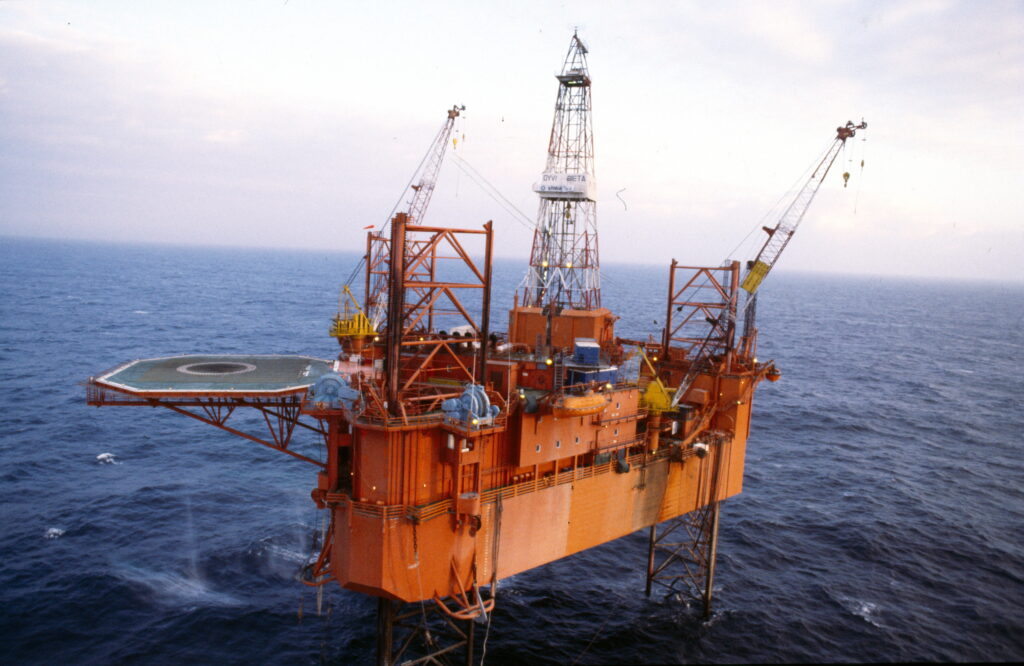
Dyvi Beta in 1978. Photo: Leif Berge/Equinor
Technical assistance offshore consisted largely of using hired consultants as drilling supervisors. These often had significantly more practical experience and know-how than formal education. Newly qualified and enthusiastic Norwegians who wanted to share their theoretical expertise could be met with a cold shoulder and a biting comment – but also with a twinkle in the eye. One example was provided by Jack Pillow, the hired supervisor on Dyvi Beta. An attempt to explain the d-exponent, used in calculating sub-surface pore pressure, was met with: “I don’t believe in the fucking d-exponent”.[REMOVE]Fotnote: Roald Riise in conversation with Björn Lindberg, 20 May 2021.
Pillow was described as a “loud, hard-living … Bourbon-drinking, steak-eating cigar-smoking, tobacco-chewing, rough and tough Texan”. New Norwegian recruits undoubtedly experienced the change from classroom to offshore as a big step in every respect.[REMOVE]Fotnote: Evans, Jack, 2016, Diamonds for rice, Matador.
Nevertheless, a good mix of theoretical analysis, experience and “listening to the well” was undoubtedly needed to complete the job – although this was not always without drama. Today’s veterans, who were then young and newly graduated, recall a fantastic time where they participated in an important phase of Statoil’s early history and rapidly gained great authority.
Combining theoretical background, drive and responsibility with practical experience and know-how is seen as an important factor in creating Statoil’s “DNA”. And these young graduates went on in many cases to become key personnel in both specialist jobs and as offshore installation managers, operations managers, vice presidents and so forth.
With the appointment of Anders Opedal as Equinor’s CEO in 2020, the group also acquired its first chief executive with a technical background – he was educated as a petroleum engineer.
From 1975 to 1979 Statoil was operator for 25 exploration wells: Ross Rig – 14 wells, Dyvi Gamma -1, Borgny Dolphin -1, Treasure Seeker -1, Dyvi Beta -2, Norskald -3, Deepsea Saga -3
Both similarities and differences between Norway and Brazil as oil nations have emerged from the partnership which has developed between them. Neither country initially had petroleum production expertise, but both created state oil companies and their own specialist milieus. These joined forces early over subsea technology, helping to make the Latin American country one of Equinor’s core areas today.
By Kristin Øye Gjerde, Norwegian Petroleum Museum
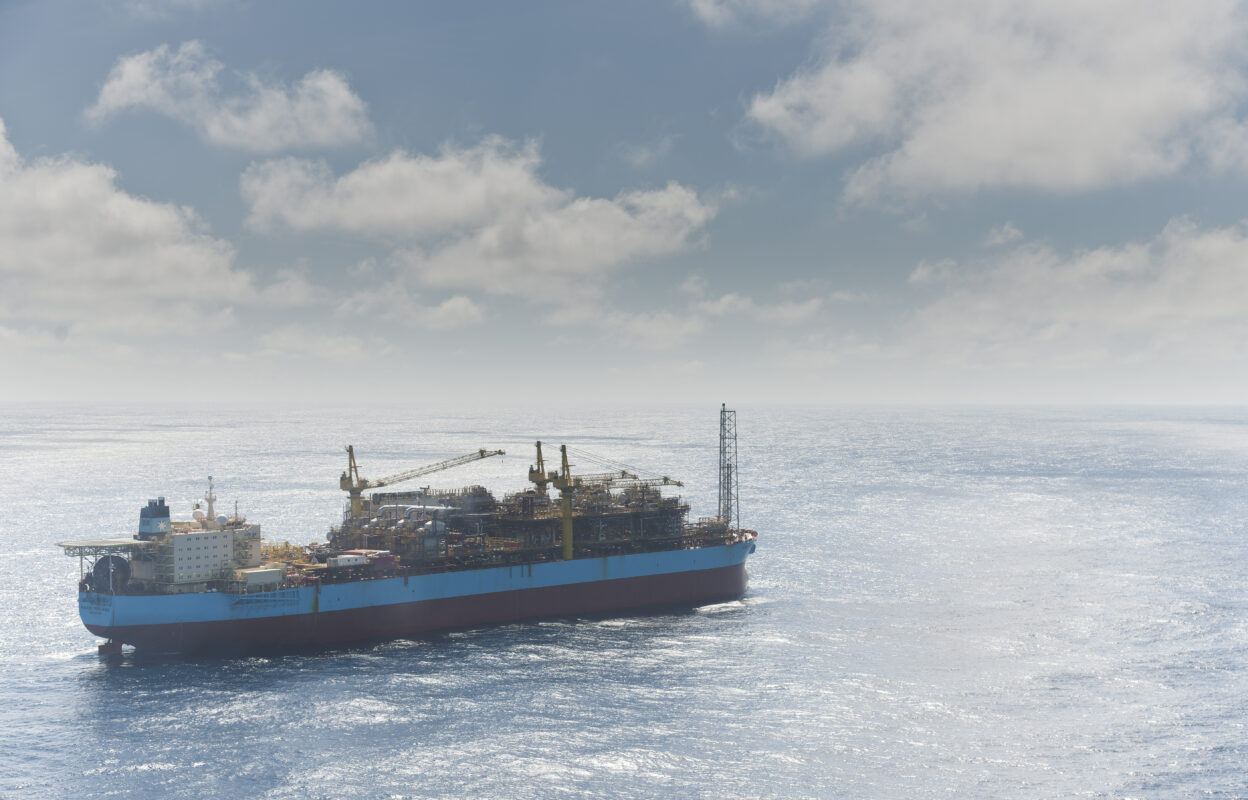
- The Peregrino field, Brazil. Photo: Equinor
Brazil and Norway have had wholly state-owned oil companies –Petrobras and Statoil respectively. The first of these dates back to 1953, when it produced on land. Unlike its Norwegian counterpart, which was founded in 1972, Petrobras had a monopoly of all domestic petroleum output. Although that ended in 1997, it retains a leading position in its home market. The company was part-privatised in 2000 – a year before Statoil.
Interesting offshore discoveries were made in both countries during the 1960s. While Norway is known for its Ekofisk find in 1969, the first oil field on the Brazilian continental shelf was proven the year before. The two nations made big offshore discoveries in deep water over the subsequent decade.
Initial subsea contacts
The Petrobras logo.
Brazil has been a pioneer with production ships and floating platforms tied back to subsea wells, with Petrobras testing a converted tanker for production as early as 1978. A floater solution was more flexible than fixed platforms. These ideas were picked up and further developed by Norway in the 1980s, when Norwegian oil companies also adopted them fully.[REMOVE]Fotnote: Gjerde, Kristin Øye and Nergaard, Arnfinn I, Getting down to it. 50 years of subsea success in Norway, 2019: 172
Along with their suppliers, Norway’s oil companies observed the boldness, inquisitiveness and willingness to pursue new technology displayed by Petrobras with great interest. A good relationship developed between Norwegian and Brazilian subsea specialists, and they learnt from each other.
When Statoil planned to utilise seabed wells on the Tommeliten field and its Gullfaks satellites in the North Sea during the mid-1980s, it hired two Brazilian subsea specialists from Braspetro – the international arm of Petrobras. Vincente de Silva and Mauro de Fauras contributed valuable operating experience to solutions for both fields. Statoil’s management was subsequently keen to continue the Petrobras collaboration, with Martin Bekkeheien – head of exploration and production activities at the time – taking the lead.[REMOVE]Fotnote: Hans Jørgen Lindland, e-mail to Kristin Øye Gjerde, 13 December 2021
Statoil drilling manager Idar Johnsen and Hans Jørgen Lindland, operations manager for Tommeliten, were dispatched to Brazil in 1987 to check the status of and interest for closer collaboration at Petrobras. They were very well received. The Norwegian company could offer collaboration on multiphase flow technology – in other words, transporting a mix of oil, gas and water in a controlled manner through a single pipeline with the use of chemical additives and pressure to prevent problems on the way to the processing plant. Much research underpinned this technology, which was highly profitable for the oil companies using it.[REMOVE]Fotnote: Gjerde and Nergaard, op.ci
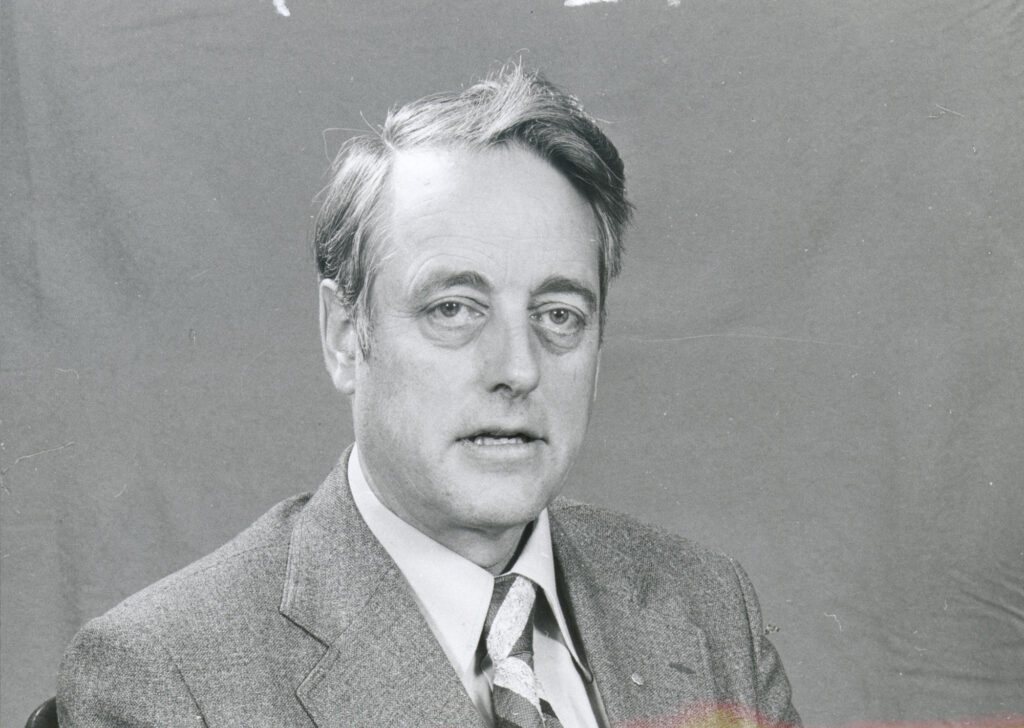
Reidar Due. Photo: Storting
Arrangements were made for an official delegation to visit Brazil a week after Johnsen and Lindland had returned home. The plan was to formalise a collaboration between Norway and Brazil on offshore and subsea technology.[REMOVE]Fotnote: Hans Jørgen Lindland, e-mail to Kristin Øye Gjerde, 13 December 2021
This group was headed by Reidar Due from the Centre Party, who was chair of the standing committee on energy and industry in the Storting (parliament). He managed to offend the host of a dinner hosted by the Brazilian government so greatly that all forms of cooperation were put on ice.[REMOVE]Fotnote: This story has been confirmed by Hans Jørgen Lindland, 13 December 2021 After this incident, a number of years passed with very little contact between Statoil’s subsea technology department and Petrobras.
Diverless methods
Subsea specialists in both Brazil and Norway wanted to ensure that work underwater could be done in a safer way. That including finding alternatives to using divers for making seabed connections.
The Brazilians made efforts to place Xmas trees – valve assemblies installed on wells to control production – under atmospheric pressure in a sealed chamber or habitat on the seabed. Unlike simply installing a tree in the open sea, this ensured that it stood in a dry environment. Instead of an operator having to dive down under pressure in order to open or close the valves, they could be lowered in a bell to the habitat, connect on, enter a dry space and breath normal air while doing the work. Brazil tested such solutions offshore.[REMOVE]Fotnote: Gjerde and Nergaard, op.cit: 301.
In Norway, opportunities for utilising a habitat of this kind were discussed for the Statfjord satellites. But Statoil decided against that approach, and it was never adopted either on the satellites or elsewhere on the Norwegian continental shelf (NCS). Diverless solutions were developed instead to eliminate the use of people completely in conducting subsea operations. Since remotely operated vehicles (ROVs) could carry out much of the work involved, divers were largely phased out on the NCS during the 1990s.[REMOVE]Fotnote: Ibid: 123
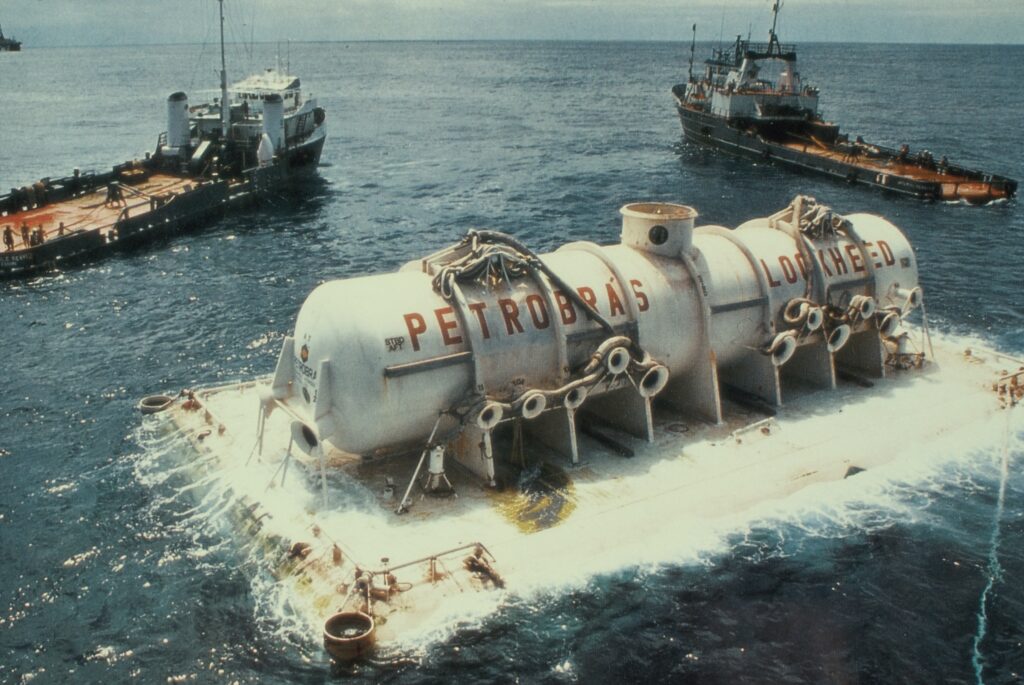
Installing an atmospheric manifold centre on the Garoupa field off Brazil in 1979. Photo: Petrobras/Norwegian Petroleum Museum
Contact re-established and extended
The Society of Petroleum Engineers held its first subsea forum in 1993 at Seefeld in Austria. Both Petrobras and Statoil attended, and were each very advanced in terms of the new projects and underwater technology they could present.
Statoil could point to a world distance record for multiphase flow transport from the Statfjord North satellite. The way this had been accomplished attracted considerable interest from the other participants.[REMOVE]Fotnote: Hans Jørgen Lindland, e-mail to Kristin Øye Gjerde, 13 December 2021. For its part, Petrobras could report records for deepwater operations. The Brazilians had made discoveries in water depths close to 2 000 metres.[REMOVE]Fotnote: Gjerde and Nergaard, op.cit: 301. Petrobras set a record in 1997 for the deepest subsea well to date of 1 709 metres on the Marlim field, and followed up in 1999 with a well in 1 855 metres on the Roncador field.
At this meeting, Lindland and the other members of Statoil’s subsea technology department got to know Orland Ribeiro at Petrobras. Good professional contacts subsequently developed between the underwater specialists at the two companies. A technology collaboration, also involving BP, was agreed a little later. This yielded a number of important results:
Petrobras supplied Statoil with operational data on production regularity from subsea fields, along with the design basis for the Brazilian company’s latest floating deepwater platform.
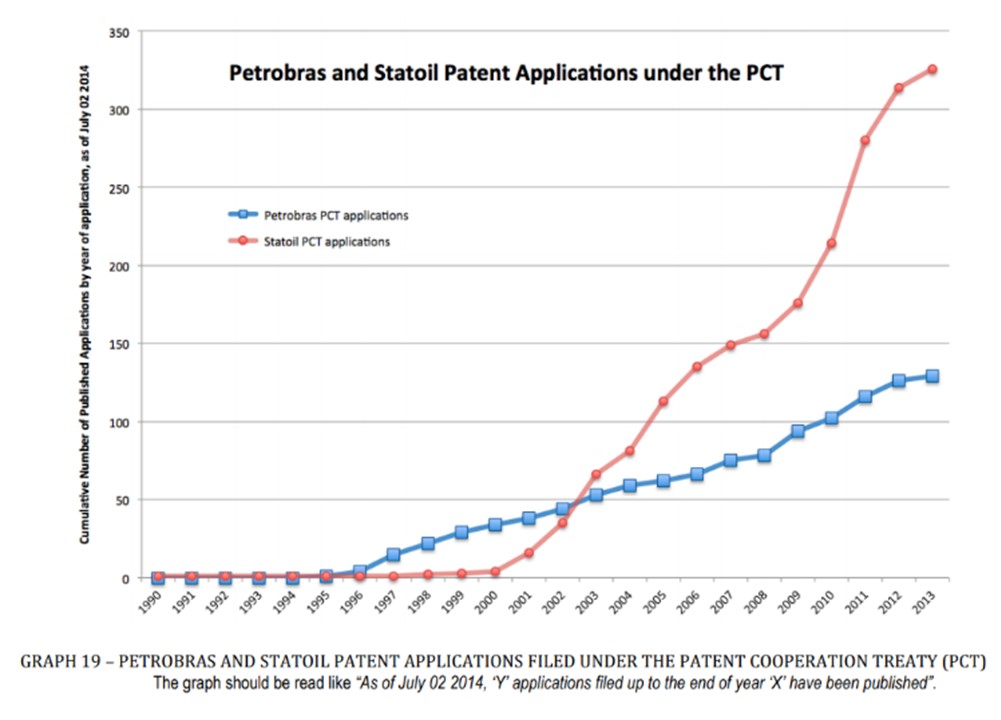
In return, Petrobras secured detailed information on drilling horizontal wells and results from Statoil’s research on multiphase flow.[REMOVE]Fotnote: Hans Jørgen Lindland, e-mail to Kristin Øye Gjerde, 13 December 2021 The Norwegian group was very innovative in terms of new patents, which made it an attractive partner for the Brazilians.[REMOVE]Fotnote: Bichara, Miguel, Technological innovation in Brazil and in Petrobras – the need of a systems approach to a complex problem
Patent applications by Petrobras and Statoil under the PCT.
As early as the mid-1990s, Statoil was recognised as a world leader in the design and operation of fields at depths down to 500 metres. The collaboration with Petrobras also gave the Norwegian group access to expertise on deep and eventually ultra-deep waters – in other words, 3 000 metres and beyond.[REMOVE]Fotnote: Hans Jørgen Lindland, e-mail to Kristin Øye Gjerde, 13 December 2021 This strategic partnership opened the way to securing a number of deepwater licences off Brazil and other countries.
Suppliers actively involved
Statoil’s establishment of such a close technology collaboration with Petrobras was also highly significant for Norway’s supplier industry in the petroleum sector and its market access in Brazil.
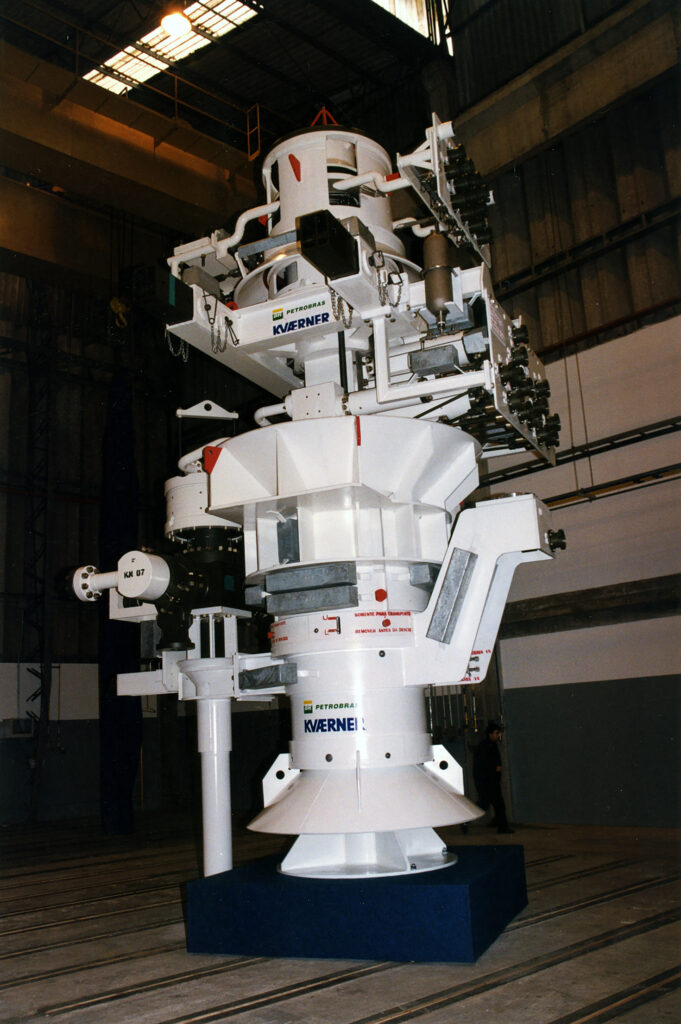
An example was the subsea connections with control systems developed by Kværner. Their installation could be assisted by ROVs, which helped to make it possible to utilise underwater technology in depths beyond the reach of diver assistance. That in turn made oil production feasible in deeper waters. Kværner established a presence in Brazil in 1996, followed by Kongsberg Offshore Subsea, Aker Solutions and others.
Kværner arrived early on the Brazilian scene, delivering Xmas trees and control systems to Petrobras as far back as the 1990s. Source: Kjell Øyvind Pedersen
These companies received good support from collaboration bodies established by the Norwegian authorities.[REMOVE]Fotnote: Gjerde and Nergaard, op.cit: 302. The Norwegian-Brazilian Chamber of Commerce, for example, was established in 1995 to promote trade, good relations and joint financial and professional interests between the two countries.
Rio de Janeiro was the centre for Norway’s commitment in Brazil, with Intsok[REMOVE]Fotnote: Intsok (short for International Continental Shelf) was created in 1997 as a Norwegian non-profit foundation by the Ministries of Petroleum and Energy, Industry and Trade, and Foreign Affairs as well as the Confederation of Norwegian Enterprise (NHO), the Norwegian Shipowners Association and the Norwegian Oil Industry Association (OLF), plus oil companies Statoil, Saga Petroleum and Norsk Hydro, the embassy and the consulate general holding seminars where Norwegian suppliers presented themselves. The government entered into trade agreements and the establishment of Norwegian subsidiaries was facilitated. The Innovation Norway trade promotion body not least established Innovation House in Rio in 2007.
The most recent addition to this set of organisations is Norwegian Energy Partners (Norwep), created in 2017 by merging Intsok with Norwegian Renewable Energy Partners (Intpow). The latter represented a relatively recent commitment in the renewables sector.[REMOVE]Fotnote: Gjerde and Nergaard, op.cit: 302-303
Collaboration of this kind between foreign and Norwegian oil companies and Norway’s supplier industry, with good backing from the government, helped to elevate a number of Norwegian companies into world leaders for subsea technology during the 2000s. The exchange of information and expertise with Brazil has been a crucial precondition for/driving force in this development.
Although the Tommeliten project reached its goals, it was not without problems along the way. Not all technical challenges were equally serious. Something good also came out of the problems, with solutions that benefited later projects.
By Kristin Øye Gjerde, Norwegian Petroleum Museum
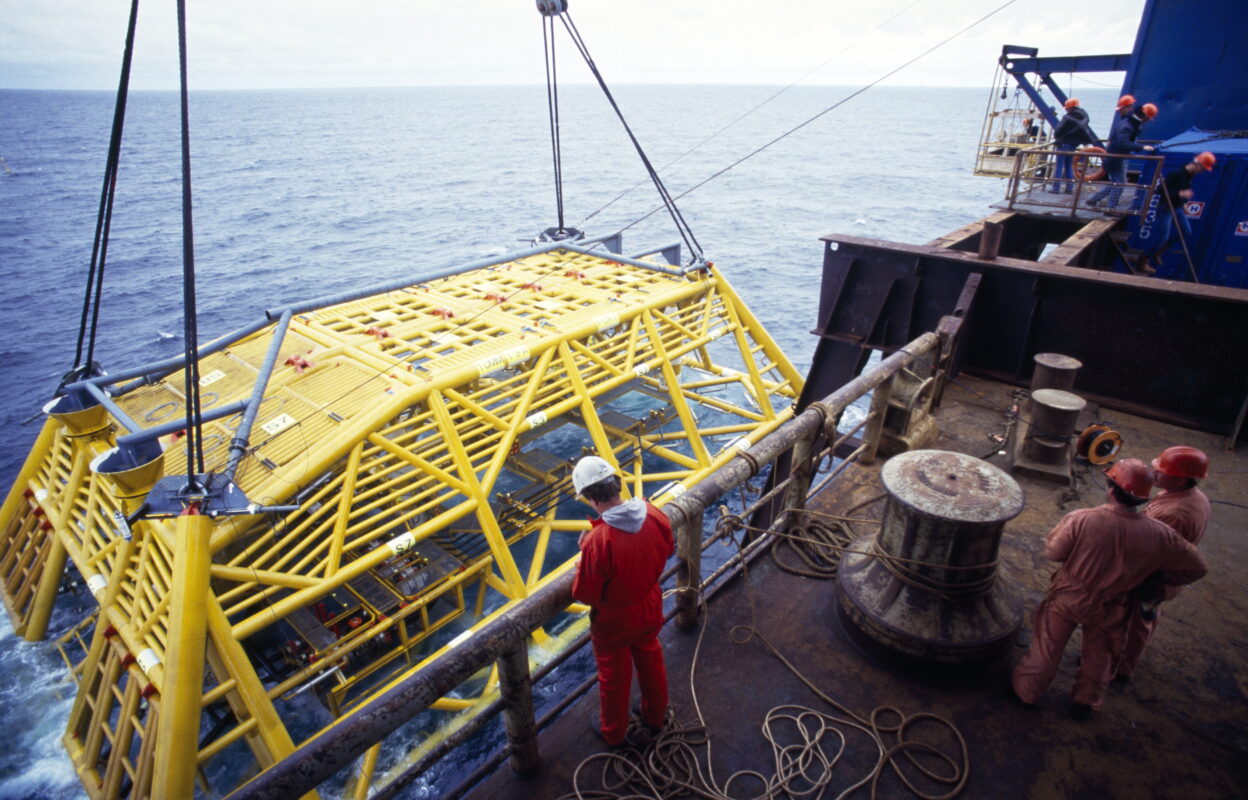
- The Tommeliten template being installed on 20 September 1987. Photo: Leif Berge/Equinor
Since the water depth on Tommeliten is about 80 metres, divers did the subsea work. A template was placed on Gamma to speed up the development. The protective structure and manifold were manufactured at the Rosenberg yard in Stavanger while drilling was under way.
Shoelace creates problems
The decision was taken to send Per Moi down in a Mantis manned submersible. As soon as he reached the seabed, however, the control room heard him yelling “get me up, get me up”. Three subsea monitoring systems were available during the installation of Tommeliten, but both the remotely operated vehicles (ROVs) were out of operation during commissioning.
This sounded strange to the American supervisor, because the vehicle had only just reached bottom. But Moi had got his shoelace stuck in the Mantis hatch, which was enough to allow water intrusion.
Loose screws and bending pipes
A number of other accidents occurred. The screws used to attach the handles to the valves on the operation panel for each well eroded. Normal unbrako screws had been used, but their sockets had vanished. Divers were used to replace them all with the right metal and external slots.
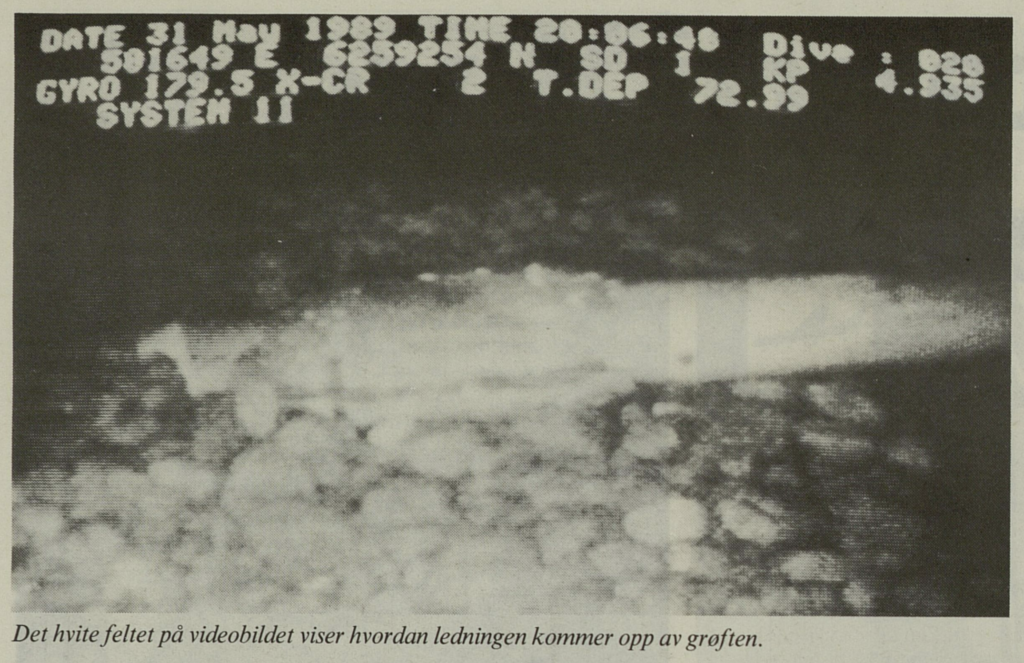
Image from a subsea video showing how the pipeline emerges from the trench. Source: Status, no 10, 1989
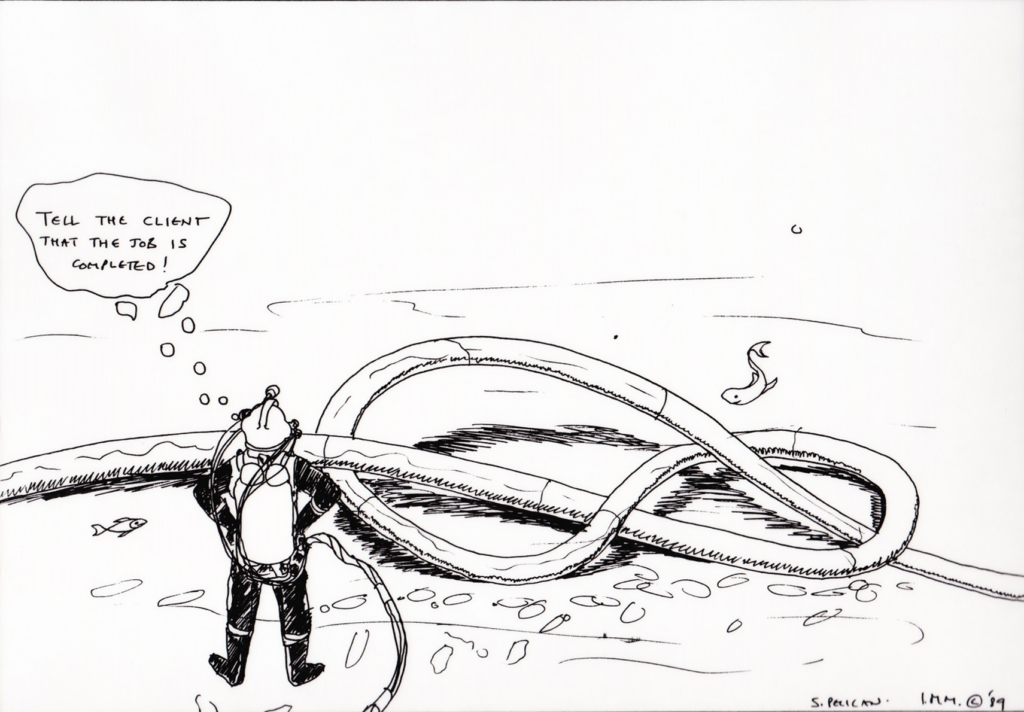
When the template was inspected before production began, a number of bolts turned out to be missing from the flange holes and were lying on the seabed. Two diving support ships, including Seaway Pelican, spent four weeks replacing all the bolts in the pipe flanges on the template, on the pipeline and beneath Edda. That delayed start-up.
Statoil laid three underwater pipelines to tie Tommeliten back to the Edda platform – two production lines and one for testing. Output from the field then entered the Ekofisk system for onward transport to Emden.
After allowing them to warm up, the pipelines were inspected. Specialists had conducted a long discussion over whether the trenched pipes should be covered with gravel or left for nature to do that job. The heated pipelines were meant to curve between the trench sides rather than escape from it. Those who favoured covering were dubious about this, since friction would differ from place to place.
Inspection showed that the pipelines had escaped from the trench in several places. The worst case of this “upheaval buckling” was about 30 metres long and 5.5 metres high. It looked as if the pipelines had come to life. Measures were needed to stabilise them.
The decision was taken to attach cement supports cast in situ. Specially manufactured plastic “tents” with attached straps were made fast to the pipelines by divers and reached down to the seabed. Each chute had several pockets which were filled with cement through a hose from a ship, starting at the bottom and moving gradually up as each pocket made contact with the pipe.Gravel was subsequently dumped at six upheaval points in an optimum manner which dispersed it both under and over the pipelines. Dumping alone was used for the smallest cases. It took a boatload totalling 8000 cubic metres of gravel to ensure that the transport lines were securely pinned down and could be overtrawled.[REMOVE]Fotnote: This article is mostly based on an interview by Hans Birger Hansen, Olav Bruset and Jarle Aksnes conducted by Kristin Øye Gjerde, 01.12.2015.
The Storting (parliament) had resolved to establish a state oil company. This now had to be built up. So who was to be responsible for managing the state’s commercial interests in the oil industry? And who were these people who would shape the company?
By Trude Meland, Norwegian Petroleum Museum
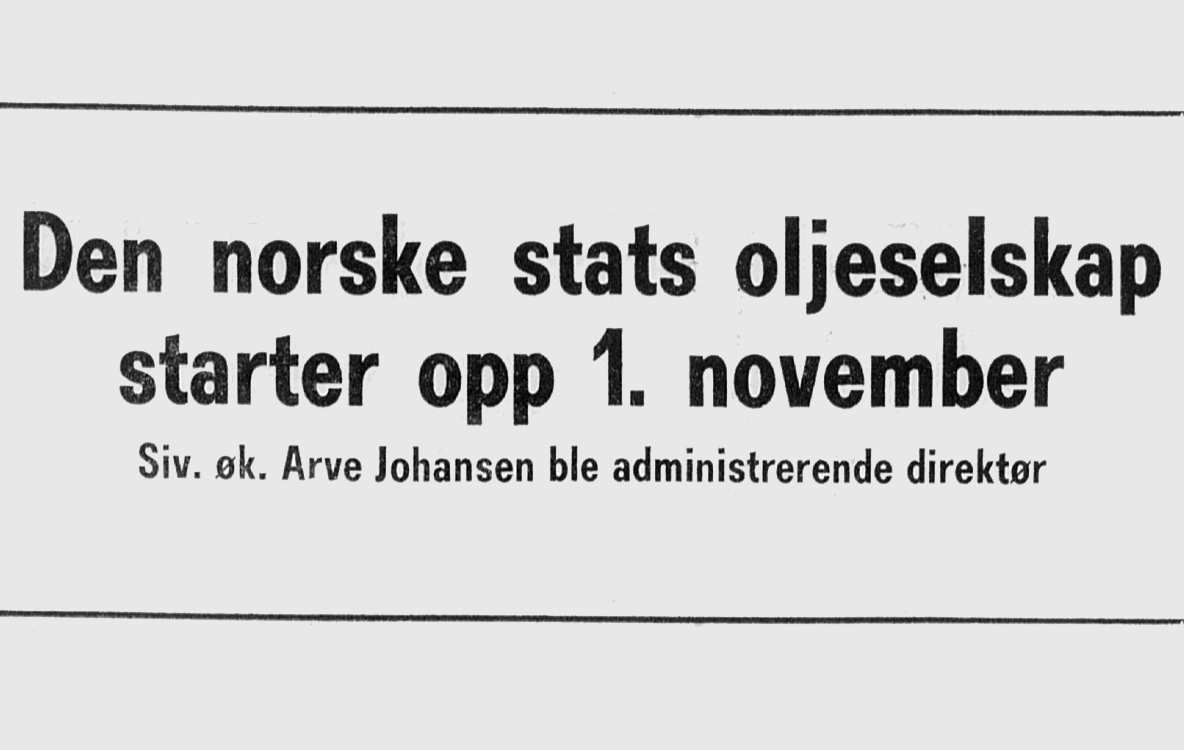
- “Det norske stats oljeselskap will commence at 1 November. Arve Johansen (sic) became CEO”. Facsimile from Moss Avis 26 October 1972
The first step was to put a board of directors in place. It had been decided that the company’s general meeting, comprising the responsible government minister, would appoint its members. In June 1972, that person was Finn Lied from the Labour Party.
He was accordingly present as promoter at the statutory general meeting of the company on 18 September 1972, along with his state secretary Arve Johnsen (later to become CEO). Also attending from the Ministry of Industry were secretary general O C Müller, director general Knut Dæhli, division heads Harald A Sommernes and Karl-E Manshaus from the ministry’s oil office, and consultant Nils Heilemann. Furthermore, representatives from the Auditor General’s office were present along with supreme court attorney Jens Christian Hauge as chair-designate of the board.[REMOVE]Fotnote: Minutes of the statutory general meeting of Den norske stats oljeselskap a.s. SAST/A-101656/0001/A/Aa/Aaa/L0001. Accessed at https://www.digitalarkivet.no/oe10511205100002.
Resistance leader and lawyer Jens Christian Hauge had a significant political career after the Second World War. He served as secretary to prime minister Gerhardsen in 1945, minister of defence in 1945–52 and minister of justice from January to November 1955. He then ran a law practice in Oslo. Hauge was a director of several state-owned companies and chair of Statoil in 1972-74. Photo: Leif Ørnelund/Oslo Museum
Together with Johnsen, Lied had clarified at an early stage who he wanted as chair of the company. The government approved his proposal to give the job to Hauge, his close friend and ally.[REMOVE]Fotnote: Njølstad, O, Jens Chr. Hauge: Fullt og helt, Aschehoug, 2008, Oslo: 630. Both had been active in the resistance to the German occupiers during the Second World War and were members of Labour’s inner circle. During the 1960s, they had helped to frame the party’s programme.[REMOVE]Fotnote: Wicken, Olav, “Finn Lied”, Norsk biografisk leksikon, snl.no, 12 October 2014. Accessed 26 June 2020 from https://nbl.snl.no/Finn_Lied.
Hauge was a lawyer and politician. Following his wartime role as a leader of Milorg, the main Norwegian resistance organisation, he became defence minister in 1945 at the age of 30. After stepping down as defence minister in 1952, a new post at the Labour Party offices gave him an active role in shaping Norwegian industry policy.
He was responsible for establishing the Norwegian Defence Research Establishment in 1946, where Lied became head of research in 1957. The latter was moreover to be his successor as Statoil chair in 1974.
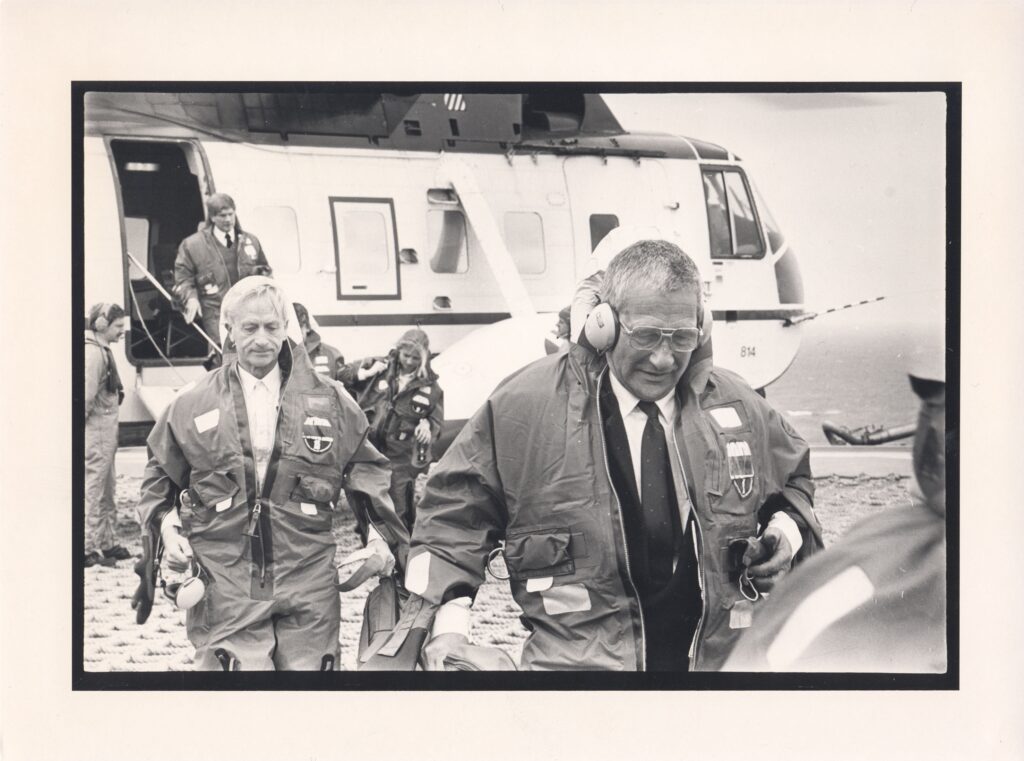
Petroleum minister Vidkunn Hveding (left) was one of the prominent guests flown out to Valhall for the official inauguration of the field on 26 May 1983. Photo: unknown/Norwegian Petroleum Museum
Vidkunn Hveding, an engineer and Conservative politician, was appointed deputy chair of the new company. His experience from various parts of the energy supply sector and the management expertise acquired in the same industry made him a professional expert. He also brought with him broad international experience through advisory and consultancy roles in such countries as Ethiopia, Brazil and Kuwait as well as a number of offices in industry and shipping.
The general meeting furthermore elected Aksel Fossen, a Storting representative from Labour who had served in the Norwegian merchant navy through six wartime years and was one of Norway’s most respected industry politicians. He was known as the “power socialist” from Odda near Stavanger.[REMOVE]Fotnote: Commemorative speech on former representative Aksel Fossen, Storting session of Thursday 22 October 2009 at 10.00.
In addition came the Conservative Party’s Per Mauritz Hanssen from Kaarbøs Mekaniske Verksted in Harstad. Finally, senior lecturer Aage Solbakken in the department for industrial chemistry at the Norwegian Institute of Technology (NTH) was appointed an alternate director.
The composition of the board gave the impression of a political compromise between the two biggest parties of the day – two from Labour and two from the Conservatives. The common denominator of these directors was that their expertise from different fields, industries and political persuasions was relevant to Statoil’s business.
Although it was due to sit until the annual general meeting in 1975, the whole board actually stepped down abruptly a year early.
Personnel required
“National management and control” was the overall goal of Norwegian oil policy from the early 1970s. Where Statoil was concerned, this translated into technological control.
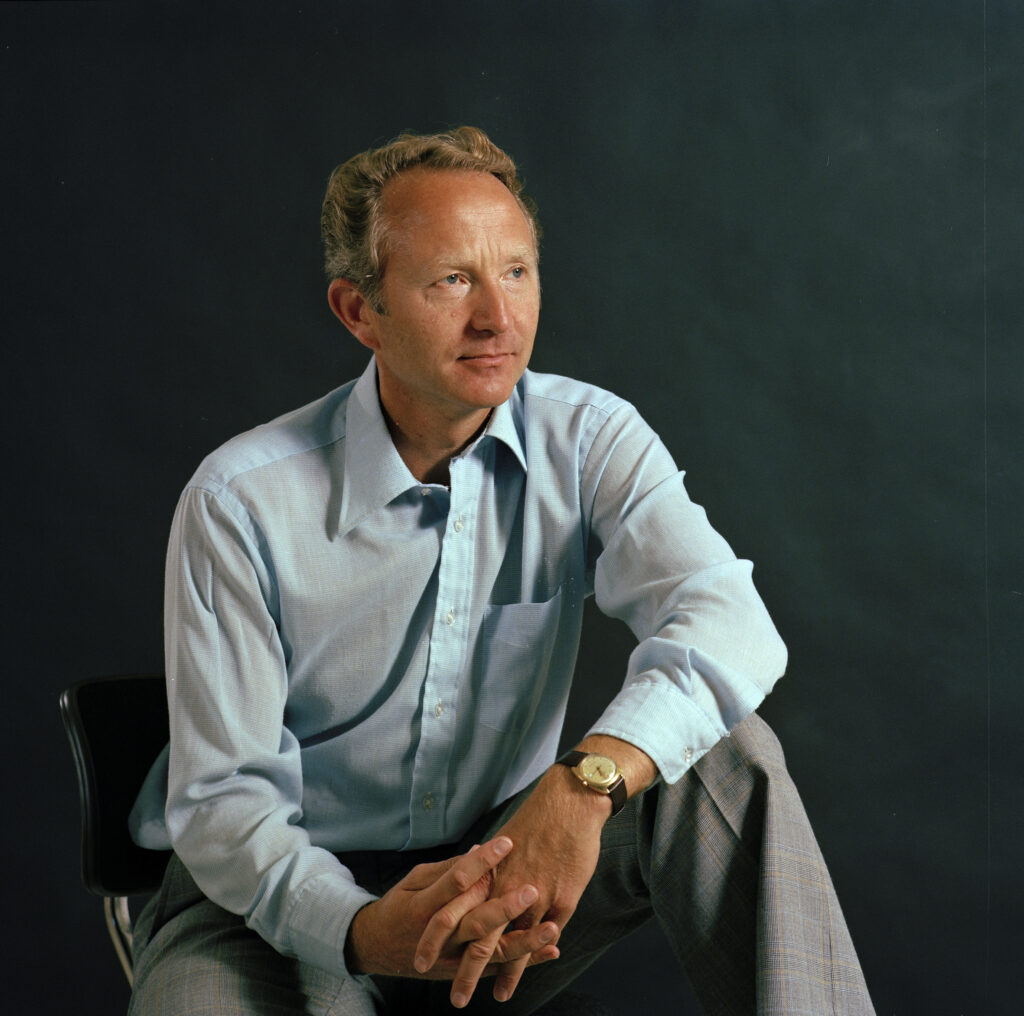
Arve Johnsen. Photo: Equinor
One way of achieving that was the rapid build-up of an organisation which mastered all the technical challenges faced when operating in the North Sea. That called in turn for recruiting the best team in terms of technological expertise.[REMOVE]Fotnote: Ryggvik, Helge, Til siste dråpe, 2009, Aschehoug, Oslo: 96.
As early as the day after the statutory general meeting of Den norske stats oljeselskap a.s, Hauge called the company’s first board meeting. That was held on 5 October 1972 at Drammensveien 40 in Oslo, and its most urgent priority was to put a management team in place.
The first step was to appoint a vigorous and visionary chief executive. This job was advertised, but Hauge quickly saw that the applicants were “pretty much of a disappointment”. In consultation with Lied and Müller, it was agreed to look around for other candidates.
Several were assessed, but the choice fell on Johnsen, who was leaving his post as state secretary at the industry ministry owing to a change of government.[REMOVE]Fotnote: Njølstad, O, op.cit: 631. With degrees in business economics and law, he had experience from the oil industry as well as the innermost circles of petroleum policy-making. According to the board minutes, he was “a person all the directors knew as an unusually able man and an outstanding leadership type”.[REMOVE]Fotnote: Minutes, board meeting, Den norske stats oljeselskap a.s, 5 October 1972. SAST, Pa 1339 – Statoil ASA, A/Ab/Aba/L0001: Styremøteprotokoller, 05.10.1972-14.12.1978, 1972-1978: 9 Hauge argued that no further candidates needed to be called in.
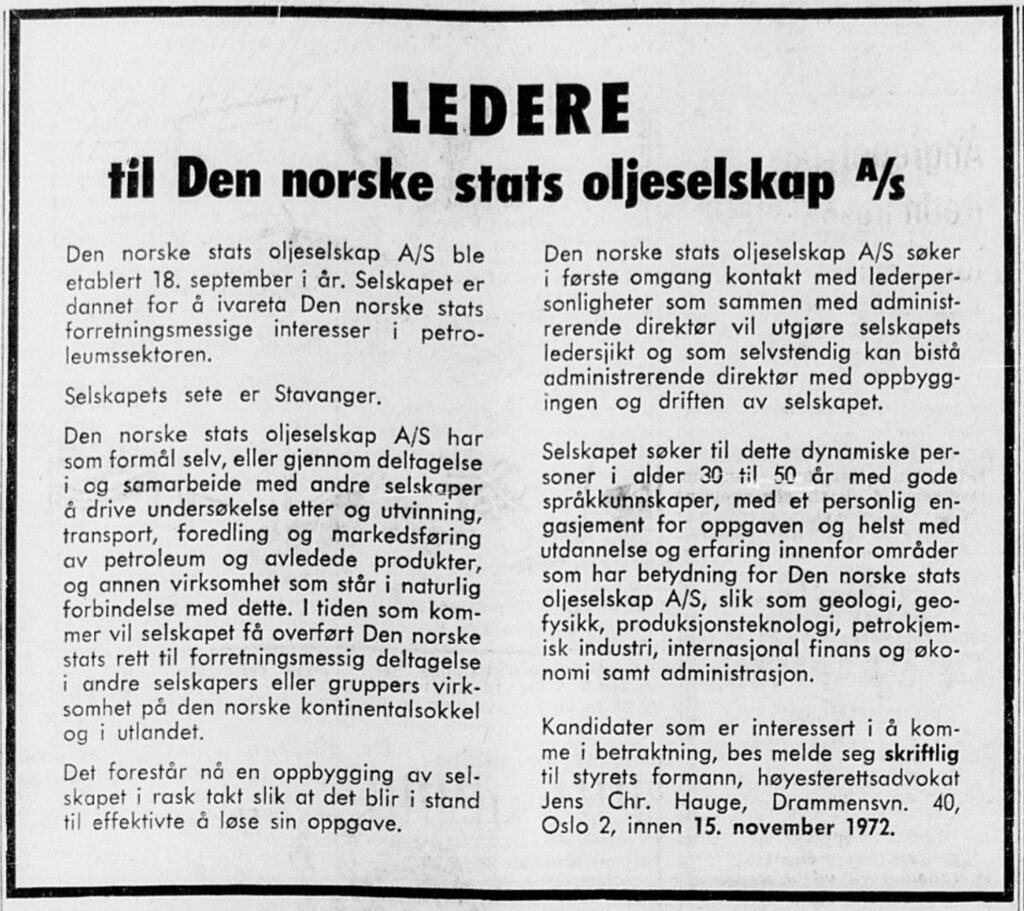
At the same meeting, the chair was given the board’s blessing to place job advertisements in a number of Norwegian newspapers and selected foreign oil journals.[REMOVE]Fotnote: Minutes, board meeting, Den norske stats oljeselskap a.s, 5 October 1972. Accessed at http://urn.digitalarkivet.no/URN:NBN:no-a1450-db60034661000003.jpg. These sought applications from “dynamic people” aged 30-50 with qualifications and practical experience in such areas as geology, geophysics, petroleum technology, petrochemical industry, international finance and economics, and administration. Putting a management team in place was the first priority.
Job advertisement. Facsimile from Dagbladet, Wednesday 18 October 1972
Johnsen was appointed CEO in December 1972, and the first interviews could then be held with relevant applicants for other posts. No job descriptions were drawn up. Johnsen wanted decisive colleague with independent views and operational experience. Those looking for formal positions or titles were rejected.[REMOVE]Fotnote: Johnsen, A. (1988). Utfordringen: Statoil-år. Oslo: Gyldendal.s.26 “I was determined not to appoint people with such ideas,” Johnsen wrote in his first memoir.[REMOVE]Fotnote: Ibid: 26.
The company had few problems recruiting competent Norwegians for financial and administrative roles or general engineering posts. But petroleum expertise was less easy to find.
Nigeria was Africa’s largest oil producer and one of the world’s biggest exporters of this commodity, with Angola close on its heels. These two big west-coast petroleum nations were designated as the second big priority area for the Statoil-BP alliance. But war, corruption, intricate licensing systems and domestic opposition did what they could to undermine the commitment.
By Trude Meland, Norwegian Petroleum Museum
- One of Nigeria’s many gas metering stations. Photo: Bjørn Rasen
When their partnership began in 1991, the two companies became involved in the Democratic republic of the Congo as well as Angola and Nigeria, but withdrew from the first of these areas in the same year. A venture in Equatorial Guinea, operated from Nigeria, was also short-lived.[REMOVE]Fotnote: Ryggvik, Helge. (2009). Til siste dråpe. Oslo: Aschehoug: 238.
Through various engagements, BP was already established in all three west African states when the alliance with Statoil began. However, the military regime in Nigeria had taken over the British oil major’s operations in the country during 1979 as part of a massive nationalisation wave. During the 1990s, the Nigerian mood shifted from nationalisation to internationalisation, and a more open attitude was adopted towards foreign companies. That change in climate created an opening for BP to return to the giant of Africa, this time accompanied by Statoil.
Repressive regimes, executions and environmental disasters
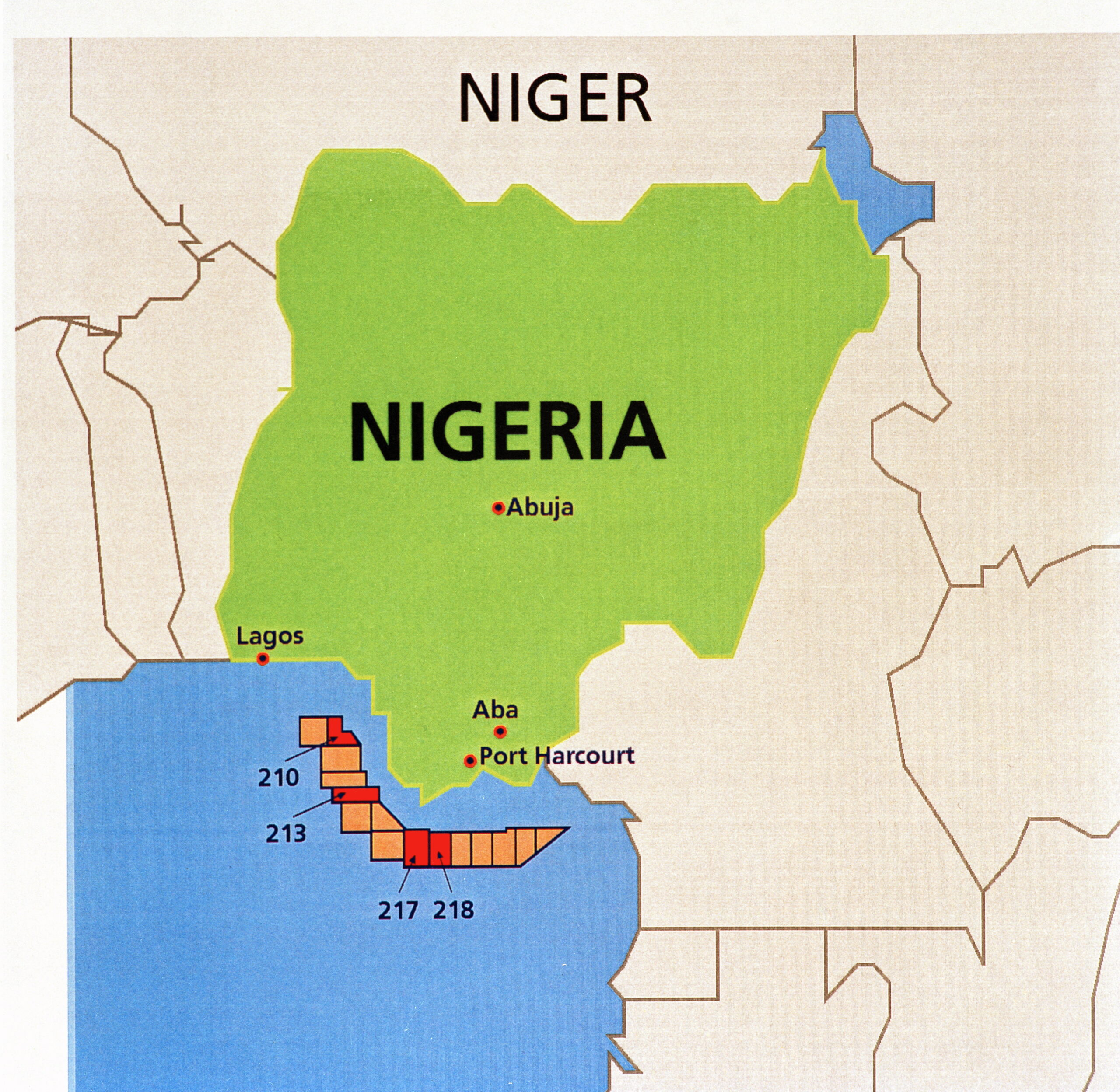
Map of Nigeria. Source: Equinor
Statoil was to be responsible for the alliance’s joint operations in Nigeria, making this country its baptism of fire as an international oil company. A significant proportion of the staff intended to support these activities were located in Stavanger. But a number of BP personnel were included in this Norway-based Nigeria management from the start.[REMOVE]Fotnote: Ryggvik, Helge. (2009). Til siste dråpe. Oslo: Aschehoug: 231
Operational responsibility for the west African commitment was allocated to BP and its London head office. Only a minimal share of alliance personnel were permanently stationed in Africa. While 23 people, all BP employees, worked with Angola from London, only one was based full-time in Luanda. Thirty staff handled Nigeria in Stavanger, with a single person in the African country itself.
Nigeria remained an important priority area until the mid-1990s, and activity there expanded. The alliance succeeded with its strategy and established itself as a leading player in the deepwater areas off the Nigerian coast. That position was completely overturned in 1995, when political conditions in Nigeria deteriorated dramatically.
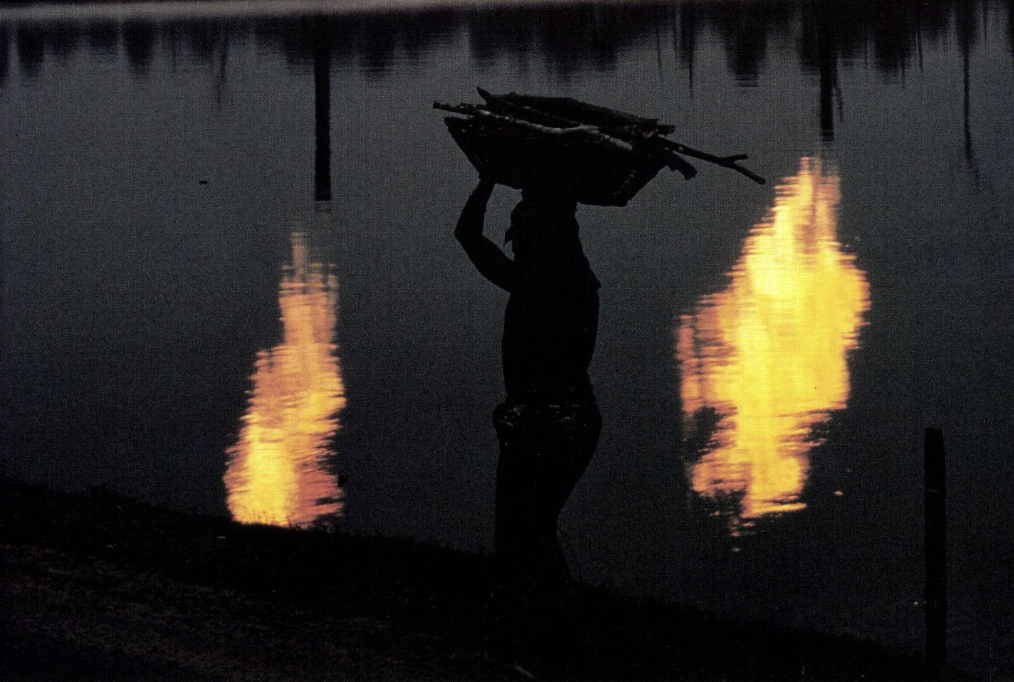
Ever greater dissatisfaction had spread among many of the people living around the Niger delta. They received little or no share of the big revenues generated by the oil resources in their region. In addition, a massive environmental disaster began to manifest itself in the delta area.
A coup in 1993 had introduced one of the most brutal and corrupt regimes in Nigeria’s history. The repressive government banned all political activity and opponents were jailed. That in turn unleashed extensive protests across much of the country. These increased from 1995 after the military regime executed nine activists from the oil-rich delta – including author and environmental activist Ken Saro-Wiwa.
These executions helped to create pressure from international public opinion. Foreign companies faced demands to pull out of Nigeria. The worst-affected was Shell, which had been producing oil for many years from a controversial part of the Nigeria delta. But organised campaigns were also conducted against Statoil in Norway. The company responded that it did not want to become involved in political processes and chose to accept the political burden of remaining in Nigeria. It argued that the human rights position would not improve if it and BP withdrew.
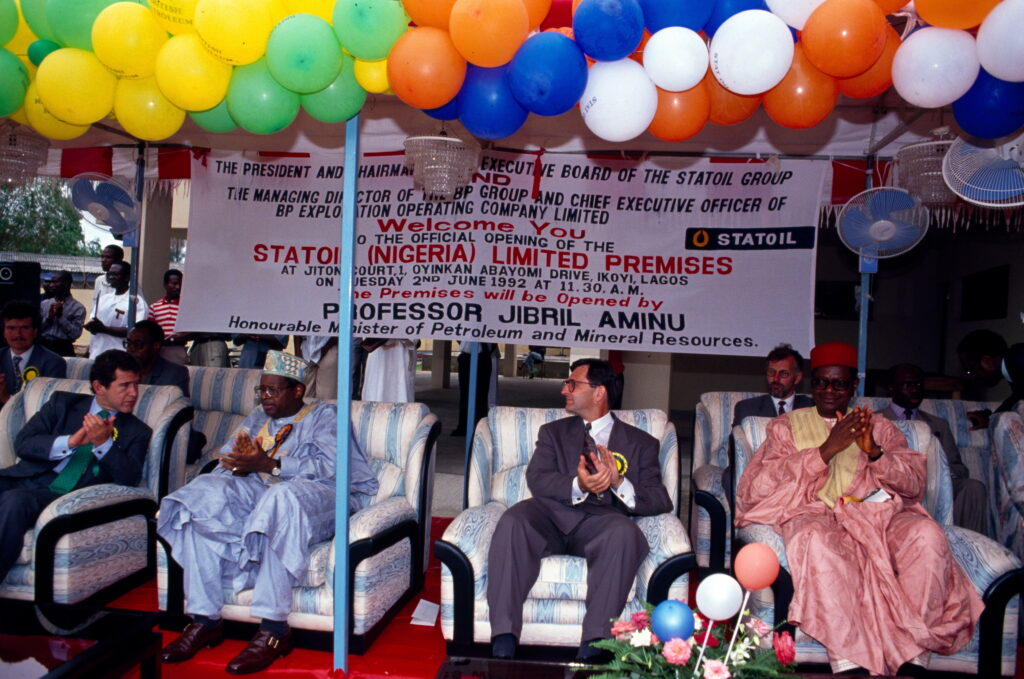
John Browne from BP, Nigerian politician Jibril Aminu and Statoil’s Harald Norvik in Nigeria. Photo: Leif Berge
These developments were not particularly concerning for the alliance to begin with. It concentrated on offshore exploration, and was not involved with oil spills and dead fish in the delta. And, in the middle of the unrest on land, the alliance could raise a mighty cheer when oil was proven with its first wildcat – which also represented the first deepwater discovery off Nigeria. But the jubilation was short-lived, since the resources proved non-commercial. At the same time, the political conditions caught up with the partners.
Statoil had the most to lose by pulling out. Nigeria was where the company intended to demonstrate that it could serve as an operator, even under difficult conditions, outside the North Sea.
It now transpired that repressive regimes, executions and environmental disasters were not the only problems facing BP and Statoil. The financial difficulties were a more difficult challenge. Nor had the alliance succeeded in securing its own operatorships. And its interests in other fields had also failed to yield sufficient oil to justify the exploration costs. The accounts were looking critical.[REMOVE]Fotnote: Ryggvik, Helge. (2009). Til siste dråpe. Oslo: Aschehoug: 233.
The Agbami oilfield project is one of Nigeria’s largest deepwater developments. Photo: unknown/Offshore Technologies
No big breakthrough occurred on the exploration side. On 20 April 1998, Statoil and BP signed a contract with Nigerian company Allied Energy on the sale of the alliance’s 40 per cent interest in block 210 – the Oyo oil field. It afterwards transpired that neither Statoil nor BP received the sale price. In addition came a price reduction of about 30 per cent, which many have characterised as incomprehensible.[REMOVE]Fotnote: Keilen, Erlend. (2003. 3. november). E24. Statoil fikk aldri betalt for oljefelt i Nigeria
An investigation was conducted, and its report concluded in 2004 that: the fact that the statements obtained are ambiguous, combined with the fact that no written documentation exists about the decisions which must have been taken, provides some scope for speculation. On that basis, the investigation committee would recommend to Statoil that it conducts an internal inquiry to clarify the circumstances. The following day, Statoil declared itself not guilty of corruption at a press conference in Oslo.[REMOVE]Fotnote: E24. (2010. 1. mars). NTB. Hemmelig Statoil-gransking av priskutt i Nigeria.
Although the alliance itself withdrew from Nigeria, Statoil remained on an independent basis and had interests in 2020 in Agbami – the country’s largest deepwater field.
Chevron is the operator of the field with a 67.30 percent ownership interest and Prime 127 has the remaining 12.49 percent. Equinor also operates two exploration licenses – OML 128 and 129 – with a share of 53.85 per cent in both. Six wells have been drilled in both, with two discoveries made. None of the fields are planned developed.
On Equinor’s own website, the company describes that its success in Nigeria “is underpinned by our sustainability work, ensuring we are a responsible operator and are proactive in improving opportunities for the communities where we work.”[REMOVE]Fotnote: https://www.equinor.com/where-we-are/nigeria