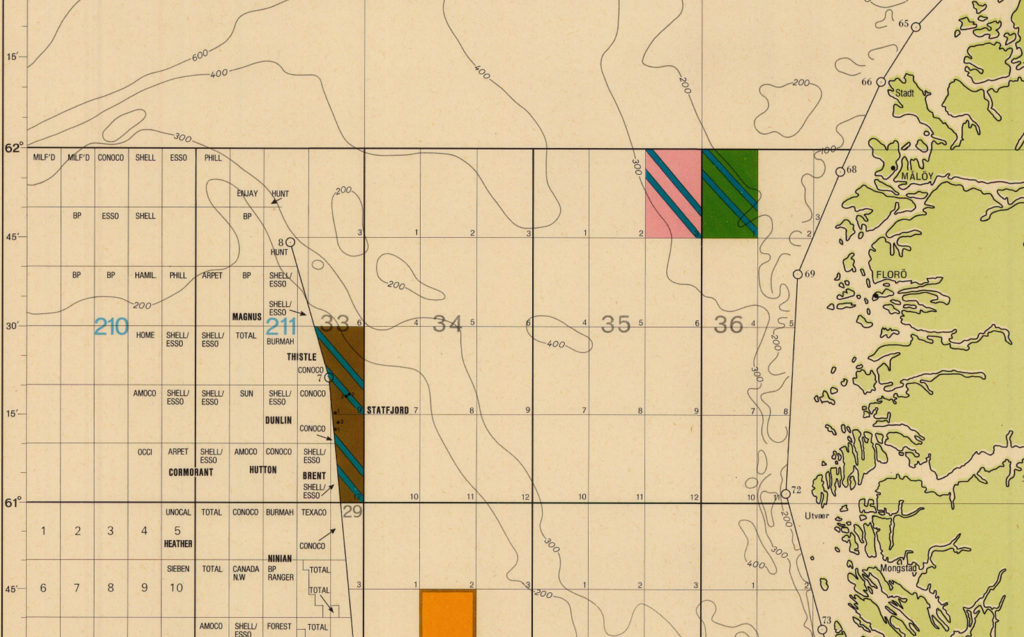
Norway was in a comfortable negotiating position when licensing its “Brent” blocks in 1973. After the Ekofisk discovery in 1969, all the players knew oil existed in Norway’s North Sea sector and were willing make concessions in return for a slice of the cake. And the government could increase its demands.
By Trude Meland, Norwegian Petroleum Museum
- Continental shelf map from 1975. Map: Norwegian Petroleum Directorate
The Storting had resolved that the largest possible state participation through Statoil was desirable. At the same time, the industry ministry was fully aware that any development needed an experienced operator. That was particularly true for the Norwegian blocks close to Britain’s big Brent field. Giving this role to Statoil was out of the question. Production plans being pursued for Brent made it clear that mapping the Norwegian acreage was a matter of urgency, and the state oil company was not sufficiently mature for such a demanding job.
Responsibility for negotiating licence terms to cover these high-priority blocks fell to veteran civil servant Karl-Edwin Manshaus. He had worked as a legal expert in the industry ministry’s oil office on framing legislation for the petroleum sector, and also played a key role in establishing Statoil and the Norwegian Petroleum Directorate.
Negotiations over the “Brent” blocks in 1973 lasted for several weeks, with many considerations needing to be taken into account. Manshaus wanted to get Norwegian participants into the licences and to ensure spin-offs for domestic industry. That meant Statoil should receive a big stake and have its share of exploration costs carried by the other licensees. At the same time, an experienced and well-capitalised operator was sought. But neither it not other private foreign companies could be allowed an overly dominant role.[REMOVE]Fotnote: Borchgrevink, A, 2020, Giganten: Fra Statoil til Equinor: Historien om selskapet som forandret Norge, Kagge Forlag, Oslo: 61. Manshaus was also to ensure that Statoil emerged well from the negotiations with the forthcoming operator.
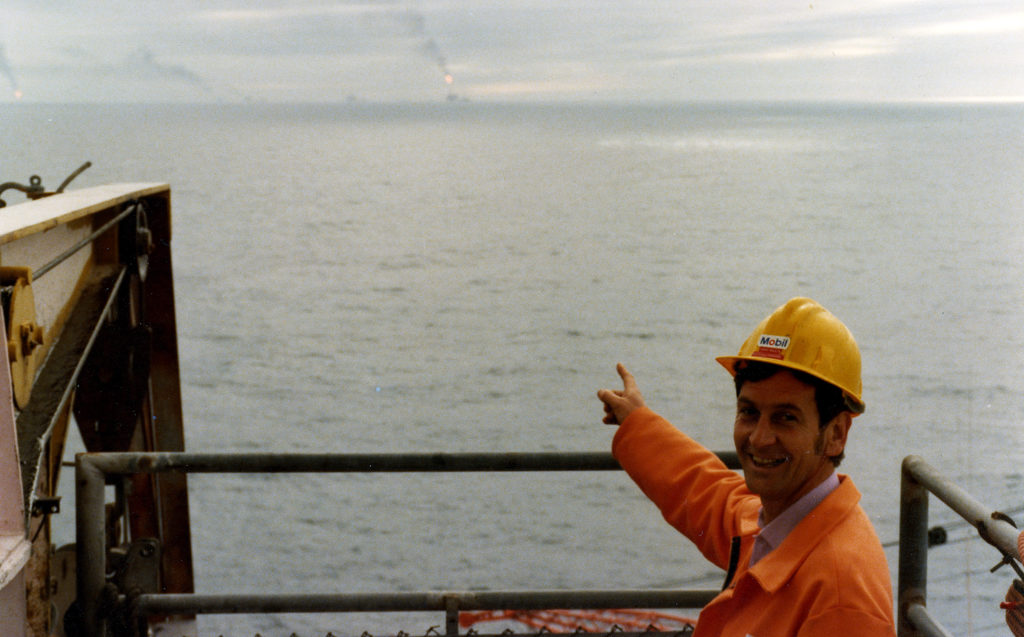
John Hollis on Statfjord A pointing to the Brent field on the British side of North Sea boundary. Photo: Odd Noreger/Norwegian Petroleum Museum
Shell and Esso, respectively operator of and partner in the Brent field, were no longer relevant as operator for the Norwegian blocks, and their dream of control on both sides of the UK-Norway boundary evaporated. The threat that the two companies might rig the division of the oil between the two sectors in order to avoid Norwegian taxes was considered too great. Concern was expressed that oil could be drained from Norway’s side of the boundary to the British unless the Norwegian authorities kept a close watch.
Manshaus offered Shell and Esso 10 per cent each in the licence.
US oil company Chevron was envisaged as the operator at an early stage of the talks, and offered a 15 per cent stake. However, it was not satisfied with the terms offered by the government. The ministry’s reaction provided a clear expression of its privileged negotiating position. Rather than continuing to negotiate with Chevron, it quite simply offered the job to the next relevant candidate.
Instead of having to accept the multinational oil companies’ rules, as in earlier licensing rounds, the ministry could now in reality play them off against each other as a result of the substantially greater interest generated by Ekofisk. Those who refused to accept Norway’s terms soon found themselves excluded. Mobil ended up accepting the conditions Chevron had rejected and took on the operatorship. The requirements set for the US major included transferring knowledge and expertise to Statoil through active training.
Final negotiations with Mobil were conducted at the end of June 1973, with CEO Arve Johnsen also present on behalf of the state oil company.
In addition to the existing terms, Manshaus now presented yet another condition. Statoil was to have an option to take over the operatorship 10 years after a possible commercial discovery had been made. Once its first shock had subsided, Mobil yielded. Blocks 33/9 and 33/12 were too attractive to lose. In its innermost thoughts, too, the US company undoubtedly did not believe Statoil would be in a position to become the operator after just 10 years.
The outcome was that Statoil received 50 per cent of the licence, Mobil 15 per cent and the operatorship, and Esso, Shell and Conoco 10 per cent each. Four other companies also received small stakes[REMOVE]Fotnote: Saga Petroleum 1.875 per cent, and Texas Eastern Norwegian Inc, Amoco Norway and Amerada Hess Norway 1.0416 per cent each.
Third licensing round results
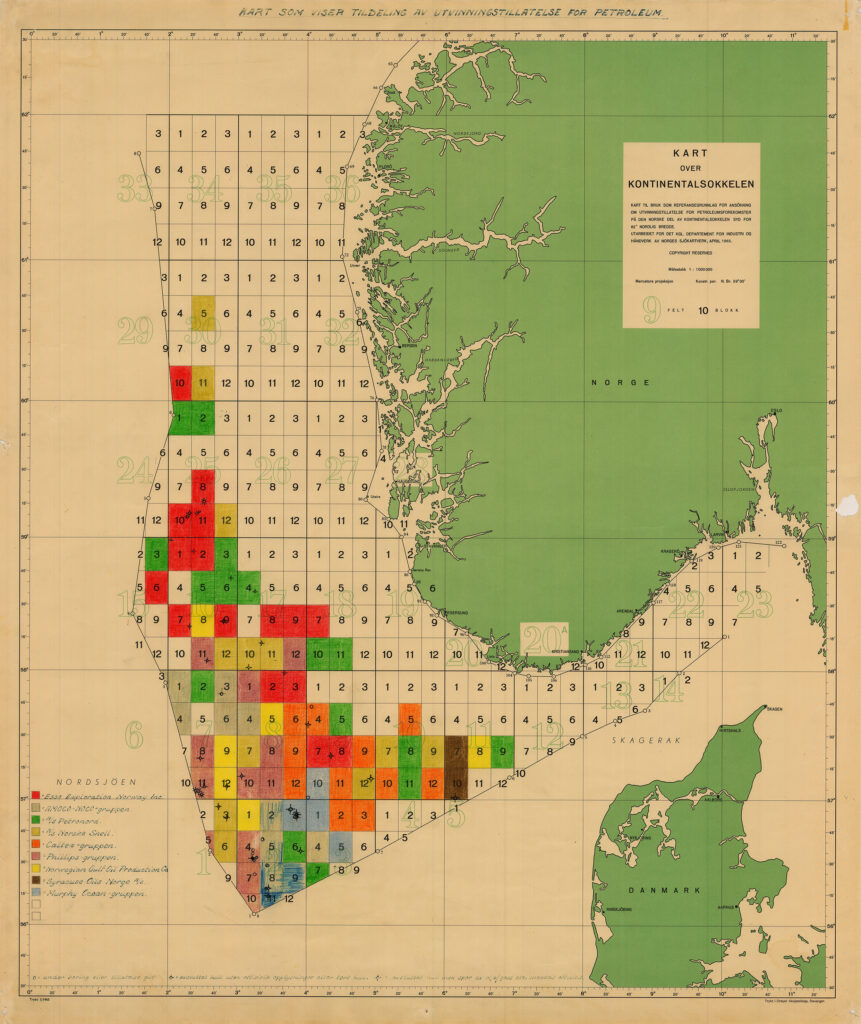
Hand-coloured map showing the licences handed out in the first licensing round on the NCS. Map: Norwegian Petroleum Directorate
A third licensing round on the Norwegian continental shelf had been initiated in parallel with the negotiations over Norway’s “Brent” blocks. Advertised in the summer of 1973, this round extended in reality all the way until 1977. Thirty-two blocks were put on offer, while nine “key” blocks were held back in part until Statoil produced a plan on how these should best be utilised. The conditions negotiated when awarding the Statfjord acreage were established as the norm and, in many respects, represented the new rules of the game. Whether state participation was attainable through awarding interests to Statoil was no longer the question – only how large that involvement should be.
White Paper no 30 (1973-74) enlarged on the political goals of state participation. The object was said to be twofold. First, such involvement opened for additional government revenues beyond merely taxing the industry. Second, it provided an opportunity to influence licensee decisions once a licence was allocated.
In total, therefore, 12 production licences covering 20 blocks were awarded in the third round. Statoil – as it had been officially known since 1974 – received at least 50 per cent in each. Some of the licences also introduced a sliding scale which could potentially give the company a holding of up to 80 per cent.
Most of the licences also contained a provision which allowed Statoil to take over as operator after eight years, while its share of exploration costs was to be carried by the other licensees.
The pracsise giving the state company a clearly preferential status with an interest of 50 per cent or more, continued after 1973. By 1977, it was the turn of the “golden” block – 34/10. Johnsen and Statoil reached one of their absolute pinnacles there by securing a share of no less than 85 per cent and the operatorship. With this award, the company manifested its privileged position.
Both similarities and differences between Norway and Brazil as oil nations have emerged from the partnership which has developed between them. Neither country initially had petroleum production expertise, but both created state oil companies and their own specialist milieus. These joined forces early over subsea technology, helping to make the Latin American country one of Equinor’s core areas today.
By Kristin Øye Gjerde, Norwegian Petroleum Museum
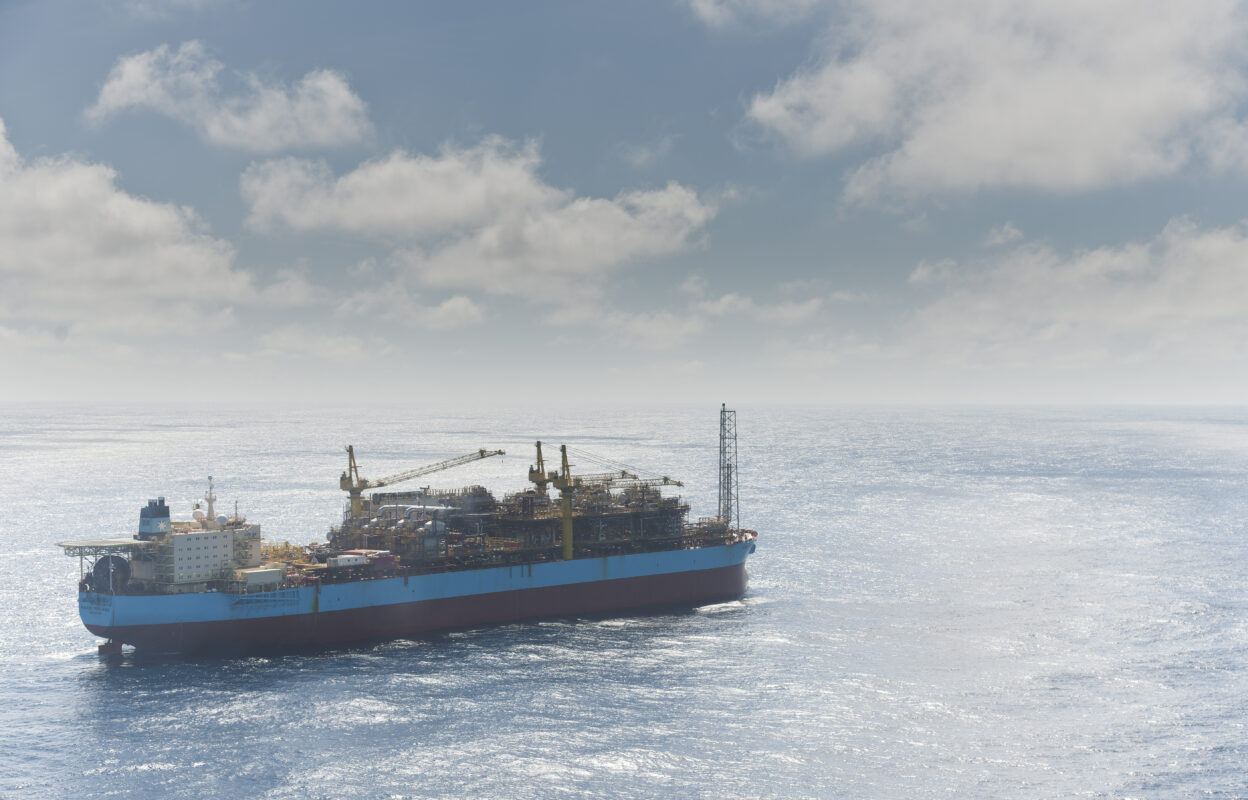
- The Peregrino field, Brazil. Photo: Equinor
Brazil and Norway have had wholly state-owned oil companies –Petrobras and Statoil respectively. The first of these dates back to 1953, when it produced on land. Unlike its Norwegian counterpart, which was founded in 1972, Petrobras had a monopoly of all domestic petroleum output. Although that ended in 1997, it retains a leading position in its home market. The company was part-privatised in 2000 – a year before Statoil.
Interesting offshore discoveries were made in both countries during the 1960s. While Norway is known for its Ekofisk find in 1969, the first oil field on the Brazilian continental shelf was proven the year before. The two nations made big offshore discoveries in deep water over the subsequent decade.
Initial subsea contacts
The Petrobras logo.
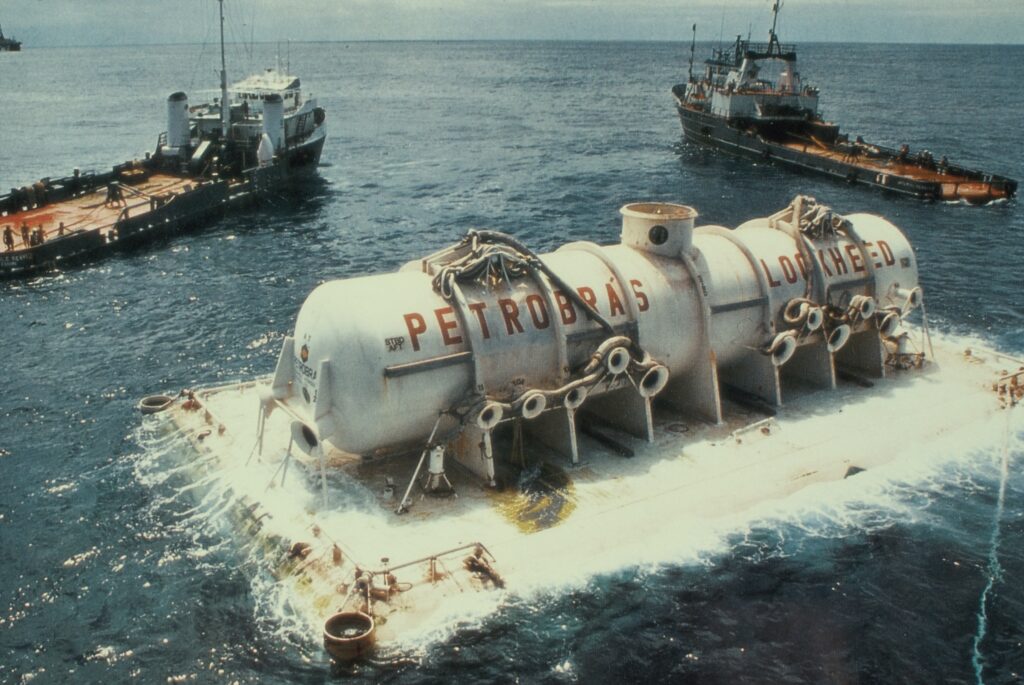
Brazil has been a pioneer with production ships and floating platforms tied back to subsea wells, with Petrobras testing a converted tanker for production as early as 1978. A floater solution was more flexible than fixed platforms. These ideas were picked up and further developed by Norway in the 1980s, when Norwegian oil companies also adopted them fully.[REMOVE]Fotnote: Gjerde, Kristin Øye and Nergaard, Arnfinn I, Getting down to it. 50 years of subsea success in Norway, 2019: 172
Along with their suppliers, Norway’s oil companies observed the boldness, inquisitiveness and willingness to pursue new technology displayed by Petrobras with great interest. A good relationship developed between Norwegian and Brazilian subsea specialists, and they learnt from each other.
When Statoil planned to utilise seabed wells on the Tommeliten field and its Gullfaks satellites in the North Sea during the mid-1980s, it hired two Brazilian subsea specialists from Braspetro – the international arm of Petrobras. Vincente de Silva and Mauro de Fauras contributed valuable operating experience to solutions for both fields. Statoil’s management was subsequently keen to continue the Petrobras collaboration, with Martin Bekkeheien – head of exploration and production activities at the time – taking the lead.[REMOVE]Fotnote: Hans Jørgen Lindland, e-mail to Kristin Øye Gjerde, 13 December 2021
Statoil drilling manager Idar Johnsen and Hans Jørgen Lindland, operations manager for Tommeliten, were dispatched to Brazil in 1987 to check the status of and interest for closer collaboration at Petrobras. They were very well received. The Norwegian company could offer collaboration on multiphase flow technology – in other words, transporting a mix of oil, gas and water in a controlled manner through a single pipeline with the use of chemical additives and pressure to prevent problems on the way to the processing plant. Much research underpinned this technology, which was highly profitable for the oil companies using it.[REMOVE]Fotnote: Gjerde and Nergaard, op.ci
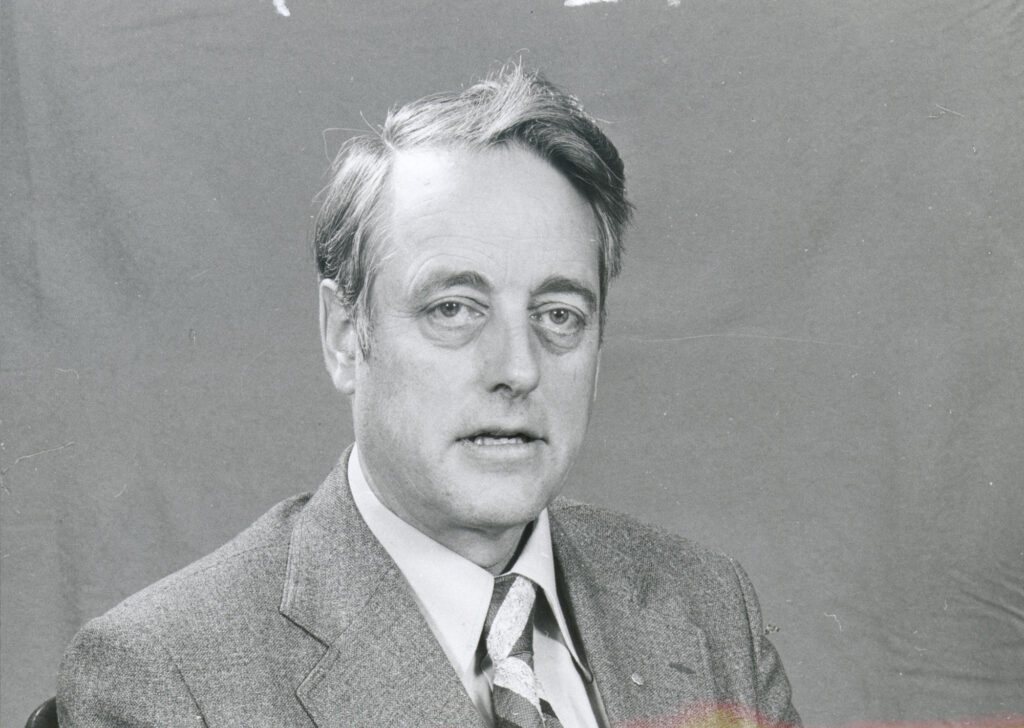
Reidar Due. Photo: Storting
Arrangements were made for an official delegation to visit Brazil a week after Johnsen and Lindland had returned home. The plan was to formalise a collaboration between Norway and Brazil on offshore and subsea technology.[REMOVE]Fotnote: Hans Jørgen Lindland, e-mail to Kristin Øye Gjerde, 13 December 2021
This group was headed by Reidar Due from the Centre Party, who was chair of the standing committee on energy and industry in the Storting (parliament). He managed to offend the host of a dinner hosted by the Brazilian government so greatly that all forms of cooperation were put on ice.[REMOVE]Fotnote: This story has been confirmed by Hans Jørgen Lindland, 13 December 2021 After this incident, a number of years passed with very little contact between Statoil’s subsea technology department and Petrobras.
Diverless methods
Subsea specialists in both Brazil and Norway wanted to ensure that work underwater could be done in a safer way. That including finding alternatives to using divers for making seabed connections.
The Brazilians made efforts to place Xmas trees – valve assemblies installed on wells to control production – under atmospheric pressure in a sealed chamber or habitat on the seabed. Unlike simply installing a tree in the open sea, this ensured that it stood in a dry environment. Instead of an operator having to dive down under pressure in order to open or close the valves, they could be lowered in a bell to the habitat, connect on, enter a dry space and breath normal air while doing the work. Brazil tested such solutions offshore.[REMOVE]Fotnote: Gjerde and Nergaard, op.cit: 301.
In Norway, opportunities for utilising a habitat of this kind were discussed for the Statfjord satellites. But Statoil decided against that approach, and it was never adopted either on the satellites or elsewhere on the Norwegian continental shelf (NCS). Diverless solutions were developed instead to eliminate the use of people completely in conducting subsea operations. Since remotely operated vehicles (ROVs) could carry out much of the work involved, divers were largely phased out on the NCS during the 1990s.[REMOVE]Fotnote: Ibid: 123
Installing an atmospheric manifold centre on the Garoupa field off Brazil in 1979. Photo: Petrobras/Norwegian Petroleum Museum
Contact re-established and extended
The Society of Petroleum Engineers held its first subsea forum in 1993 at Seefeld in Austria. Both Petrobras and Statoil attended, and were each very advanced in terms of the new projects and underwater technology they could present.
Statoil could point to a world distance record for multiphase flow transport from the Statfjord North satellite. The way this had been accomplished attracted considerable interest from the other participants.[REMOVE]Fotnote: Hans Jørgen Lindland, e-mail to Kristin Øye Gjerde, 13 December 2021. For its part, Petrobras could report records for deepwater operations. The Brazilians had made discoveries in water depths close to 2 000 metres.[REMOVE]Fotnote: Gjerde and Nergaard, op.cit: 301. Petrobras set a record in 1997 for the deepest subsea well to date of 1 709 metres on the Marlim field, and followed up in 1999 with a well in 1 855 metres on the Roncador field.
At this meeting, Lindland and the other members of Statoil’s subsea technology department got to know Orland Ribeiro at Petrobras. Good professional contacts subsequently developed between the underwater specialists at the two companies. A technology collaboration, also involving BP, was agreed a little later. This yielded a number of important results:
Petrobras supplied Statoil with operational data on production regularity from subsea fields, along with the design basis for the Brazilian company’s latest floating deepwater platform.
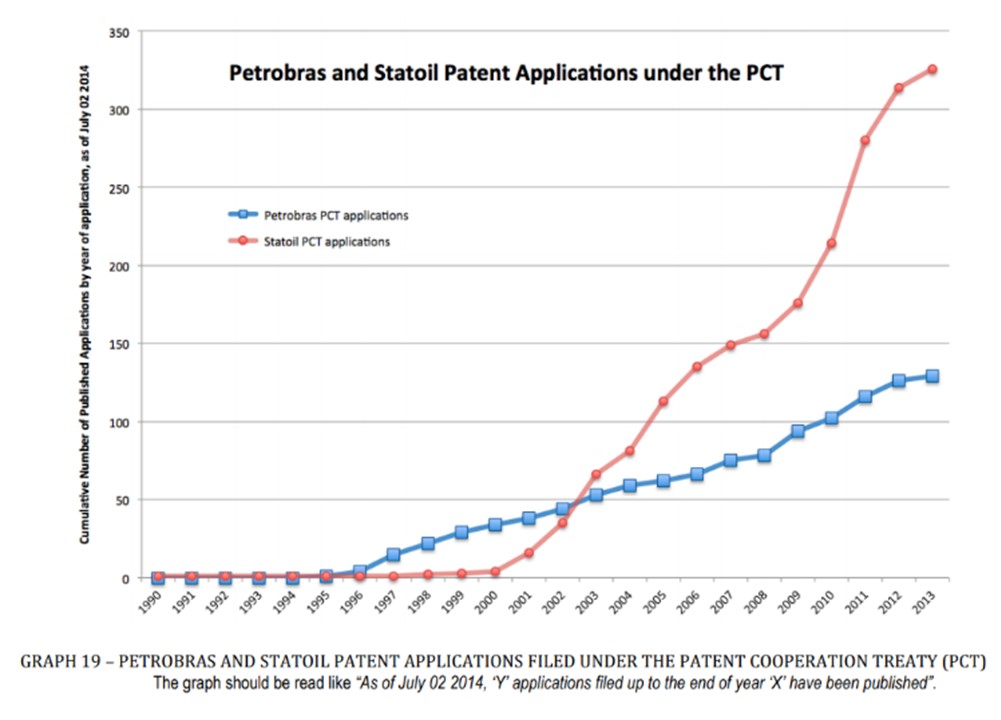
In return, Petrobras secured detailed information on drilling horizontal wells and results from Statoil’s research on multiphase flow.[REMOVE]Fotnote: Hans Jørgen Lindland, e-mail to Kristin Øye Gjerde, 13 December 2021 The Norwegian group was very innovative in terms of new patents, which made it an attractive partner for the Brazilians.[REMOVE]Fotnote: Bichara, Miguel, Technological innovation in Brazil and in Petrobras – the need of a systems approach to a complex problem
Patent applications by Petrobras and Statoil under the PCT.
As early as the mid-1990s, Statoil was recognised as a world leader in the design and operation of fields at depths down to 500 metres. The collaboration with Petrobras also gave the Norwegian group access to expertise on deep and eventually ultra-deep waters – in other words, 3 000 metres and beyond.[REMOVE]Fotnote: Hans Jørgen Lindland, e-mail to Kristin Øye Gjerde, 13 December 2021 This strategic partnership opened the way to securing a number of deepwater licences off Brazil and other countries.
Suppliers actively involved
Statoil’s establishment of such a close technology collaboration with Petrobras was also highly significant for Norway’s supplier industry in the petroleum sector and its market access in Brazil.
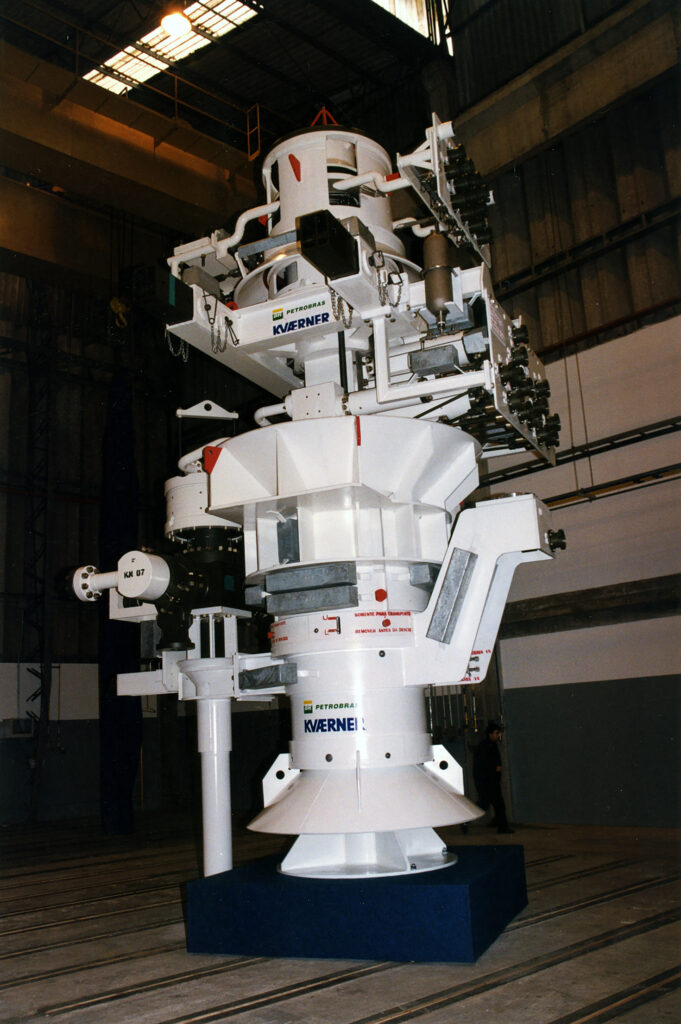
An example was the subsea connections with control systems developed by Kværner. Their installation could be assisted by ROVs, which helped to make it possible to utilise underwater technology in depths beyond the reach of diver assistance. That in turn made oil production feasible in deeper waters. Kværner established a presence in Brazil in 1996, followed by Kongsberg Offshore Subsea, Aker Solutions and others.
Kværner arrived early on the Brazilian scene, delivering Xmas trees and control systems to Petrobras as far back as the 1990s. Source: Kjell Øyvind Pedersen
These companies received good support from collaboration bodies established by the Norwegian authorities.[REMOVE]Fotnote: Gjerde and Nergaard, op.cit: 302. The Norwegian-Brazilian Chamber of Commerce, for example, was established in 1995 to promote trade, good relations and joint financial and professional interests between the two countries.
Rio de Janeiro was the centre for Norway’s commitment in Brazil, with Intsok[REMOVE]Fotnote: Intsok (short for International Continental Shelf) was created in 1997 as a Norwegian non-profit foundation by the Ministries of Petroleum and Energy, Industry and Trade, and Foreign Affairs as well as the Confederation of Norwegian Enterprise (NHO), the Norwegian Shipowners Association and the Norwegian Oil Industry Association (OLF), plus oil companies Statoil, Saga Petroleum and Norsk Hydro, the embassy and the consulate general holding seminars where Norwegian suppliers presented themselves. The government entered into trade agreements and the establishment of Norwegian subsidiaries was facilitated. The Innovation Norway trade promotion body not least established Innovation House in Rio in 2007.
The most recent addition to this set of organisations is Norwegian Energy Partners (Norwep), created in 2017 by merging Intsok with Norwegian Renewable Energy Partners (Intpow). The latter represented a relatively recent commitment in the renewables sector.[REMOVE]Fotnote: Gjerde and Nergaard, op.cit: 302-303
Collaboration of this kind between foreign and Norwegian oil companies and Norway’s supplier industry, with good backing from the government, helped to elevate a number of Norwegian companies into world leaders for subsea technology during the 2000s. The exchange of information and expertise with Brazil has been a crucial precondition for/driving force in this development.